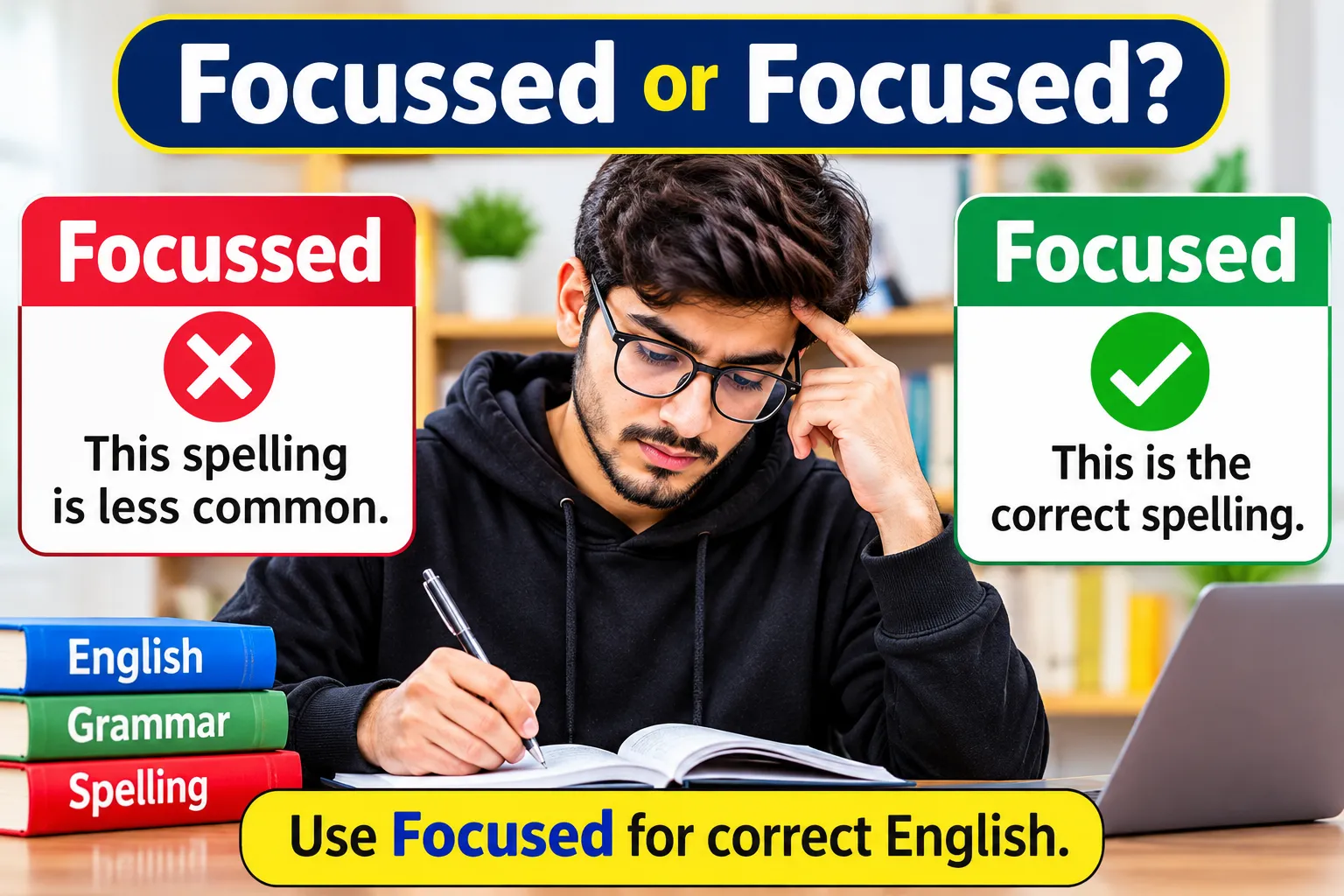
Focused and focussed mean the same thing. Focused is the standard spelling. Focussed is a rare British variant.
Sam wrote an email at his London office. His boss was in New York. Sam typed “focussed.” The boss’s software put a red line under it. Sam changed it. Later, a friend said “focused” looked odd. Sam felt lost. Which one is right?
Both words describe a mind or a lens that is sharp on one thing. A focused student studies hard. A focused camera takes a clear photo.
People search “focussed or focused” because they see both spellings. They want to avoid a mistake. This guide clears up that doubt. Most people never learn why two spellings exist. You will. By the end, the focussed or focused question will feel easy.
Pronunciation
- Focused: US /ˈfoʊkəst/ (FOH-kuhst). UK /ˈfəʊkəst/ (FOH-kuhst).
- Focussed: US /ˈfoʊkəst/ (FOH-kuhst). UK /ˈfəʊkəst/ (FOH-kuhst).
Both words sound the same. Only the spelling changes. The UK “o” is a little rounder than the US “o.”
Read More About https://orlymean.com/imperial-or-metric/
Difference Between Focussed and Focused
The meaning is the same. The differences are about spelling, region, and style.
1. Spelling
Focused has one “s” in the middle. Focussed has two.
- She stayed focused all day.
- She stayed focussed all day.
2. Main region
Focused is standard in the US. Focussed is a British option.
- The American coach wanted a focused team.
- The British coach wanted a focussed team.
3. Dictionary status
Most dictionaries list focused first. They list focussed as a variant.
- Look up “focused” and you find the main entry.
- Look up “focussed” and you often see “chiefly British.”
4. How common it is
Focused is far more common worldwide. Focussed is rare, even in the UK.
- News sites in the UK mostly print “focused.”
- Old British books often print “focussed.”
5. Spell-check
US spell-check accepts focused. It may flag focussed.
- Your phone may fix “focussed” to “focused.”
- UK settings may accept both.
6. The -ing form
The pair is focusing and focussing.
- He is focusing on his exam.
- He is focussing on his exam.
7. The verb forms
Past tense is focused or focussed. Present tense is focuses or focusses.
- She focuses on one task.
- She focusses on one task.
8. Formal writing
Focused is safest in formal writing. Focussed can look dated.
- A job application should say “focused.”
- A school paper should say “focused.”
9. Global audiences
Focused works for readers everywhere. Focussed may confuse some readers.
- A blog for the world should use “focused.”
- A global brand should use “focused.”
10. Search and SEO
More people search for focused. Focussed is a smaller keyword.
- “Focused meaning” gets many searches.
- “Focussed meaning” gets fewer.
Nature and Behaviour of Focussed and Focused
Focused acts like most English words. The word focus has two syllables. The stress is on the first. English usually does not double the last letter when the stress is on the first syllable. So focus becomes focused. It behaves like benefit and benefited.
Focussed breaks that habit. It doubles the “s,” as in bus and bussed. Writers did this to show a short vowel sound. It is a spelling choice, not a rule. The word still means the same. It acts as an adjective and a verb.
Why People Get Confused About Focussed or Focused
There are three main reasons.
- Two spellings look right. Both are real words.
- British and American English differ. Many words change across the sea, like colour and color.
- Doubling rules are messy. English sometimes doubles a letter and sometimes does not.
People think one must be wrong. In truth, one is just more common.
Comparison Table
| Feature | Focused | Focussed |
| Meaning | Paying close attention | Paying close attention |
| Spelling | One “s” | Two “s” |
| US use | Standard | Rare |
| UK use | Common | Accepted, less common |
| -ing form | Focusing | Focussing |
| Formal writing | Safe | Less safe |
| Pronunciation | FOH-kuhst | FOH-kuhst |
| Best for | Global readers | Some UK writing |
Similarities: Same meaning, same sound, same word class.
Differences: Spelling and how often people use them.
The Origin of Focus
Focus comes from Latin. The Latin word meant “hearth,” or the place where a fire burns. A hearth was the center of the home.
Later, scientists used the word for the point where light rays meet. This is the point where a lens makes a sharp image. English borrowed the word in the 1600s. First it was a noun. Then people began to use it as a verb.
When writers needed a past tense, they had two options. Some wrote focused. Others doubled the “s” and wrote focussed. Both spellings have been used for a long time. Over time, focused won most of the ground.
British vs American English
Spelling:
- US: focused, focusing
- UK: focused or focussed, focusing or focussing
Rules:
- Americans keep one “s.” They follow the stress rule.
- Britons often double final letters more than Americans do. Think of travelled (UK) and traveled (US).
Usage:
- The US report was focused on cost.
- The UK report was focussed on cost.
Even in Britain, many newspapers and schools prefer focused.
Which One Should You Use?
- For US readers: Use focused.
- For UK readers: Use focused. It is safe. Focussed is fine if your style guide allows it.
- For global readers: Use focused. Everyone understands it.
Pick one spelling and keep it in your whole text.
Common Mistakes
| Mistake | Correction |
| She is focusd. | She is focused. |
| He focussed and focused in one email. | Use one spelling only. |
| They are focuing. | They are focusing. |
| He focusses on work (in a US text). | He focuses on work. |
| A focused-on goal (hyphen error). | A focused goal. |
Everyday Usage Examples
Emails
- I am focused on the Monday deadline.
- Please stay focused on the main task.
Social media
- Feeling focused today. Let’s go!
- Stay focused. Keep going.
News
- The talks stayed focused on trade.
- The new law is focused on safety.
Formal writing
- This study is focused on child learning.
- The company has a focused plan.
Usage Trends
Around the world, focused is used much more than focussed. It leads in the US by a huge margin. In the UK, it also leads in most modern writing.
Focussed is still seen in some British books and older texts. It is slowly fading. Writers today pick the simple spelling. The internet pushes this trend. Most software, apps, and style guides prefer focused.
Metaphors and Similes
Metaphors
- Her mind is a laser. (She is very focused.)
- He is a camera lens, sharp and clear.
Similes
- She was as focused as an eagle watching a mouse.
- He studied like a runner staring at the finish line.
Connotative Meaning
Positive: Focused often shows skill and drive.
- She is a focused leader.
Negative: It can suggest being too narrow.
- He is so focused on work that he forgets his family.
Neutral: It can simply describe where attention goes.
- The meeting was focused on the budget.
Idioms and Proverbs
- Keep your eye on the ball. Stay focused.
Keep your eye on the ball during the exam. - Laser-focused. Very focused.
The team is laser-focused on the launch. - Nose to the grindstone. Work hard without distraction.
He kept his nose to the grindstone. - Proverb: Jack of all trades, master of none. Too many interests can weaken skill.
Pick one skill. Jack of all trades, master of none.
Literature and Movies
Literature
- Focus by Arthur Miller. A novel about prejudice. American writer. Published in 1945.
- Flow by Mihaly Csikszentmihalyi. A psychology book about deep attention. Published in 1990.
- Deep Work by Cal Newport. A self-help book about focused work. Published in 2016.
Movies
- Focus (2001, USA). A drama based on Miller’s novel.
- Focus (2015, USA). A crime comedy with Will Smith.
- Whiplash (2014, USA). A drama about a drummer’s extreme drive.
Why This Difference Matters
For learners, two spellings feel like a trap. Knowing the rule builds trust. It helps with exams, emails, and job forms.
For society, spelling shows how language grows. English has no single owner. Britain, America, and many other places shape it. Seeing these small differences helps people respect each other’s writing. It also helps writers look careful and professional.
Usefulness in Daily Life
- At work: Write clear emails with the right spelling.
- At school: Avoid lost marks on essays.
- Online: Spell your posts, profiles, and resumes correctly.
- In design and photography: Use focus for lenses and sharp images.
- In self-growth: Use the word for goals and habits.
Situational Preference
Use focused for almost every case. It suits emails, reports, websites, school work, and social media. It works in the US, the UK, and everywhere else. Use focussed only if your British style guide, editor, or school asks for it. Also keep it if you are quoting an older text. Never mix both spellings in one document. Pick one and stay with it. When in doubt, choose focused. It is simple and safe.
Possible Short Questions
1. Is focussed a real word?
Yes. It is a real variant, mostly British.
2. Is focussed wrong in the UK?
No. It is accepted, but focused is more common.
3. Which spelling do Americans use?
Americans use focused.
4. Do they sound different?
No. Both sound like FOH-kuhst.
5. What about focusing and focussing?
The same rule applies. Focusing is the main spelling. Focussing is the variant.
6. Which is best for SEO and global blogs?
Focused is best. More people use and search for it.
7. Can I use both in one text?
No. Pick one and stay with it.
Conclusion
Focused and focussed are two spellings of the same word. They share the same meaning and the same sound. The only change is one extra “s.”
Focused is the standard choice. Americans use it. Most Britons use it. It is also the best pick for global readers. Focussed is a British variant. It is allowed, but it is rare and fading.
The word comes from the Latin word for hearth. Over time, it grew into a word for sharp attention. That history explains why writers once used two spellings.
Here is the simple rule. Use focused unless a style guide tells you otherwise. Keep your spelling the same through the whole text. Avoid mistakes such as focusd or focuing.

I’m Ghafoor Khan, a content writer and blogger at Orly. I write simple, engaging articles on English grammar, word meanings, synonyms, antonyms, and vocabulary to help readers improve their English skills.