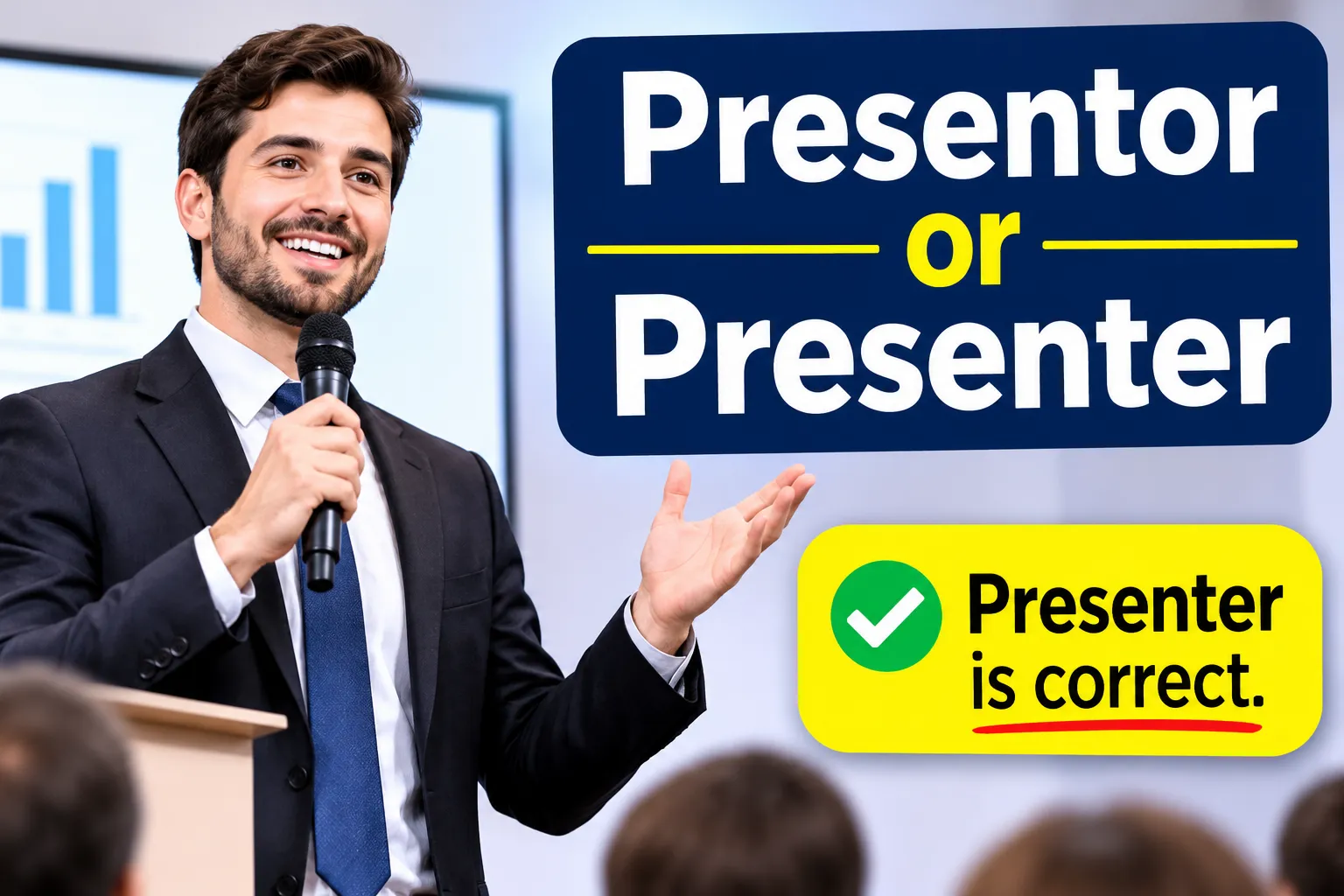
Presenter is the right spelling. Presentor is a rare spelling. Most people call it a mistake.
Mia had a big talk at work. She made her slides at night. On slide one she typed: “Presentor: Mia Lopez.” Her boss smiled. “Check the spelling,” he said. Mia looked it up. The word was presenter.
A presenter is a person who shows or tells something to a group. It can be a speaker at a meeting. It can be a host on TV or radio.
People search presentor or presenter because both look right. Words like actor and doctor end in -or. Words like teacher and singer end in -er. So it is hard to pick.
This guide helps you choose. You will learn the right spelling and why. Then you can pick between presentor and presenter with no doubt.
Pronunciation
Presenter
- US: /prɪˈzɛn.tɚ/ (pri-ZEN-ter)
- UK: /prɪˈzen.tə/ (pri-ZEN-tuh)
Presentor
- US: /prɪˈzɛn.tɚ/ (pri-ZEN-ter)
- UK: /prɪˈzen.tə/ (pri-ZEN-tuh)
Both words sound the same. Only the spelling is different.
Read More About https://orlymean.com/fiction-or-nonfiction/
Difference Between Presentor and Presenter
Both words name a person who presents. The gap is in spelling and trust. Here are 10 differences.
1. Spelling status
Presenter is the main spelling. Presentor is rare.
- The presenter walked on stage.
- Spell-check changed presentor to presenter.
2. Dictionaries
Dictionaries list presenter first. Presentor is a side note, if it is there at all.
- I found presenter at once.
- She could not find presentor.
3. How often people use it
Presenter is used far more. You see it each day.
- The presenter thanked the crowd.
- Few news pages use presentor.
4. Editors
Editors pick presenter. They fix presentor.
- The editor wrote “presenter” in red.
- The style guide says: use presenter.
5. School
Teachers mark presentor wrong.
- Spell presenter right on your test.
- He lost a mark for presentor.
6. Spell-check
Apps flag presentor. They accept presenter.
- A red line showed under presentor.
- No red line showed under presenter.
7. Word ending
Presenter ends in -er, like teacher and singer. The -or ending is for words like actor and donor.
- A teacher, a singer, a presenter.
- An actor and a donor.
8. Job titles
TV credits and event lists say presenter.
- The credits read: “Presenter: Sam Hill.”
- The list had three presenters.
9. First look
Presenter looks neat. Presentor can look like a slip.
- Her CV said presenter. It looked neat.
- His flyer said presentor. Readers frowned.
10. Names and brands
A brand may pick presentor on purpose. Then copy it as it is.
- The tool is named “Presentor Pro.” Keep it.
- In plain writing, use presenter.
Nature and Behaviour of Presenter and Presentor
Presenter
It is a noun. It means a person who presents. The plural is presenters. It can also mean a small clicker for slides.
- The presenter smiled at the room.
- Each presenter had ten minutes.
Presentor
It acts the same in a sentence. The plural is presentors. But it is rare, so many readers see a typo.
- The presentor opened the meeting.
- Two presentors joined. (Better: presenters.)
Why People Get Confused About Presenter and Presentor
- The sounds match. You cannot hear the spelling.
- Many words end in -or. Actor, doctor, and visitor do. So presentor feels right.
- Some words take both. Advisor and adviser are both fine.
- Fast typing. One wrong key changes the word.
Here is a trick. Think of the verb present. Add -er. Done.
Comparison Table
| Feature | Presenter | Presentor |
|---|---|---|
| Status | Standard | Rare, often a mistake |
| Meaning | A person who presents | The same |
| Sound | pri-ZEN-ter | pri-ZEN-ter |
| Plural | Presenters | Presentors |
| Dictionaries | Main word | Rare or missing |
| Spell-check | Accepted | Often flagged |
| US and UK use | Common | Very rare |
| Best for school and work | Yes | No |
| Same in both | Sound, meaning, and root word | Sound, meaning, and root word |
The Origin of Presenter
The story starts in Latin. Praesens means “being there.” From it came praesentare. It means “to show” or “to place before.” Old French made it presenter. English took it as the verb present.
Then English added -er. This ending means “one who does it.” A baker bakes. A teacher teaches. A presenter presents.
The -or ending also comes from Latin. That is why presentor looks right to some people. But English chose -er for this word.
British vs American English
There is no split. The UK and the US both write presenter. Presentor is not a UK spelling or a US spelling. It is just rare.
The use is a bit different. The UK says presenter for TV and radio hosts.
- She is a BBC news presenter.
- The radio presenter played a new song.
The US often says host or anchor for TV. It says presenter for talks.
- The host welcomed the guests.
- The presenter showed ten slides.
Which One Should You Use?
Use presenter. It is safe everywhere.
- US: Use presenter for talks. Use host or anchor for TV.
- UK: Use presenter for talks, TV, and radio.
- Global: Use presenter. Spell-check accepts it.
Use presentor only to copy a brand or a name.
Common Mistakes
| Mistake | Fix |
|---|---|
| The presentor is late. | The presenter is late. |
| Two presentors will speak. | Two presenters will speak. |
| She is our guest presentor. | She is our guest presenter. |
| He is a good presentator. | He is a good presenter. |
| The presentor’s slides are great. | The presenter’s slides are great. |
Everyday Usage Examples
- Email: Our presenter will join at 10 a.m.
- Social media: Our presenter was great today! #conference
- News: The TV presenter won a new award.
- Formal writing: Each presenter must send a short summary.
Usage Trends
Around the world, people use presenter far more. You see it in books, news, and job ads. Presentor shows up in typos and a few brand names.
Spell-check helps too. It fixes the word before many people hit send.
Metaphors and Similes
- Metaphor: The sun is the presenter of the morning.
- Metaphor: Memory is the presenter of old stories.
- Simile: She spoke like a presenter on a big show: calm and clear.
- Simile: The guide pointed to each statue like a proud presenter.
Connotative Meaning
- Positive: She is a gifted presenter. He makes hard ideas easy.
- Negative: He was a stiff presenter who read every word. The presenter rushed and lost the room.
- Neutral: The presenter starts at nine. The presenter uses a laptop.
Idioms and Proverbs
No famous idiom has the word presenter in it. But these fit a presenter well.
- Steal the show: The new presenter stole the show.
- Take center stage: The presenter took center stage.
- Break the ice: The presenter broke the ice with a joke.
- Practice makes perfect: Practice makes perfect, so rehearse your talk.
Literature and Movies
Presentor is rare in books and film. These works are about presenters or the art of presenting.
Literature
- The Presentation of Self in Everyday Life, nonfiction, Erving Goffman, 1956.
- Presentation Zen, nonfiction, Garr Reynolds, 2008.
- Talk Like TED, nonfiction, Carmine Gallo, 2014.
Movies
- Network, 1976, USA.
- Good Morning, Vietnam, 1987, USA.
- Anchorman, 2004, USA.
- The Boat That Rocked, 2009, UK.
Why This Difference Matters
For learners, one wrong letter can cost a mark. The right spelling builds trust.
For society, clear spelling helps people read fast. It also helps search tools find the right page.
Usefulness in Daily Life
- Work: Write presenter on slides and name tags.
- School: Use it in reports and talks.
- Online: Use it in posts so people can find you.
- Job hunting: Put presenter on your CV.
Situational Preference
In almost every case, presenter is better. On a test, use presenter. In a work email, use presenter. On a CV, use presenter. In a news story, use presenter. On a poster, use presenter. In a UK radio script, use presenter. In a US talk, use presenter. For US TV, you may say host. The only time to use presentor is to copy a brand or a name. If the name has that spelling, keep it. Everywhere else, pick presenter and move on.
Possible Short Questions
1. Is presentor a real word?
It is a rare spelling. Most editors want presenter.
2. Is presentor wrong?
In most writing, yes. Use presenter.
3. How do you say presenter?
US: pri-ZEN-ter. UK: pri-ZEN-tuh.
4. Do the UK and US spell it differently?
No. Both write presenter.
5. What is the plural?
Presenters.
6. Is a presenter the same as a host?
Not always. A presenter shows or explains things. A host welcomes guests or leads a show.
Conclusion
So which is right: presentor or presenter? The answer is simple. Presenter is the right spelling. Presentor is a rare spelling that most people see as a mistake.
Both words mean the same thing. Both sound the same. Only the ending is different, and that small change matters. Presenter is in the dictionary. Presenter passes spell-check. People in the US, the UK, and the rest of the world use it.
Here is an easy trick. Start with the verb present. Add -er. That gives you presenter. It works like teacher, singer, and baker.
Use presenter in emails, school work, news, posts, and job papers. Keep presentor only for a brand or a name that uses it.

I’m Ghafoor Khan, a content writer and blogger at Orly. I write simple, engaging articles on English grammar, word meanings, synonyms, antonyms, and vocabulary to help readers improve their English skills.