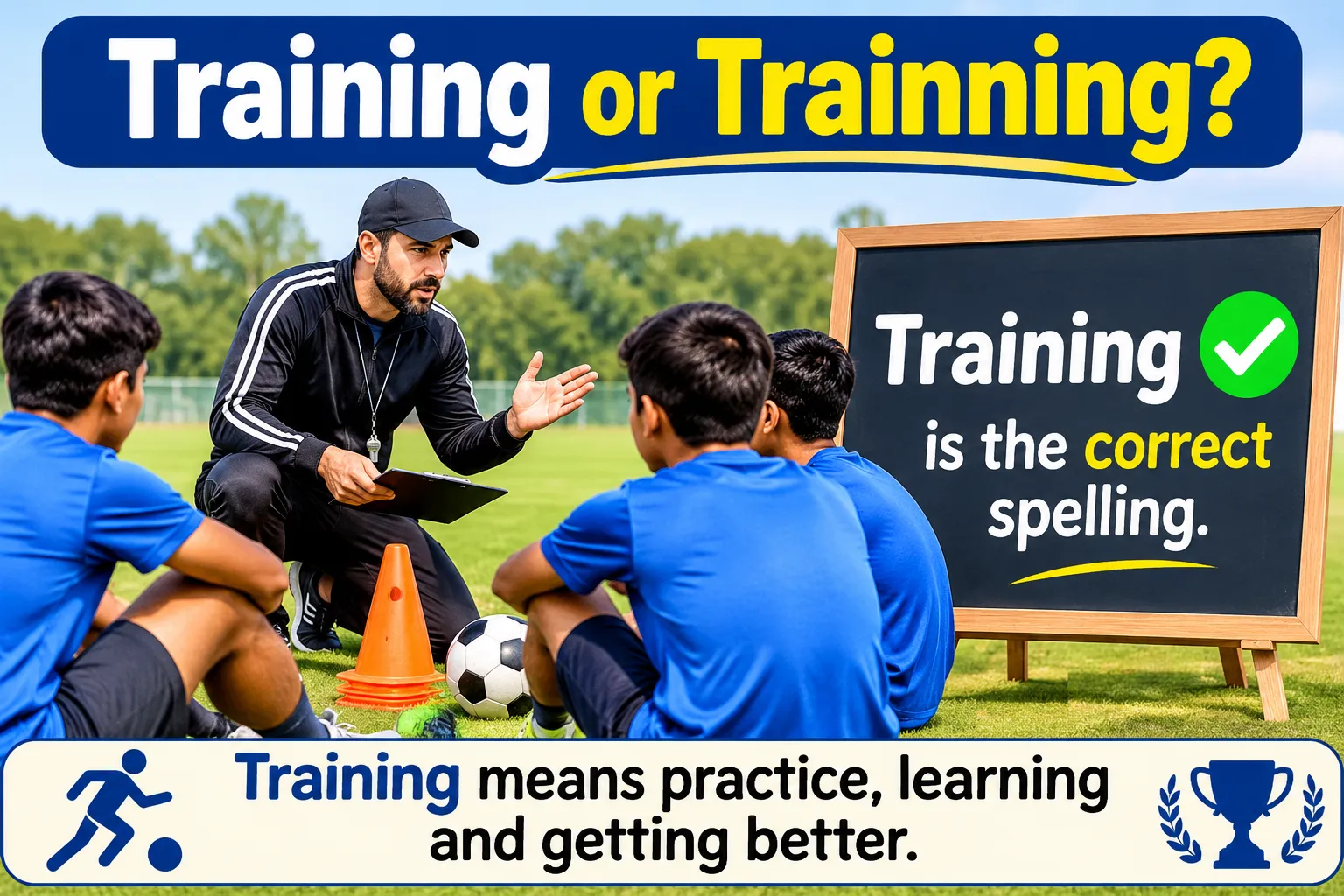
“Training” is the correct spelling. “Trainning” is a typo.
Last week, Sam wrote a job email. He typed, “I finished my trainning course.” The spell checker showed a red line. Sam stared at it. Did he add one n too many? He was not sure. So he searched online.
Many people do this. The word “train” ends with one n. When we add “-ing,” some words double the last letter, like “run” and “running.” So people think “train” does the same. It does not. That is the confusion this guide solves.
Training means learning or teaching a skill. It can be sports, work, or school. People search “trainning or training” because they want a fast, clear answer. Now you have it. Training is right. Trainning is wrong. Let’s see why.
Pronunciation
- Training (US): /ˈtreɪ.nɪŋ/ (TRAY-ning)
- Training (UK): /ˈtreɪ.nɪŋ/ (TRAY-ning)
- Trainning: It is not a word. If you say it, it sounds the same: TRAY-ning.
The sound is the same, so only spelling shows the mistake.
Read More About https://orlymean.com/kiki-or-bouba/
Difference Between Trainning and Training
1. Correctness
Training is a real word. Trainning is a spelling error.
- I need training for this job.
- She loves her dog training class.
2. Dictionary Status
Training is in every dictionary. Trainning is in none.
- Look up “training” and you will find it.
- Look up “trainning” and you get “Did you mean training?”
3. Letter Count
Training has 8 letters. Trainning has 9.
- T-R-A-I-N-I-N-G is training.
- T-R-A-I-N-N-I-N-G has one extra n.
4. Word Root
Training comes from “train.” Trainning breaks that root.
- Train + ing = training.
- Train + n + ing is wrong.
5. Doubling Rule
We double a final letter only after a short vowel sound. “Train” has a long vowel sound (the “ai”), so no doubling.
- Run → running (short vowel).
- Train → training (long vowel).
6. Professional Look
Training looks professional. Trainning looks careless.
- A resume with “training” looks sharp.
- A resume with “trainning” may lose the job.
7. Spell Check
Training passes. Trainning gets flagged.
- Your phone accepts “training.”
- Your phone underlines “trainning” in red.
8. Search Results
Training gives clean results. Trainning gives mixed or fewer results.
- Search “training courses” for good pages.
- Search “trainning courses” and Google often fixes it for you.
9. School and Exams
Teachers mark training as right and trainning as wrong.
- “Football training starts at five.” ✔
- “Football trainning starts at five.” ✘
10. Trust
Readers trust correct spelling.
- A gym with “personal training” looks reliable.
- A gym with “personal trainning” looks sloppy.
Nature and Behaviour of Trainning and Training
Training is a noun and a verb form. As a noun, it means a learning process: “The training was fun.” As a verb form, it shows action: “She is training for a race.” It follows normal English rules.
Trainning has no nature or behaviour.It is not a real word. It has no meaning or place in grammar. People use it when they type too fast or spell a word incorrectly.
Why People Get Confused About Trainning and Training
Three reasons cause most mistakes:
- The doubling rule. Words like “run,” “sit,” and “swim” double the last letter. People think “train” does too.
- Fast typing. Fingers press n twice by accident.
- Look-alike words. “Beginning,” “winning,” and “planning” all have double n. The eye expects it.
The fix is easy. Train has a long vowel sound. Long vowel, no doubling.
Comparison Table
| Feature | Training | Trainning |
| Correct? | Yes | No |
| In dictionaries? | Yes | No |
| Letters | 8 | 9 |
| Meaning | Learning a skill | None |
| US use | Yes | No |
| UK use | Yes | No |
| Pronunciation | TRAY-ning | Same sound |
| Where to use | Everywhere | Nowhere |
| Similarity | Sound the same | Sound the same |
The Origin of Training
“Training” comes from the verb “train.” The word came into English from Old French, where it meant to pull or drag. That French word came from Latin trahere, which means “to pull.”
At first, “train” meant to drag something along. Later it meant to guide a plant or a person in a direction. By the 1500s, it meant to teach a skill. Today, we use it for sports, jobs, schools, and pets.
No version of this word ever had a double n. “Trainning” has no history at all.
British vs American English
Here is good news. Both use the same spelling.
- US: “The team has training at noon.”
- UK: “The team has training at noon.”
There is no spelling split like color and colour. Some words do differ, though, so here is the comparison:
- “Train” + “ing” stays training in both.
- Compare “travel”: US traveling, UK travelling. That one doubles in the UK.
- Compare “program”: US program, UK programme. The UK often prefers the longer form.
Do not mix up these rules. “Training” never changes.
Which One Should You Use?
Use training. Always.
- For US readers: Training.
- For UK readers: Training.
- For global readers: Training.
Common Mistakes
| Wrong | Right |
| Trainning course | Training course |
| Staff trainning | Staff training |
| Dog trainning | Dog training |
| Trainning day | Training day |
| Online trainning | Online training |
| Trainning wheels | Training wheels |
Tip: Say “train,” then add “ing.” Do not add an extra letter.
Everyday Usage Examples
Email: “Please join the safety training on Friday.”
Social media: “Day 30 of marathon training. My legs hurt, but I am happy!”
News: “The city will fund new job training for workers.”
Formal writing: “All new staff must complete training within two weeks.”
Usage Trends
People worldwide use “training” every day. It is a very common word in jobs, sports, and schools. It rises when people start new jobs or new fitness goals. January is a big month, since many make fitness plans.
“Trainning” shows up as a small number of typos. Search tools fix it fast. Over time, spell check has made this error less common.
Metaphors and Similes
Metaphors
- “Life is training for what comes next.”
- “Failure is the best training ground.”
Similes
- “Learning to write is like training a muscle.”
- “Her mind was as well trained as an athlete’s body.”
Connotative Meaning
Positive: Training means growth and skill. “Her training made her a star.”
Negative: Sometimes it sounds like control. “The training felt like punishment.”
Neutral: Often it is just a fact. “The training lasts two hours.”
Idioms and Proverbs
- Training wheels: Help for a beginner. “This app has training wheels for new users.”
- Practice makes perfect: Training leads to skill. “Keep going. Practice makes perfect.”
- You can’t teach an old dog new tricks: Some say adults can’t learn. “My boss proved it wrong.”
- No pain, no gain: Hard training brings results. “I’m sore, but no pain, no gain.”
Literature and Movies
Literature
- Ender’s Game by Orson Scott Card (1985). Science fiction. Young Ender goes through hard military training.
- How to Train Your Dragon by Cressida Cowell (2003). Children’s fantasy. A boy learns to train dragons.
Movies
- Training Day (2001, USA). A crime drama about a young officer’s first day with a tough partner.
- The Karate Kid (1984, USA). A boy learns martial arts through training.
- How to Train Your Dragon (2010, USA). An animated film about a Viking boy and a dragon.
Why This Difference Matters
For learners, spelling builds trust. A small mistake can make a big message look weak. Knowing why “training” has one n also helps with other words.
For society, clear spelling makes sharing ideas easier. Schools, jobs, and websites all need words people can read fast. One wrong letter can slow us down.
Usefulness in Daily Life
- At work: Write “training” on your resume.
- At school: Spell it right in essays.
- At the gym: Post clear fitness updates.
- Online: Name your course or business correctly.
- With pets: Look up “dog training” and get real help.
Situational Preference
Use “training” in every situation. In a job email, it looks sharp. In an essay, it earns marks. On a business website, it builds trust. On social media, it helps people find your post. In a text to a friend, it keeps your message clear. In a school test, it is the only right answer. There is no case where “trainning” is better. If you ever feel unsure, think of the word “train.” Say it slowly. Add “ing.” Stop there. That one simple step works for every reader, in every country, and every setting.
Possible Short Questions
1. Is “trainning” ever correct?
No. It is always a typo.
2. Why does “training” have one n?
“Train” has a long vowel sound, so we do not double the last letter.
3. Is “training” spelled differently in the UK?
No. The US and UK both use “training.”
4. Does spell check catch “trainning”?
Yes. Most tools flag it and suggest “training.”
5. Does “trainning” hurt my website’s SEO?
It can. People search the correct word, so wrong spelling may reduce reach.
6. How can I remember the right spelling?
Remember: train + ing. No extra letter.
7. Do other words work like this?
Yes. “Rain” becomes “raining,” and “gain” becomes “gaining.” No doubling.
Conclusion
Here is the short story. “Training” is the right spelling. “Trainning” is a mistake. They sound the same, so the error only shows in writing.
People make this error for simple reasons. They think of words like “running” and “winning.” They type too fast. Or they guess. But “train” has a long vowel sound, so it does not double its last letter.
Training has a long, clear history. It started from a Latin word meaning “to pull.” Over time, it came to mean teaching and learning a skill. The US and the UK both spell it the same way. You can use it in emails, essays, news, and social posts.
Use “training” in every case. Check your spelling before you hit send. Remember the easy rule: train + ing. Do that, and you will never wonder again. One small letter can make your writing look better and feel more trusted. Now you know the answer, and you can share it with others.

I’m Ghafoor Khan, a content writer and blogger at Orly. I write simple, engaging articles on English grammar, word meanings, synonyms, antonyms, and vocabulary to help readers improve their English skills.