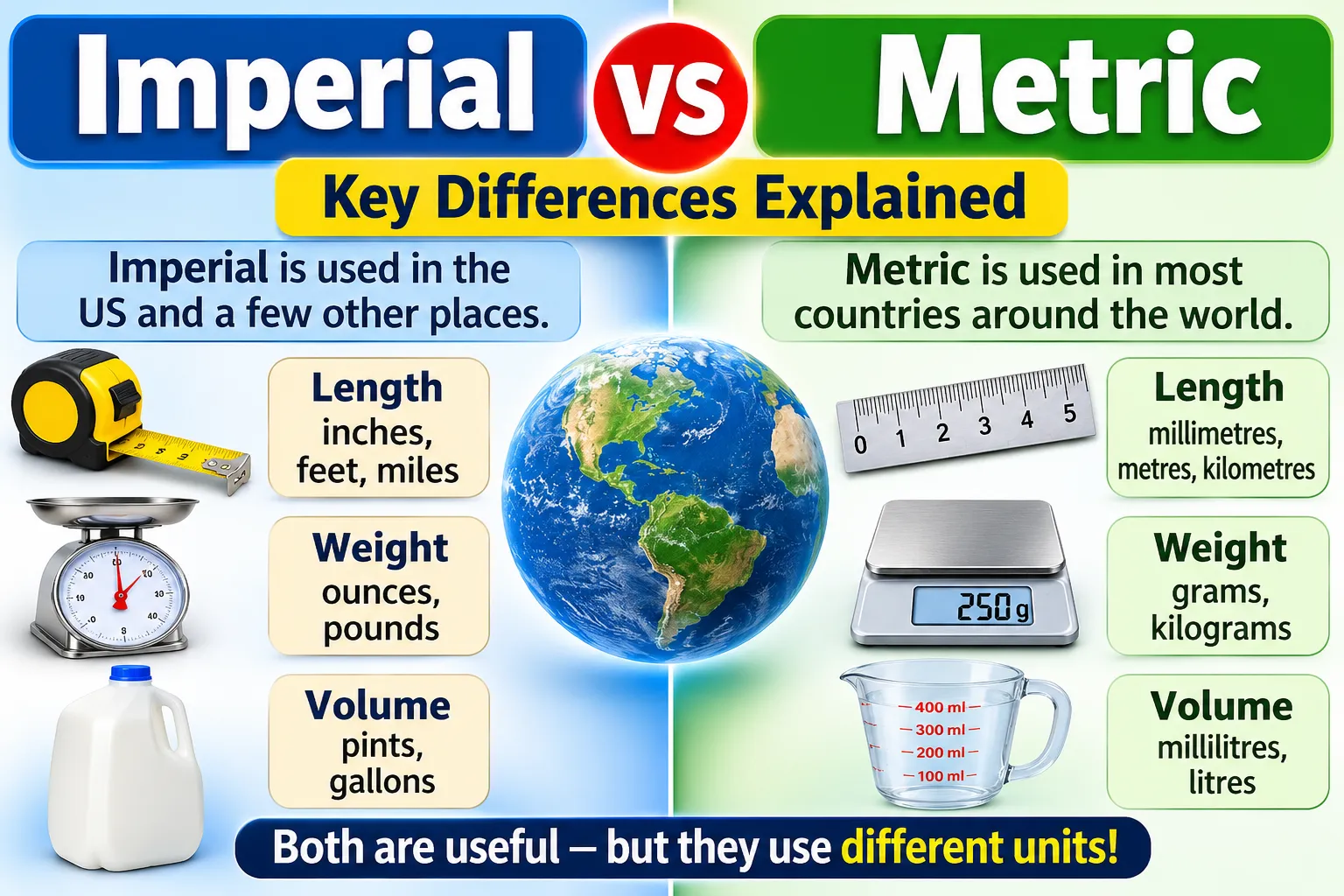
Imperial uses inches, pounds, and gallons. Metric uses meters, grams, and liters. Metric counts by tens, so it is easy.
Sara moved to London from Texas. She wanted two pounds of apples. The clerk said, “Do you want one kilo?” Sara was lost. The road signs said miles. The shop said kilos. Why did one place use both?
That is the puzzle behind imperial or metric. Imperial is an old way to measure. It came from old Britain. Metric is a new way to measure. It counts by tens. Both tell us how long, how heavy, or how full.
People search imperial or metric because they get mixed up. Many check imperial or metric before a trip or a recipe. Which one is right? Which one should I use? This guide helps. You will see the main differences and easy examples. Soon, imperial or metric will feel simple.
Pronunciation
- Imperial (US): im-PEER-ee-ul, /ɪmˈpɪriəl/
- Imperial (UK): im-PEER-ee-ul, /ɪmˈpɪəriəl/
- Metric (US): MEH-trik, /ˈmɛtrɪk/
- Metric (UK): MEH-trik, /ˈmɛtrɪk/
Read More About https://orlymean.com/hawk-or-falcon/
Difference Between Imperial and Metric
1. Base
Metric uses tens. Imperial does not.
- 1 meter is 100 centimeters.
- 1 foot is 12 inches.
2. Length
Metric uses meters. Imperial uses feet and miles.
- The road is 5 kilometers long.
- The road is 3 miles long.
3. Weight
Metric uses grams. Imperial uses pounds.
- The bag is 2 kilograms.
- The bag is 4 pounds.
4. Volume
Metric uses liters. Imperial uses gallons.
- Buy 1 liter of milk.
- Buy 1 gallon of milk.
5. Math
Metric math is easy. You move a dot. Imperial math is harder.
- 2 meters is 200 centimeters.
- 2 miles is 10,560 feet.
6. Heat
Metric uses Celsius. Many imperial places use Fahrenheit.
- Water boils at 100°C.
- Water boils at 212°F.
7. Who Uses It
Most places use metric. The US uses imperial-type units.
- Japan and France use metric.
- The US uses miles and pounds.
8. Science
Science uses metric. It helps the whole world share facts.
- A lab weighs things in grams.
- A nurse counts medicine in milliliters.
9. Names
Metric names follow a pattern. Imperial names do not.
- Kilo means 1,000.
- Foot, yard, and mile have no link.
10. Age
Imperial is very old. Metric began in France in the 1790s.
- The foot came from a real foot.
- Metric was planned by thinkers.
Nature and Behaviour of Imperial and Metric
Imperial
Imperial grew from daily life. People used a foot or a thumb to measure. It has odd steps. A pound has 16 ounces. A gallon has 4 quarts. You must learn each step.
Metric
Metric was planned. Every step is 10, 100, or 1,000. Kilo is big. Milli is small. Learn these small words. Then you can use them for every unit.
Why People Get Confused About Imperial or Metric
- Some places use both.
- The word “ton” has two sizes. A metric tonne is 1,000 kilograms. A US ton is 2,000 pounds.
- A UK pint is bigger than a US pint.
- The UK uses metric in shops. It uses miles on roads.
- Some people say “imperial” for US units. They are close, but not the same.
Know the place, and the mix-up fades.
Comparison Table
| Feature | Imperial | Metric |
| Base | Mixed | Ten |
| Length | Foot, mile | Meter, kilometer |
| Weight | Pound | Kilogram |
| Volume | Gallon | Liter |
| Heat | Fahrenheit | Celsius |
| Math | Harder | Easier |
| Used in | US, some UK life | Most of the world |
Same: Both measure length, weight, and volume.
Use: Imperial for roads and homes in the US. Metric for school, labs, and trade.
The Origin of Imperial or Metric
Imperial is old. It came from Roman and old English measures. In 1824, Britain set clear rules. This was called the Imperial System.
Metric began in France in the 1790s. Leaders wanted one fair system. The meter came from the size of the Earth. Later it was named SI. Britain began to switch in the 1960s. The US kept its own units.
British vs American English
| Topic | British | American |
| Spelling | metre, litre | meter, liter |
| Pint | About 568 ml | About 473 ml |
| Body weight | Stones | Pounds |
| Old system name | Imperial | US customary |
- The room is five metres wide. (UK)
- The room is five meters wide. (US)
- He weighs 12 stone. (UK)
- He weighs 168 pounds. (US)
Which One Should You Use?
- US: Use miles and pounds for daily life. Use metric for science.
- UK: Use metric in shops. Use miles on roads.
- Global: Use metric.
If you are not sure, show both: 10 km (6 miles).
Common Mistakes
| Wrong | Right |
| 5 feet 2 meters | 5 feet 7 inches, or 1.7 meters |
| A UK pint is a US pint. | A UK pint is bigger. |
| A ton is always 1,000 kg. | A tonne is 1,000 kg. A US ton is 2,000 lb. |
| Meter in UK text | Metre in UK text |
Everyday Usage Examples
- Email: The box weighs 3 kilograms.
- Social media: I ran 10K today!
- News: The storm gave us 5 centimeters of rain.
- Formal writing: We measured each sample in milliliters.
Usage Trends
Most of the world now uses metric. Labs, schools, and big firms use it most. Many shops show both units. The US still likes imperial in daily life. Metric grows slowly.
Metaphors and Similes
- Imperial is a drawer of mixed tools.
- Metric is a ruler made of tens.
- Metric is as neat as ten blocks in a row.
- Imperial feels like an old coat.
Connotative Meaning
- Imperial, positive: warm and old-school. Grandpa still uses inches.
- Imperial, negative: slow and hard. Imperial math takes too long.
- Imperial, neutral: a set of units. The recipe uses cups.
- Metric, positive: clear and modern. Metric makes lab work easy.
- Metric, negative: cold or strange. Kilometers feel odd to me.
- Metric, neutral: a set of units. The label lists grams.
Idioms and Proverbs
- Give an inch, take a mile. Let him be late once, and he will take a mile.
- Go the extra mile. She went the extra mile for us.
- Miss by a mile. His guess missed by a mile.
- An ounce of prevention is worth a pound of cure. Wear a helmet. It is worth it.
Literature and Movies
Few stories are about these systems. Some play with size and measure.
Books
- Gulliver’s Travels by Jonathan Swift, 1726. Genre: satire and adventure.
- The Martian by Andy Weir, 2011. Genre: science fiction.
- Around the World in Eighty Days by Jules Verne, 1872. Genre: adventure.
Movies
- Honey, I Shrunk the Kids, 1989, USA.
- Gulliver’s Travels, 2010, USA.
- The Martian, 2015, USA and UK.
Why This Difference Matters
Wrong units can hurt. Learners must switch between both. Stores, doctors, and travelers need clear units. In 1999, NASA lost the Mars Climate Orbiter. One team used metric. Another used imperial. The mix-up ended the mission.
Usefulness in Daily Life
- Cooking: Recipes use cups or grams.
- Travel: Signs show miles or kilometers.
- Shopping: Sizes differ. Read the label.
- Health: Doctors use kilograms. Many people track pounds.
- Home work: Tools use inches or millimeters.
Situational Preference
Pick by place and goal. In a lab, use metric. It is clear for all. On a US road, use miles. The signs match. In baking, use grams if you can. They are exact. For a world reader, write metric first. Add imperial in brackets. For a UK reader, do as locals do. Use miles on roads and pints in pubs. Use metric in shops. If you are not sure, show both units. Then no one is lost.
Possible Short Questions
1. What is the main difference?
Metric uses tens. Imperial uses mixed numbers.
2. Does the UK use imperial or metric?
Both. Metric in shops. Miles on roads.
3. Why does the US use imperial?
Habit and cost. A big change is hard.
4. Are imperial and US units the same?
Close, but not the same. A UK pint is bigger.
5. How do I convert fast?
An inch is 2.54 cm. A mile is 1.6 km. A kilogram is 2.2 pounds.
6. Which is better for science?
Metric. The whole world shares it.
Conclusion
Imperial and metric both measure the world. They do it in different ways. Imperial uses inches, pounds, and gallons. It grew from old habits. Metric uses meters, grams, and liters. It was planned on tens.
Metric is easy for math and science. Most of the world uses it. Imperial lives on in the US and in some parts of British life, like road signs and pubs.
Keep a few rules in mind. Use metric for science and global work. Use imperial when your place does. Do not mix units in one line. When unsure, show both, like 5 miles (8 km).
Now you know how to pick between imperial or metric. Choose the one that fits the place, the people, and the goal.

I’m Ghafoor Khan, a content writer and blogger at Orly. I write simple, engaging articles on English grammar, word meanings, synonyms, antonyms, and vocabulary to help readers improve their English skills.










1 thought on “Imperial vs. Metric: Key Differences Explained”