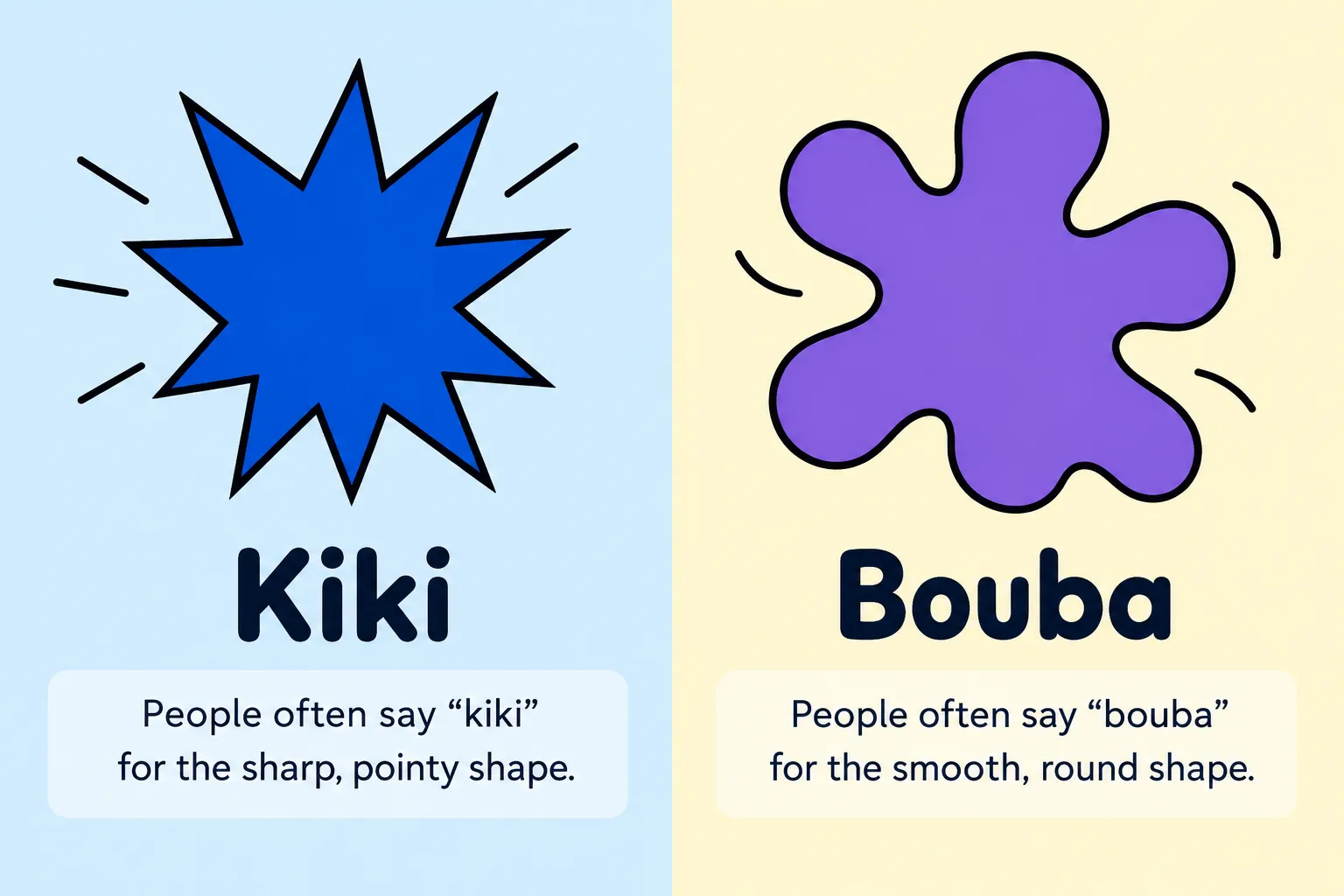
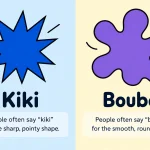
Kiki matches sharp shapes, while Bouba matches round shapes.
Imagine you see a sharp star and a round cloud. Which name fits each shape? Most people choose Kiki for the star and Bouba for the cloud. This is called the Kiki or Bouba effect.
Kiki and Bouba are made-up words. They have no fixed meaning in a normal dictionary. Scientists use them to study how people link sounds with shapes.
People search for Kiki or Bouba to learn why these words feel different. They also want to know how our brains make these links. The test is simple and fun. You can even try it with a friend.
The Kiki or Bouba effect helps us learn how sound and sight work together. It may also help us understand how people react to names, shapes, and signs.
Pronunciation
Word
US Pronunciation
UK Pronunciation
Kiki
KEY-key
KEY-key
Bouba
BOO-bah
BOO-bah
Read More About https://orlymean.com/partys-or-parties/
Difference Between Kiki and Bouba
1. Shape
- Kiki: Matches sharp shapes.
- Bouba: Matches round shapes.
Examples:
- A sharp star looks like Kiki.
- A round ball looks like Bouba.
2. Sound
- Kiki: Has quick, sharp sounds.
- Bouba: Has soft, smooth sounds.
Examples:
- Kiki sounds short and sharp.
- Bouba sounds soft and round.
3. Mouth Shape
- Kiki: Your lips often spread wide.
- Bouba: Your lips form a round shape.
Examples:
- Say Kiki and notice your lips.
- Say Bouba and notice your rounded lips.
4. Feel
- Kiki: May feel sharp or hard.
- Bouba: May feel soft or smooth.
Examples:
- A thorn may remind you of Kiki.
- A soft pillow may remind you of Bouba.
5. Look
- Kiki: Often seems sharp and bold.
- Bouba: Often seems soft and friendly.
Examples:
- A pointed logo may look like Kiki.
- A round logo may look like Bouba.
6. Lines
- Kiki: Fits lines with sharp corners.
- Bouba: Fits lines with smooth curves.
Examples:
- A zigzag line suggests Kiki.
- A curved line suggests Bouba.
7. Toys
- Kiki: May suit a sharp robot shape.
- Bouba: May suit a round teddy bear.
Examples:
- A robot with pointed arms looks like Kiki.
- A round plush bear looks like Bouba.
8. Sounds in Design
- Kiki: May suit a bold design.
- Bouba: May suit a soft design.
Examples:
- Sharp letters can suggest Kiki.
- Rounded letters can suggest Bouba.
9. Names
- Kiki: Often sounds quick and bright.
- Bouba: Often sounds warm and soft.
Examples:
- A sharp shape may suit Kiki.
- A round shape may suit Bouba.
10. Brain Links
- Kiki: People often link it with pointed forms.
- Bouba: People often link it with rounded forms.
Examples:
- People may match Kiki with a star.
- People may match Bouba with a cloud.
These are common links, not strict rules. People may give different answers.
Nature and Behaviour of Kiki and Bouba
Nature of Kiki
Kiki often feels sharp, quick, and bold. Its sound may bring pointed shapes to mind. It can suit designs that look active or strong.
For example, a star with sharp points may feel like Kiki.
Nature of Bouba
Bouba often feels soft, smooth, and round. Its sound may bring curves to mind. It can suit designs that look warm or friendly.
For example, a round cloud may feel like Bouba.
Why People Get Confused About Kiki or Bouba
Kiki and Bouba are not names for real shapes. They are made-up words used in a test.
People may wonder why they choose the same names for shapes. The answer may lie in how our brains link sounds and sights.
The hard sounds in Kiki may feel sharp. The softer sounds in Bouba may feel round. Still, not everyone makes the same choice.
Comparison Table
Feature
Kiki
Bouba
Similarity
Shape
Sharp
Round
Both match shapes
Sound
Quick and sharp
Soft and smooth
Both are made-up words
Mouth
Lips often spread
Lips often round
Both use mouth movements
Look
Bold and pointed
Soft and curved
Both help study sound links
Use
Shape tests and design ideas
Shape tests and design ideas
Both show sound and sight links
The Origin of Kiki or Bouba
In 1929, psychologist Wolfgang Köhler studied links between sounds and shapes. He used made-up words such as “Takete” and “Baluba.”
In 2001, researchers Vilayanur Ramachandran and Edward Hubbard helped make the Kiki and Bouba test well known.
Their work explored why people match certain sounds with certain shapes. Many people chose Kiki for sharp shapes and Bouba for round ones.
British vs American English
Kiki and Bouba are used in the same way in US and UK English. Their spelling does not change.
- US English: Kiki matches sharp shapes; Bouba matches round shapes.
- UK English: The same words and links are used.
US example: “This sharp logo looks like Kiki.”
UK example: “This round logo looks like Bouba.”
These are examples, not fixed English rules.
Which One Should You Use?
Use Kiki when talking about sharp shapes. Use Bouba when talking about round shapes.
In the US and UK, the basic idea is the same. Around the world, people use these words in tests and lessons about sound and sight.
You can also use the idea when making logos, toys, or signs. Remember that Kiki and Bouba are test words, not names for all sharp and round things.
Common Mistakes
- Mistake: Thinking Kiki and Bouba are real objects. Correction: They are made-up test words.
- Mistake: Saying everyone picks the same shape. Correction: Many people agree, but some do not.
- Mistake: Thinking the words have different US and UK spellings. Correction: The spelling stays the same.
- Mistake: Treating the test as a strict rule. Correction: It shows a common link, not a rule for all people.
Everyday Usage Examples
- Email: “I like the round Bouba-style logo.”
- Social media: “Try the Kiki or Bouba shape test!”
- News: “Researchers study how people link sounds with shapes.”
- Formal writing: “The Kiki or Bouba effect shows a link between sound and shape.”
Usage Trends
The Kiki or Bouba effect is known in studies of sound, shape, and thought. Teachers may use it to explain how people link sounds and sights.
Designers may also find the idea useful. For example, they can test if people link a name with a logo shape.
However, there is no need to claim that everyone uses this idea every day.
Metaphors and Similes
Kiki and Bouba are not common English idioms. But they can be used in simple comparisons.
- Kiki-like: “The star has a Kiki-like shape.”
- Bouba-like: “The cloud has a Bouba-like look.”
- Example: “The sharp logo looks more Kiki than Bouba.”
These are creative examples, not set phrases.
Connotative Meaning
A connotative meaning is an idea or feeling linked to a word.
- Kiki: May suggest sharp, quick, bold, or bright.
- Bouba: May suggest round, soft, warm, or calm.
These are common impressions in the test. They are not the true dictionary meanings of the words.
Idioms and Proverbs
There are no well-known English idioms or proverbs based on Kiki and Bouba.
The words were made for sound and shape tests. You can make your own phrases, but they should not be called established idioms.
Literature and Movies
Literature
Phantoms in the Brain is a science book by V. S. Ramachandran and Sandra Blakeslee. It was first published in 1998. It covers brain science and how people understand the world.
Movies
Inside Out is a Pixar animated film from the United States, released in 2015. It uses shapes and colors to show feelings. It is not a direct study of the Kiki or Bouba effect.
Why This Difference Matters
The Kiki or Bouba effect helps us study how people link sounds with shapes. It shows that a word’s sound may affect how a shape feels to us.
This idea can help in science, learning, and design. For example, a designer may test a round logo with a soft-sounding name.
The effect also helps us ask questions about how the brain works. Still, it does not mean every person thinks in the same way.
Usefulness in Daily Life
You can use this idea in simple ways.
- Logos: Try sharp or round shapes.
- Toys: Match a toy’s shape with its name.
- Learning: Show children how sounds can feel different.
- Art: Use curves or points to create a certain mood.
- Games: Ask friends to match names with shapes.
These are possible uses, not strict rules.
Situational Preference
Choose Kiki when you want to describe a sharp or pointed shape. It may fit a star, a zigzag line, or a logo with hard corners. Choose Bouba when you want to describe a round or smooth shape. It may fit a cloud, a ball, or a logo with curves. The best choice depends on the shape and the task. Neither word is better in every case. They are most useful when you want to show how sounds can match shapes.
Possible Short Questions
What is the Kiki or Bouba effect?
It is a test that links sharp shapes with Kiki and round shapes with Bouba.
Who studied this effect first?
Wolfgang Köhler studied related sound and shape links in 1929.
Why does Kiki match sharp shapes?
Its quick sounds may remind people of sharp points.
Why does Bouba match round shapes?
Its soft sounds and rounded mouth movement may remind people of curves.
Do all people give the same answer?
No. Many people make similar choices, but answers can vary.
Are Kiki and Bouba real English words?
They are used as made-up words in this test. They do not name real shapes.
Is the effect used in design?
The idea can help people explore how names and shapes work together.
Conclusion
The Kiki or Bouba effect shows how people link sounds with shapes. Kiki is often matched with sharp points. Bouba is often matched with round curves. These words are made up, but they help scientists study how the brain connects sound and sight.
The idea is simple. Show someone a sharp star and a round cloud. Ask which one is Kiki and which one is Bouba. Many people choose Kiki for the star and Bouba for the cloud.
This effect can help us learn about words, shapes, and thought. It may also give designers ideas for logos, toys, and signs. Still, the result is not the same for every person. Kiki and Bouba are not strict rules for naming things. They are useful tools for learning how sounds can shape our ideas.

I’m Ghafoor Khan, a content writer and blogger at Orly. I write simple, engaging articles on English grammar, word meanings, synonyms, antonyms, and vocabulary to help readers improve their English skills.



2 thoughts on “Kiki or Bouba: What Is the Difference?”