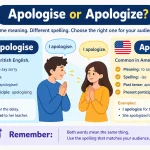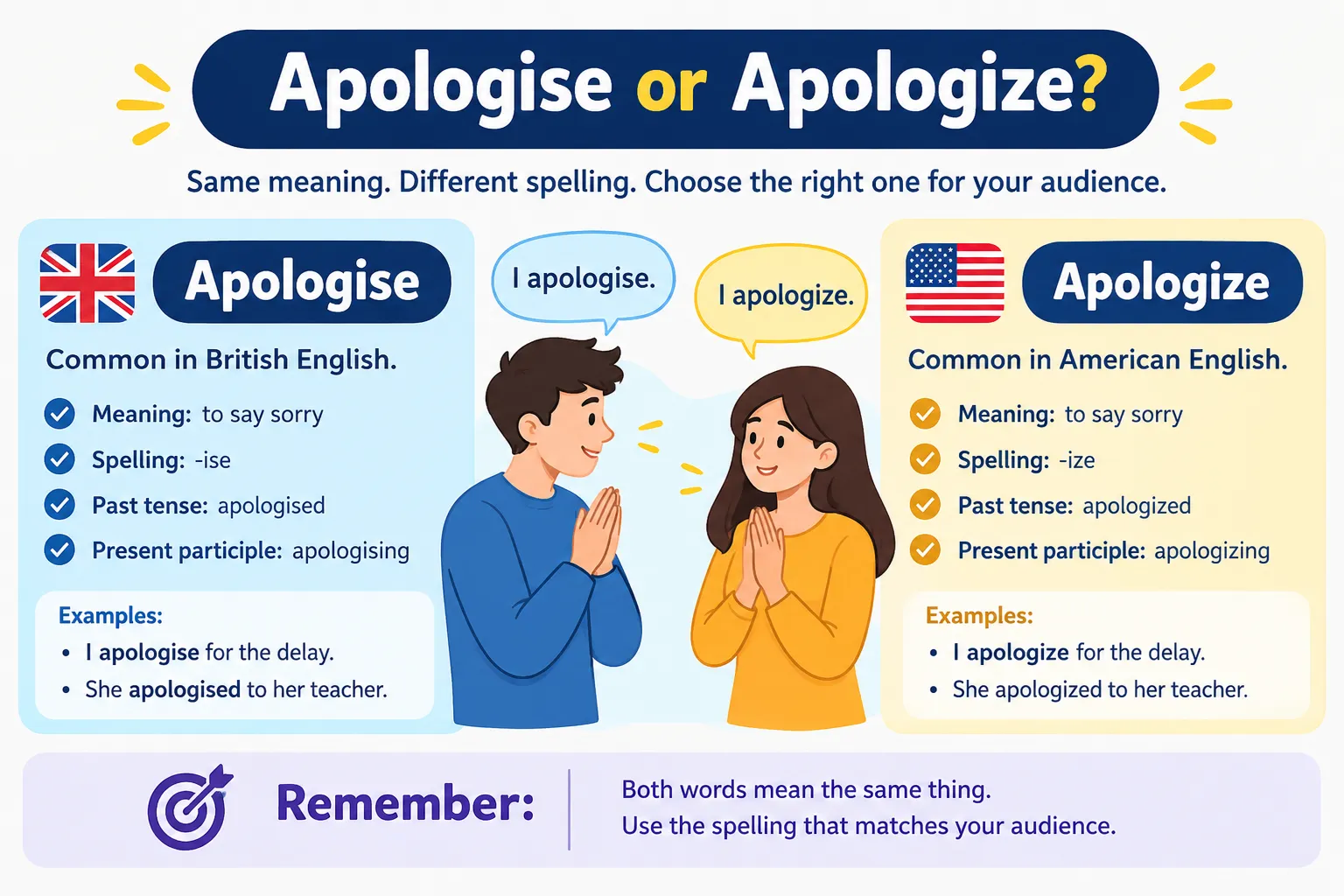
Apologise and apologize mean the same thing. They only differ in spelling. The UK often uses “apologise.” The US uses “apologize.”
Sam lives in London. His friend Ben lives in Texas. Sam was late for a call. He typed, “I apologise!” Ben frowned. “Is that a typo?” Sam smiled. “No. We spell it that way here.”
People search for “apologise or apologize” for this reason. They see two spellings. They want the right one. Should you apologise or apologize in an email? Both are right. Each one fits a place.
To apologise or apologize means to say sorry. You own your mistake. You show you care. It is a kind and strong word. It works in emails, texts, and talks.
This guide makes it clear. You will learn the sounds, the past, and the rules.
Pronunciation
Apologise and apologize sound the same. Both end with a “z” sound.
- US: uh-PAH-luh-jize (/əˈpɑːləˌdʒaɪz/)
- UK: uh-POL-uh-jize (/əˈpɒlədʒaɪz/)
- Read More About https://orlymean.com/attorneys-or-attornies/
Difference Between Apologise and Apologize
The meaning is the same. The small details differ. Here are ten.
1. Spelling
Apologise has an “s.” Apologize has a “z.”
- I apologise for the mess.
- I apologize for the mess.
2. Home Region
Apologise is UK style. Apologize is US style.
- A teacher in Leeds says, “We apologise.”
- A teacher in Ohio says, “We apologize.”
3. Ending Pattern
Think of organise and organize. The same rule applies.
- Please organise it. I apologise.
- Please organize it. I apologize.
4. Past Tense
Add -d to the end.
- Tom apologised to his mum.
- Tom apologized to his mom.
5. The -ing Form
Change the end to -ing.
- She is apologising now.
- She is apologizing now.
6. Third Person
With singular subjects, add -s to the verb.
He always apologises first.
- He always apologizes first.
7. The Doer Noun
This is a person who says sorry. It is rare.
- He is a quick apologiser.
- He is a quick apologizer.
8. Spell-Check
Your tool may flag one spelling.
- UK settings may flag “apologize.”
- US settings may flag “apologise.”
9. Other Countries
Australia, New Zealand, and Ireland often use -ise. Canada often uses -ize.
- An Aussie blog writes, “We apologise.”
- A Canadian blog writes, “We apologize.”
10. Style Guides
Most UK papers use -ise. Oxford style often uses -ize.
- A UK paper prints, “The mayor apologised.”
- An Oxford book prints, “The mayor apologized.”
Nature and Behaviour of Apologise and Apologize
Apologise
Apologise is a verb. It is the UK spelling. It looks calm and formal. You apologise to a person. You apologise for a mistake.
- I apologise to you for the late reply.
- The shop apologised for the error.
Apologize
Apologize is a verb too. It is the US spelling. It is also the top spelling in the world. You apologize to a person. You apologize for a mistake.
- I apologize to you for the late reply.
- The shop apologized for the error.
Why People Get Confused About Apologise and Apologize
People see both spellings online. They think one must be wrong.
- Words like advertise and exercise only end in -ise. So people think all UK words do.
- Many think -ize is only American. That is a myth.
- Spell-check may underline one spelling.
- Teachers and bosses may like one style.
The truth is simple. Both are correct. Pick one and stay with it.
Comparison Table
| Feature | Apologise | Apologize |
| Meaning | To say sorry | To say sorry |
| Main place | UK, Australia, NZ, Ireland | US, Canada, world |
| Past tense | Apologised | Apologized |
| -ing form | Apologising | Apologizing |
| Third person | Apologises | Apologizes |
| Noun | Apology | Apology |
| Best for | UK readers | US and global readers |
Similarities: Same meaning. Same grammar. Same sound at the end. Both are correct.
Usage: Use apologise for UK readers. Use apologize for US or global readers.
The Origin of Apologise and Apologize
Both words come from the Greek word “apologia.” It meant a speech to defend yourself. At first, it did not mean sorry. Later, the meaning changed. By the 1600s, people used it for saying sorry too.
The verb came into English in the late 1500s. The -ize ending came from Greek. The -ise ending came through French. So the two spellings share one root.
British vs American English
Spelling. British often uses -ise. American uses -ize.
- British: apologise, realise, organise
- American: apologize, realize, organize
Rules. The grammar is the same.
- British: I apologise to Mia for the noise.
- American: I apologize to Mia for the noise.
Usage. Both say “my apologies.”
Which One Should You Use?
US readers: Use apologize.
UK readers: Use apologise. Check your style guide.
Global readers: Use apologize. It is the most common worldwide.
Be consistent. Do not use both in one text.
Common Mistakes
- Mixing both spellings. Wrong: “I apologise. She apologized.” Right: “I apologise. She apologised.”
- Wrong small word. Wrong: “I apologize about the delay.” Right: “I apologize for the delay.”
- Missing “to.” Wrong: “He apologised me.” Right: “He apologised to me.”
- Noun and verb mix-up. Wrong: “I give my apologize.” Right: “I give my apology.”
- Typos. Wrong: “appologize.” Right: “apologize.”
Everyday Usage Examples
- Email: “I apologise for the late reply.” / “I apologize for the late reply.”
- Social media: “Sorry, fans! We apologise for the delay.” / “Sorry, fans! We apologize for the delay.”
- News: “The minister apologised to the public.” / “The senator apologized to the public.”
- Formal writing: “The firm apologises for the trouble.” / “The firm apologizes for the trouble.”
Usage Trends
Apologize is the top spelling in the world. The US has the most English writers online. Apologise is strong in the UK, Australia, New Zealand, and Ireland. Canada leans toward -ize. Many apps and tech sites use -ize.
Metaphors and Similes
- Metaphor: An apology is a bridge. It leads back to a friend.
- Metaphor: His apology was a warm blanket.
- Simile: Her apology was as sweet as honey.
- Simile: The silence grew like a dark cloud when he did not apologize.
Connotative Meaning
Positive: It shows kindness and courage. “She was brave to apologize first.”
Negative: It can sound fake. “He apologised, but it felt like an act.”
Neutral: It can just state a fact. “The airline apologizes for the gate change.”
Idioms and Proverbs
- Eat humble pie. Say sorry and admit you were wrong. “He had to eat humble pie and apologize.”
- Bury the hatchet. End a fight. “They buried the hatchet when she apologised.”
- Better safe than sorry. Take care now, so you need not say sorry later. “Check twice. Better safe than sorry.”
Literature and Movies
Literature
- Apology by Plato. Philosophy. About 399 BC. Here “apology” means a defense speech.
- Pride and Prejudice by Jane Austen. Romance novel. 1813. Characters say sorry and learn.
Movies
- Atonement. 2007. United Kingdom. A girl’s mistake brings lifelong guilt.
- Love Story. 1970. United States. A romance with a famous line about saying sorry.
Why This Difference Matters
Learners feel less fear when they know both spellings are right. English is spoken in many places. Each place has its own habits. When you match your reader, you show respect. Steady spelling also looks neat and builds trust.
Usefulness in Daily Life
- Work: You apologise for a late report. It calms your boss.
- School: You apologize to a teacher. It shows respect.
- Home: You apologise after a fight. It heals hurt feelings.
- Online: You apologize when a service fails. It saves your brand.
Situational Preference
Choose by your reader. Write for a UK school, a UK firm, or a British paper? Use apologise. Write for a US business, an American app, or a US class? Use apologize. Write for readers all over the world? Apologize is the safe pick. Follow the style guide if you have one. On a personal blog, use the spelling you like, and stay the same all the way through. If you write to a boss or a teacher, ask what they like best.
Possible Short Questions
1. Is it apologise or apologize? Both are right. Apologise is UK style. Apologize is US and world style.
2. Do they mean different things? No. Both mean to say sorry.
3. Is apologize only American? No. Some UK publishers use it too.
4. Which is best for a global reader? Apologize is usually the safest.
5. Can I use both in one article? No. Pick one and keep it.
6. Which small words follow it? Use “to” for the person. Use “for” for the reason.
Conclusion
So, apologise or apologize? Both words mean the same. They sound the same at the end. Both follow the same rules. Only the spelling is different.
Apologise is the UK style. You see it in Britain, Australia, New Zealand, and Ireland. Apologize is the US style. It is also the most common spelling in the world. Canada leans this way too.
To choose, think about your reader. Write for a UK reader? Use apologise. Write for a US or global reader? Use apologize. Follow your school, firm, or style guide if it has one.
The key rule is to stay steady. Do not mix both in one text. Also, remember the small words. You apologise or apologize “to” a person and “for” a mistake.
A good apology is more than a spelling. It is honest and kind. Now you know how to write it. Next time you say sorry, you can type it with trust.

I’m Ghafoor Khan, a content writer and blogger at Orly. I write simple, engaging articles on English grammar, word meanings, synonyms, antonyms, and vocabulary to help readers improve their English skills.