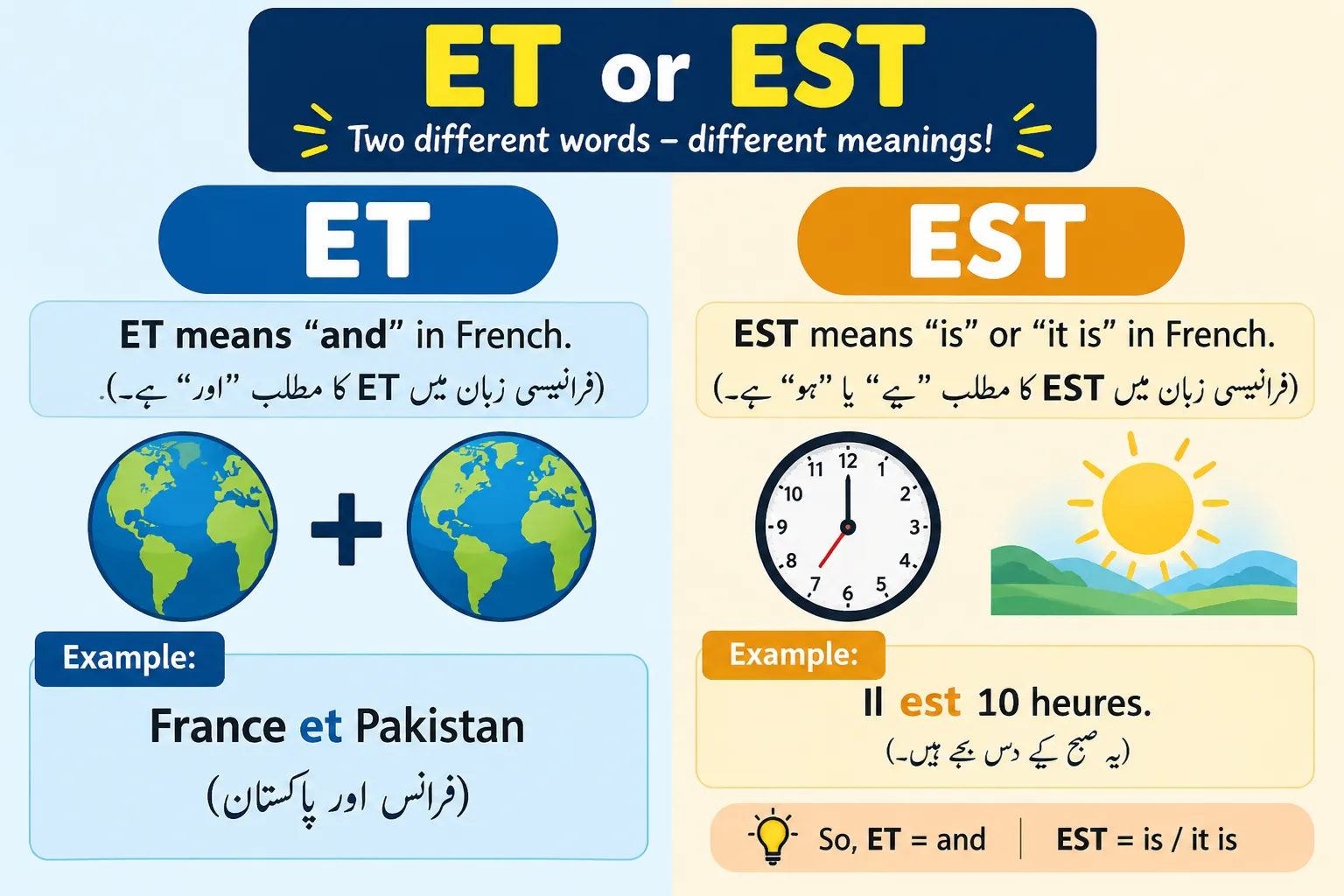
The word et means “and” in French, while est means “is” in French. In English, est is a time zone and a standard suffix.
Imagine you visit a French bakery in Paris. You want to order bread and butter. You look at your phone note. It says “bread est butter.” You show it to the baker. He looks confused. He smiles and tells you that you used the wrong word! You meant to write “bread et butter.” Many people make this exact mix-up every day.
The main keyword here is et or est. The word et is a small conjunction. It joins two words or phrases together. The word est is a form of a verb. It tells us what something is or where something is. People search for et or est because they look and sound very similar. Learning et or est solves confusion for language students, travel fans, and global readers. Knowing et or est makes your writing clear and correct.
Pronunciation Guide
- ET:
- US Pronunciation: /eɪ/ (sounds like “ay” in day)
- UK Pronunciation: /eɪ/ (sounds like “ay” in day)
- EST:
- US Pronunciation: /ɛst/ (sounds like “ehst”) or /ɛs/ in pure French
- UK Pronunciation: /ɛst/ (sounds like “ehst”) or /ɛs/ in pure French
Read More About https://orlymean.com/kiki-or-bouba/
Difference Between Et and Est
Here are ten clear differences between these two words with simple examples.
1. Part of Speech
The word et is a conjunction. It connects words. The word est is a verb. It shows action or state.
- Example 1: Tom et Sam play games.
- Example 2: The cat est on the mat.
2. Meaning in English
The word et means “and.” The word est means “is.”
- Example 1: I like milk et tea.
- Example 2: He est a happy boy.
3. Sentence Role
Use et to list items. Use est to describe something.
- Example 1: Buy apples et pears.
- Example 2: The sun est very hot.
4. Pronunciation Sound
The word et ends with a silent ‘t’. The word est ends with a spoken ‘st’ in English or ‘s’ sound in French.
- Example 1: Say “ay” for et.
- Example 2: Say “ehst” for est in time zones.
5. Time Zone Meaning
The word et stands for Eastern Time. The word EST stands for Eastern Standard Time.
- Example 1: The game is at 5 PM ET.
- Example 2: Winter uses EST time.
6. Suffix Usage
The word et can mean small in words like booklet. The ending est means the most, like biggest.
- Example 1: Read this small booklet.
- Example 2: He is the tallest boy.
7. Latin Roots
The word et comes from Latin “and.” The word est comes from Latin “to be.”
- Example 1: Latin et joins phrases.
- Example 2: Latin est means existence.
8. Singular vs Plural
The word et works with singular or plural lists. The word est only works with one subject.
- Example 1: One dog et two cats run.
- Example 2: She est at school today.
9. Use in Math
The word et can mean plus in old text. The word est means equal or is.
- Example 1: Two et two makes four.
- Example 2: The answer est four.
10. Placement in Sentences
Put et between two nouns. Put est after a singular noun.
- Example 1: Red et blue are colors.
- Example 2: The sky est blue.
Nature and Behaviour of Et and Est
Nature of Et
The word et is a friendly joining word. Never stands alone. Sits between two words. Brings ideas together. Keeps sentences moving forward. Acts like glue in a sentence.
Nature of Est
The word est is a state-of-being word.
Why People Get Confused About Et and Est
People get confused because these words share the first two letters. Both start with ‘e’ and ‘t’. In French, both words are used all the time. People who learn French mix them up because they sound almost the same when spoken fast. In English, people get confused when reading time zones like ET and EST.
Comparison Table
| Feature | Et | Est |
| Meaning | And | Is |
| Type of Word | Conjunction | Verb / Suffix |
| Time Meaning | Eastern Time | Eastern Standard Time |
| Latin Root | Et (And) | Esse (To be) |
| Usage | Connects words | Describes state |
| Example | Fish et chips | The dog est fast |
The Origin of Et and Est
Both words come from ancient Latin. Latin speakers used et to join words. They used est to mean “it is.” As Latin changed into modern French over hundreds of years, both words stayed in the language. Later, English borrowed phrases from Latin and French. English also created time zone abbreviations using these letters.
British vs American English
American English and British English both use ET and EST for time zones. American news channels write ET during daylight saving time in summer. British writers often add full stops, like E.S.T. or E.T., in formal books.
- American Style: The show starts at 8 PM ET.
- British Style: The meeting is at 3 PM E.S.T.
Which One Should You Use?
- For US Readers: Use ET when talking about current New York time. Use EST in winter months when daylight time stops.
- For UK Readers: Use et only when writing French phrases or Latin terms.
- For Global Readers: Use et to join items in French. Use est to mean “is” in French sentences.
Common Mistakes
- Mistake 1: Writing “bread est butter.”
- Correction: Bread et butter.
- Mistake 2: Writing “He et tall.”
- Correction: He est tall.
- Mistake 3: Using EST in summer in America.
- Correction: Use EDT or ET in summer.
- Mistake 4: Forgetting that est at the end of a word makes it superlative.
- Correction: Write “fastest,” not “fast et.”
Everyday Usage Examples
Emails
- Please meet me at 4 PM ET tomorrow.
- My team est ready for the project.
Social Media
- Live video starting now at 6 PM EST!
- Love et peace to everyone online.
News Reports
- The President spoke at 9 PM ET last night.
- France est top in soccer this week.
Formal Writing
- The contract was signed et approved by all.
- The truth est clear to the jury.
Usage Trends
Around the world, searches for ET are higher than EST during summer. Searches for EST jump in late autumn. This happens because time changes in North America. Language learners search for these words all year long.
Metaphors and Similes
- Metaphor: Et is the bridge that links two islands of words.
- Simile: Est is like a mirror, reflecting what a subject really is.
Connotative Meaning
- Et (Neutral): It has no emotional weight. It simply adds information.
- Est (Positive/Neutral): It asserts reality. It builds facts.
- Misuse (Negative): Mixing them up creates confusion and makes writing look unprofessional.
Idioms and Proverbs
- Et cetera (Etc.): A famous Latin phrase meaning “and other things.”
- Sentence: We bought pens, papers, et cetera.
- Id est (i.e.): A Latin phrase meaning “that is.”
- Sentence: Come at the end of the week, i.e., Friday.
Literature and Movies
Literature
- Book: Et Tu, Brute? in the play Julius Caesar by William Shakespeare (Drama, 1599).
Movies
- Movie: E.T. the Extra-Terrestrial (Sci-Fi, USA, 1982).
Why This Difference Matters
Learning this difference helps you write correctly. It stops simple errors in school papers and business emails. Small words change the full meaning of a sentence. Clear language helps people work together across the globe without confusion.
Usefulness in Daily Life
You will see these words on television schedules, travel tickets, and online maps. Knowing the difference helps you catch flight times on schedule. It also helps you pass foreign language tests with high scores.
Situational Preference
In business settings, select ET for general scheduling. Use EST only when specifying standard winter time. When writing French essays, always use et for “and” to connect items like food or names. Use est when describing a person, place, or object. Choosing the right word shows skill and saves time for your readers.
Possible Short Questions
1. What does ‘et’ mean in simple English?
It means “and” in French and Latin.
2. What does ‘est’ mean in simple English?
It means “is” in French and Latin.
3. Is ET the same as EST?
No. ET is Eastern Time. EST is Eastern Standard Time used in winter.
4. What is the suffix -est used for?
It is added to adjectives to mean “the most,” like in “fastest.”
5. Why is ET used on TV programs?
It shows viewers when a show starts in the US Eastern time zone.
6. Can I use ‘et’ in normal English sentences?
Only in short forms like “et cetera” or French names.
7. How do I remember the difference?
Remember: Et has 2 letters like “and”. Est has 3 letters like “is” plus an ‘s’.
Conclusion
Understanding et or est is very easy once you know the basic rules. The word et acts as a conjunction that joins items together, meaning “and.” The word est functions as a verb that describes a state of being, meaning “is.” In time zones, ET covers Eastern Time overall, while EST refers specifically to Eastern Standard Time during winter months.
Mixing up these two small words can change the entire meaning of a sentence or cause you to miss an important event. By following the simple rules, examples, and charts in this guide, you can write with confidence every time. Whether you are typing an email, reading a TV guide, or learning a new language, remembering this difference will keep your communication accurate, professional, and clear for everyone.

I’m Ghafoor Khan, a content writer and blogger at Orly. I write simple, engaging articles on English grammar, word meanings, synonyms, antonyms, and vocabulary to help readers improve their English skills.










1 thought on “Et or Est: Learn the Simple Difference Between These Two Words”