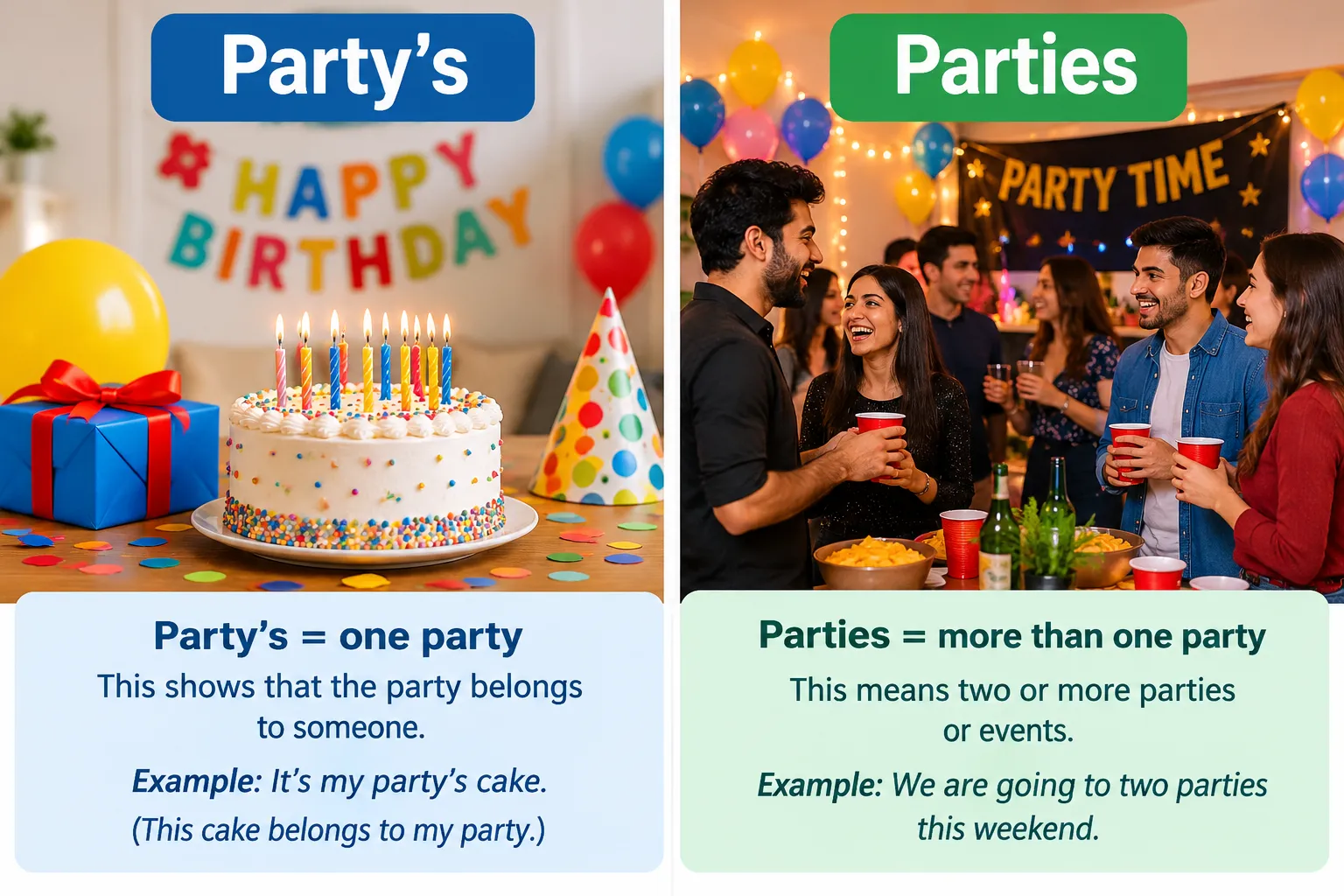
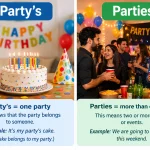
Party’s means something belongs to one party. Parties means more than one party.
Last week, Mia made an invite for her brother. She wrote, “Join us for the parties start time.” Then she stopped. Was it party’s or parties? She did not know.
A party is a fun event. It can also be a side in a deal or a vote. Party’s has a small mark called an apostrophe (‘). It shows that something belongs to one party. It can also mean “party is,” as in “the party’s at six.” Parties has no mark. It means two or more parties.
People search for party’s or parties because the words sound the same. They look the same, too. One small mark changes the meaning. This guide makes it easy. You will learn how to pick party’s or parties every time.
Pronunciation
Both words sound the same.
| Word | US | UK |
| Party’s | /ˈpɑːrtiz/ (PAR-teez) | /ˈpɑːtiz/ (PAH-teez) |
| Parties | /ˈpɑːrtiz/ (PAR-teez) | /ˈpɑːtiz/ (PAH-teez) |
In the US, you say the “r.” In the UK, the “r” is soft. You cannot hear the mark, so check the spelling.
Read More About
Difference Between Party’s and Parties
Here are 10 simple differences.
1. One or Many
Party’s is about one party. Parties is about many.
- The party’s cake was big.
- We went to three parties.
2. The Mark
Party’s has the mark (‘). Parties does not.
- The party’s song was loud.
- Her parties are fun.
3. The Job
Party’s shows who owns it. Parties shows how many.
- The party’s host was late.
- Two parties ended early.
4. Short Form
Party’s can mean “party is” or “party has.” Parties cannot.
- The party’s at six.
- The party’s started.
5. Kind of Word
Party’s is a “belongs to” word. Parties is a “many” word.
- The party’s balloons are red.
- The parties were loud.
6. What Comes Next
When party’s shows owning, a thing comes after it. Parties can stand alone.
- The party’s food ran out.
- Parties can be tiring.
7. Action Word
Parties can mean “has fun at parties.” Party’s cannot.
- He parties on Fridays.
- She parties with friends.
8. The Swap Test
Try “party is” or “of the party.” If it fits, use party’s. Try “more than one party.” If it fits, use parties.
- The party’s music. (The music of the party.)
- Parties are fun. (More than one party.)
9. Law and Votes
Party’s is one side’s thing. Parties names the sides.
- The party’s lawyer spoke first.
- Both parties signed.
10. Formal Writing
In formal writing, write “party is” in full. Use parties for many.
- Casual: The party’s over.
- Formal: The parties agreed.
Nature and Behaviour of Party’s and Parties
Party’s
Party’s needs help from other words. It shows owning, or it joins two words. “The party’s cake” needs “cake.”
Parties
Parties names many. It can stand alone. It can also be an action word, as in “she parties a lot.”
Why People Get Confused About Party’s and Parties
- They sound the same. You cannot hear a mark.
- They look the same. Only a few letters change.
- Many people add a mark to every “many” word.
- The “y” changes to “ies.” People forget this.
There is also parties’. It means many parties own something. Example: “The parties’ lawyers met.”
Comparison Table
| Feature | Party’s | Parties |
| Meaning | Belongs to one party, or “party is” | More than one party |
| Mark (‘) | Yes | No |
| Sound | PAR-teez (US), PAH-teez (UK) | PAR-teez (US), PAH-teez (UK) |
| Example | The party’s music was great. | The parties were great. |
| Likeness | Both come from “party” | Both come from “party” |
The Origin of Party’s and Parties
“Party” comes from the old French word partie. It meant a part or a side. French took it from a Latin word that means “to divide.”
English used “party” in the 1200s and 1300s. It meant a side in a fight or a deal. By the 1700s, it also meant a fun group event.
To make “many,” English changes the “y” to “ies.” That gives us parties.
British vs American English
The spelling is the same in both. The mark rules are the same too. The small changes are in sound and habit.
- Sound: US says PAR-teez. UK says PAH-teez.
- Groups: The US says, “The party is split.” The UK may say, “The party are split.”
- Event names: The UK says “hen party.” The US says “bachelorette party.”
Examples:
- US: The party’s start time is seven.
- UK: Both parties will meet on Friday.
Which One Should You Use?
Your choice does not depend on where you live. It depends on what you mean.
- US: Use party’s for one owner. Use parties for many.
- UK: The rules are the same.
- Everywhere: Write “party is” in full. It is easier to read.
Tip: if you can say “more than one,” use parties.
Common Mistakes
| Mistake | Fix |
| Three party’s came. | Three parties came. |
| We had two partys. | We had two parties. |
| Both party’s agreed. | Both parties agreed. |
| The parties music was loud. | The party’s music was loud. |
| Party’s are fun. | Parties are fun. |
Everyday Usage Examples
- Email: The party’s date is now Friday.
- Social media: Best parties of the year!
- News: The two parties made a deal on Tuesday.
- Formal writing: The parties agree to the terms below.
Usage Trends
People use parties more in daily writing. It fits events, votes, and law. Party’s shows up when one party owns something. Many writers mix them up online. A spell checker may not catch it. You can check the trend in Google Ngram Viewer.
Metaphors and Similes
- Her laugh was the party’s heartbeat. (It kept the party alive.)
- The city is a party that never sleeps. (It is always busy.)
- The room was as noisy as a party.
- The talk felt like a party’s last hour: slow and tired.
Connotative Meaning
| Feeling | Party’s | Parties |
| Good | The party’s music made us dance. | Her parties bring friends together. |
| Bad | The party’s leaders lied. | Wild parties kept us awake. |
| Neutral | The party’s lawyer filed it. | Both parties signed. |
Idioms and Proverbs
There are no famous proverbs with these words. But there are good idioms.
- Life of the party: the most fun person. Sam is the life of the party.
- Party pooper: a person who spoils fun. Do not be a party pooper.
- The party’s over: the fun has ended. The party’s over, so let us go.
- Toe the party line: follow the group. He had to toe the party line.
- A party to something: part of it. She would not be a party to the plan.
Literature and Movies
- The Great Gatsby, F. Scott Fitzgerald, 1925. A novel of the Jazz Age, full of big parties.
- Mrs Dalloway, Virginia Woolf, 1925. A modern novel about one woman and her party.
- The Party, 1968, USA. A comedy with Peter Sellers.
- Project X, 2012, USA. A comedy about a wild birthday party.
- The Party, 2017, UK. A dark comedy by Sally Potter.
Why This Difference Matters
For learners, small marks show care. One wrong mark can confuse a reader. For society, clear words stop mix-ups. In law, one mark can change who owns a right.
Usefulness in Daily Life
- Invites: “Do not miss the party’s start.”
- Work: “Both parties will read the plan.”
- School: “The party’s plan changed.”
- Texts: “The party’s on! Bring snacks.”
Situational Preference
Use party’s when one party owns something. This fits an essay about one party or an invite for one event. Use parties when you count more than one. This fits a contract, a news story, or a list of events. In formal writing, use parties for many and write “party is” in full. In chat with friends, “the party’s tonight” is fine. When you are not sure, use the swap test. Say “of the party” or “more than one.” The one that fits is right. At a wedding, the party’s cake is one thing. The parties after it are many.
Possible Short Questions
1. Is it party’s or parties for many parties?
Use parties. Example: “We went to three parties.”
2. When do I use party’s?
Use it when one party owns something. Use it for “party is” or “party has,” too.
3. What does parties’ mean?
Many parties own something. Example: “The parties’ lawyers met.”
4. Is “partys” right?
No. Change the “y” to “ies.” Write parties.
5. Do they sound the same?
Yes. US: PAR-teez. UK: PAH-teez.
Conclusion
The difference is small, but it matters. Party’s shows that one party owns something. It can also mean “party is” or “party has.” Parties means more than one party. It can also mean “has fun at parties.” Parties’ means many parties own something.
Use the swap test. Can you say “more than one”? Use parties. Can you say “of the party” or “party is”? Use party’s. Never add a mark just to make a “many” word.
Both words sound the same in the US and the UK. Only the spelling shows the difference. The rules are the same in both places.
A tiny mark helps readers get your point fast. Now you know how to choose party’s or parties with ease. Try the swap test on your next invite. Soon it will feel easy.

I’m Ghafoor Khan, a content writer and blogger at Orly. I write simple, engaging articles on English grammar, word meanings, synonyms, antonyms, and vocabulary to help readers improve their English skills.






2 thoughts on “Party’s or Parties: What Is the Difference?”