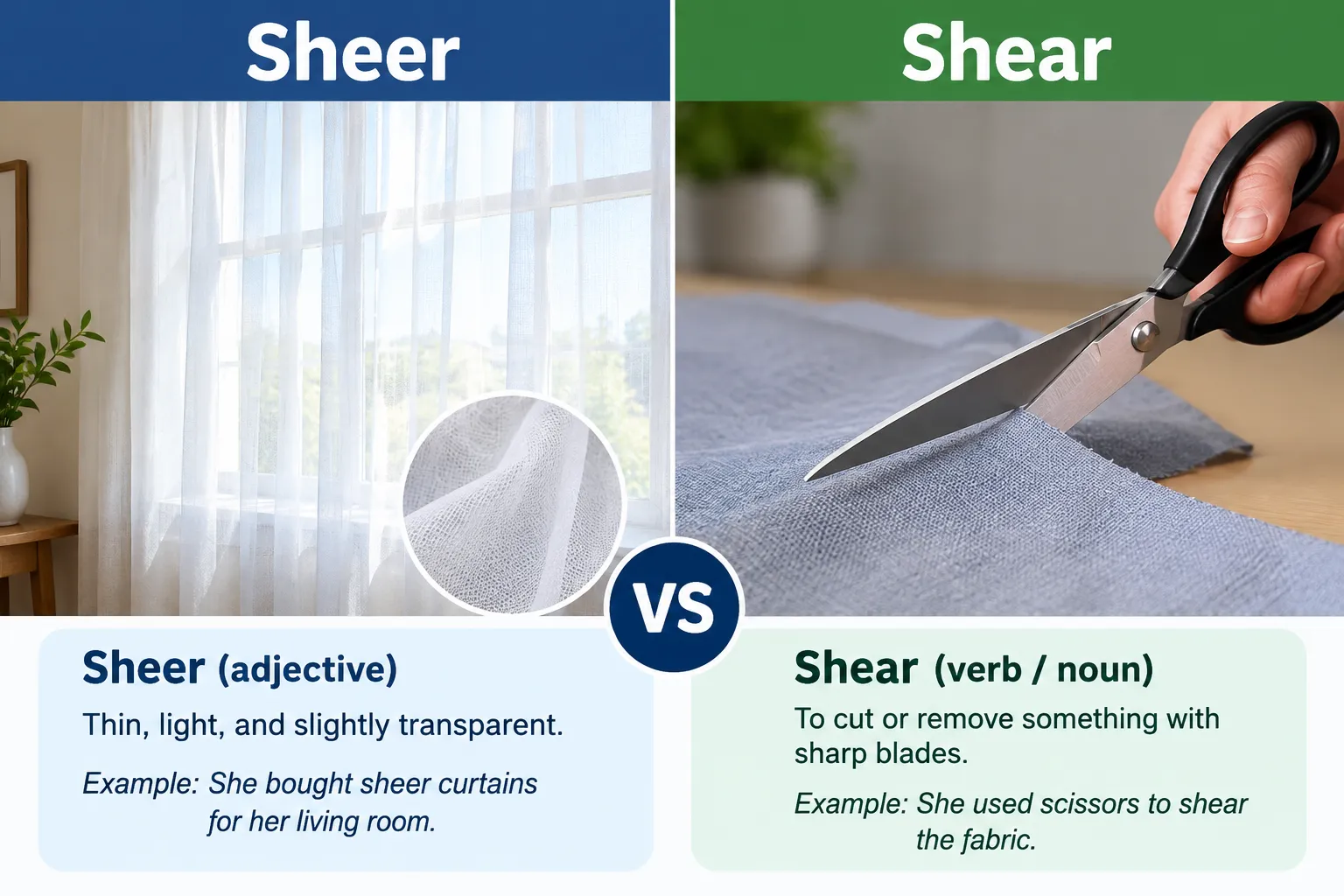
“Sheer” means thin, see-through, or total. “Shear” means to cut, usually with scissors or clippers.
Last spring, my aunt asked me to buy “sheer curtains” for her kitchen window. I almost typed “shear curtains” by mistake while searching online. My phone never caught the slip, since both words are spelled correctly, just not for what I meant. That small mistake showed me how easy it is to swap these two words without noticing.
“Sheer” tells you something is thin, light, or complete, like sheer cloth or sheer joy. “Shear” tells you about cutting, often with a sharp tool, like shearing sheep or shearing metal. People search for “sheer or shear” because both words sound exactly alike out loud, yet they mean very different things in writing. This mix-up shows up in shopping lists, farm talk, and even tech writing about force and materials. Knowing the real gap between sheer and shear helps you skip a mistake that spell check often misses, since both spellings count as real words.
Pronunciation
Sheer
- US English: /ʃɪr/ (say “sheer”)
- UK English: /ʃɪə/ (say “shee-uh”)
Shear
- US English: /ʃɪr/ (sounds just like “sheer”)
- UK English: /ʃɪə/ (sounds just like “sheer”)
Since both words sound the same, let’s look at how they differ in meaning and use.
Read More About https://orlymean.com/blinds-or-curtains/
Difference Between Sheer and Shear
1. Word Type
“Sheer” is mostly a describing word. “Shear” is mostly an action word.
- Example: The curtain was sheer and light.
- Example: The farmer will shear the sheep.
2. Core Meaning
“Sheer” means thin, clear, or complete. “Shear” means to cut or trim.
- Example: Her dress was made of sheer cloth.
- Example: He used shears to trim the hedge.
3. Naming vs Doing
“Sheer” names a trait. “Shear” names an action.
- Example: The cliff had a sheer drop.
- Example: Wind can shear branches off a tree.
4. Use With Fabric
“Sheer” often pairs with cloth, clothes, and light material. “Shear” never names fabric.
- Example: Sheer stockings let light pass through.
- Example: “Shear stockings” isn’t a real phrase.
5. Use With Animals
“Shear” pairs with sheep and wool work. “Sheer” has no tie to farms or animals.
- Example: Farmers shear their sheep each spring.
- Example: “Sheer sheep” would be incorrect.
6. Strong Feelings
“Sheer” often boosts feeling words, meaning full or total. “Shear” carries no emotion at all.
- Example: She felt sheer joy at the news.
- Example: He felt sheer fear during the storm.
7. Noun Form
“Shear” can become a naming word, “shears,” for a cutting tool. “Sheer” rarely becomes a noun.
- Example: She trimmed the bushes with garden shears.
- Example: “Sheerness” exists but is rarely used.
8. Science and Tech Use
“Shear” shows up in engineering, meaning force that makes things slide or split. “Sheer” never appears in this kind of writing.
- Example: Engineers check shear stress on a bridge.
- Example: “Sheer stress” would be a wrong term.
9. Land and Cliffs
“Sheer” describes a steep, almost straight-down drop. “Shear” never describes land at all.
- Example: The climbers avoided the sheer rock face.
- Example: “Shear rock face” would be incorrect.
10. Past Tense
“Shear” shifts to “sheared” or “shorn” in the past tense. “Sheer” stays the same, since it’s a describing word, not an action word.
- Example: The sheep were sheared last week.
- Example: The curtain stayed sheer all year.
How Sheer and Shear Behave
Sheer works like a describing word. It adds detail about thinness, clarity, steepness, or intensity to whatever noun sits beside it. It never shows action, and it stays unchanged no matter the tense.
Shear works like an action word. It shows the act of cutting or trimming, often with force or a sharp tool. It shifts form with tense, and it can also name the cutting tool itself.
Why People Mix Up Sheer and Shear
Both words sound identical when spoken, so pronunciation offers no clue at all for the correct spelling. Since spell checkers recognize both as real words, they rarely flag a mistake, even when the wrong one appears. That leaves meaning and context as the only real guide, which gets tricky when you’re writing fast or typing on a phone without a careful check.
Comparison Table
| Feature | Sheer | Shear |
| Word type | Mostly describing word | Mostly action word |
| Core meaning | Thin, clear, or full | To cut or trim |
| Common use | Fabric, feeling, steep land | Wool, metal, cutting tasks |
| Noun form | Rare (sheerness) | Common (shears) |
| Tech use | Not used | Used in engineering (shear force) |
| Past tense | Stays the same | Becomes “sheared” or “shorn” |
The History of Sheer and Shear
“Sheer” likely traces back to an old Germanic root close to “clear” or “bright,” which explains its link to clarity and openness. Over time, English speakers stretched its meaning to cover steepness and full intensity too, giving us “sheer cliff” and “sheer joy” today.
“Shear” comes from Old English “sceran,” tied directly to the act of cutting. Sheep farming played a major role in early English life, so the need for a clear word about cutting wool kept “shear” in steady use for over a thousand years, with little shift in meaning.
British vs American English
Both British and American English spell “sheer” and “shear” the same way, with no gap in spelling or core meaning between regions. Pronunciation shows a small shift, since British speakers often use a slightly different vowel sound than American speakers, though both stay close.
- Example (US): The fabric felt sheer and light.
- Example (UK): The fabric felt sheer and light.
- Example (US): They will shear the sheep in April.
- Example (UK): They will shear the sheep in April.
Which One Should You Use?
Use “sheer” to describe something thin, see-through, steep, or full of strong feeling. Use “shear” to describe cutting, trimming, or a force that makes things slide or split. This rule holds steady across the US, the UK, and every English-speaking region, since neither word shifts meaning by place.
Common Mistakes
- Wrong: She bought shear curtains for the living room. Correct: She bought sheer curtains for the living room.
- Wrong: The farmer will sheer the sheep tomorrow. Correct: The farmer will shear the sheep tomorrow.
- Wrong: The climbers avoided the shear cliff edge. Correct: The climbers avoided the sheer cliff edge.
- Wrong: Engineers checked the sheer force on the beam. Correct: Engineers checked the shear force on the beam.
Everyday Usage Examples
Email: “Please confirm if the sheer fabric samples arrived for the wedding order.”
Social Media: “Just watched the farmers shear the whole flock at the county fair!”
News: “Engineers say the bridge failed due to unexpected shear stress on the beams.”
Formal Writing: “The report names sheer determination as key to the team’s final win.”
What’s Popular Now
“Sheer” shows up often in fashion writing, poetry, and descriptions of steep landscapes. “Shear” shows up often in farm reports, engineering papers, and grooming content. Search interest in both words stays steady, especially among online shoppers looking for fabric and students studying basic science or engineering terms.
Fun Comparisons
“Sheer willpower” describes drive so strong it feels like a physical force pushing someone forward. “Like a knife shearing through butter” describes something cutting through an obstacle with ease, borrowing the cutting sense from “shear” to show smooth, effortless progress.
How People Feel About Each Word
Positive: “Sheer delight” feels warm and joyful, carrying a strong positive emotion.
Negative: “Sheer panic” feels heavy and stressful, carrying a strong negative emotion.
Neutral: “The farmer will shear the sheep” simply states a fact, with no emotion attached.
Sayings
“By sheer chance” describes something happening with no planning at all. Example: “We met again by sheer chance at the train station.”
“Shear off” describes something breaking away suddenly, often from force or weight. Example: “The branch sheared off during the storm and crashed onto the roof.”
Books and Movies
In literature, “sheer” often appears in poetry about nature and emotion, a habit common in Romantic-era English poems from the late 1700s and early 1800s, when writers frequently used this exact word for cliffs, fabric, and feelings. Farm life, including wool cutting, shows up often in older rural stories and country poems from the same period.
In movies, “sheer” occasionally appears in dramatic dialogue about fear or joy, common in American films exploring intense emotion. Documentaries about farm life, made in places like the UK and Australia, often show sheep-shearing scenes, capturing a skilled process still practiced today.
Why This Matters
Getting “sheer” and “shear” right matters for clear writing in fashion, farming, engineering, and everyday talk. A small mix-up can confuse readers, especially in technical writing, where “shear force” and “sheer force” would mean two very different, even nonsensical, things. For English learners, this pair builds a stronger sense for sound-alike words, a common challenge throughout the language.
How This Helps in Daily Life
You might use “sheer” when shopping for clothes or curtains, or when naming a strong feeling like sheer relief. You might use “shear” when discussing farm work, haircuts, or basic science concepts. Knowing the right word helps you speak clearly in both casual and formal settings.
Which Fits Your Sentence
Choose “sheer” when your sentence involves clarity, thinness, steepness, or strong emotion, like fabric, cliffs, or big feelings. Choose “shear” when your sentence involves cutting, trimming, or a force that makes things slide or split, like farm work or tech reports. When in doubt, ask whether the sentence shows a cutting action; if yes, use “shear.” If it simply names a trait, use “sheer” instead.
Possible Short Questions
Do “sheer” and “shear” sound exactly the same? Yes, both words sound identical in US and UK English.
Can “shear” ever name fabric? No, “shear” never names fabric. Only “sheer” fits there.
Is “shears” the plural of “shear”? “Shears” usually names a cutting tool, like scissors, rather than a plain plural of the action word.
Why does spell check miss this mistake? Both “sheer” and “shear” are spelled correctly, so spell check tools often can’t tell which one matches your intended meaning.
Can “sheer” ever mean cutting? No, “sheer” never means cutting. That sense belongs only to “shear.”
Is “shear” used in science and engineering? Yes, “shear force” and “shear stress” are common terms in physics and engineering.
How can I remember the difference quickly? Picture scissors for “shear,” since both start with an “s” tied to cutting, and picture thin, soft cloth for “sheer.”
Conclusion
“Sheer” and “shear” sound exactly the same, yet they carry very different meanings. “Sheer” describes something thin, clear, steep, or full of strong emotion, while “shear” describes the act of cutting or trimming, often with a sharp tool or strong force. This mix-up happens because sound offers no clue at all, leaving spelling and context as the only real guide.
Understanding this gap helps you write clearly in fashion, farming, engineering, and daily conversation. Whether you’re shopping for sheer curtains or reading about a farmer preparing to shear a flock of sheep, knowing which word fits keeps your writing sharp and clear. Remember this: sheer names a trait, while shear names an action, and that simple split will guide you every time.

I’m Ghafoor Khan, a content writer and blogger at Orly. I write simple, engaging articles on English grammar, word meanings, synonyms, antonyms, and vocabulary to help readers improve their English skills.









1 thought on “Sheer or Shear: The Sound-Alike Words That Trip Up Every Writer”