MLA is for English and story papers. APA is for science papers.
Jake sat in the library at midnight. His paper was due at 9 a.m. His teacher said, “Cite your sources.” Jake did not know which style to use. He felt stuck and tired. He looked at his notes. Nothing helped. He felt more lost by the minute.
This happens to many students. MLA means Modern Language Association. APA means American Psychological Association. Both are styles for writing papers. They tell you how to give credit to other writers. They also tell you how to format your whole paper, not just the citations.
People search mla or apa because teachers do not always explain the rules. Some just say “cite your work” and stop there. This mix-up wastes time. It also causes stress right before a due date. This guide will help you pick the right one fast, so you can stop guessing and start writing.
Pronunciation
- MLA: Say each letter: em-el-AY
- APA: Say each letter: AY-pee-AY
Both are said the same way in the US and UK. No sound changes across these two places.
Read More About https://orlymean.com/mla-or-apa/
Difference Between MLA and APA
1. Full Name
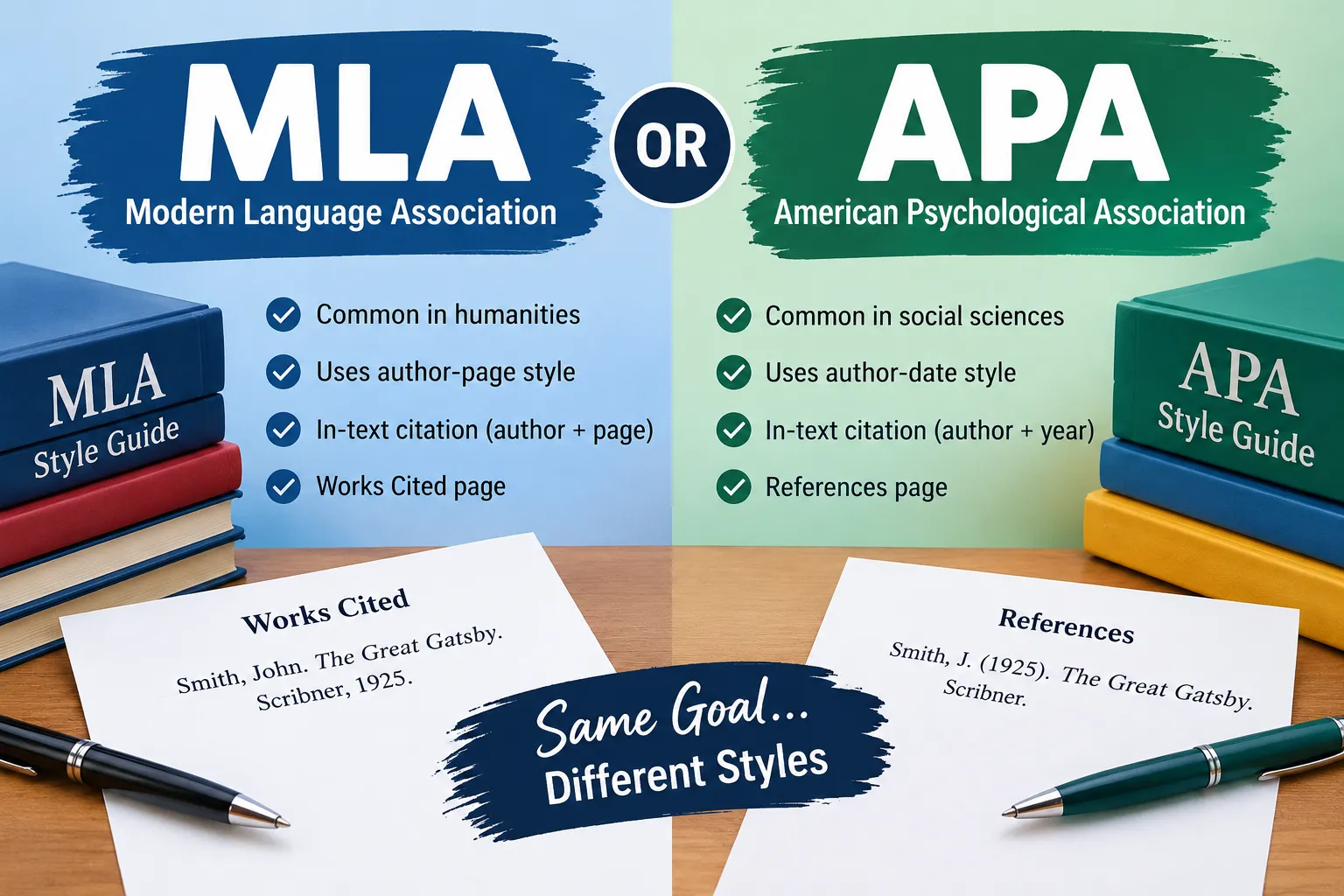
MLA means Modern Language Association. APA means American Psychological Association.
- MLA is for language studies.
- APA is for science studies.
2. Subject Area
MLA fits English and art classes. APA fits science and psychology classes.
- A poem essay uses MLA.
- A science report uses APA.
3. In-Text Citation
MLA uses the author’s name and page number. APA uses the author’s name and year.
- MLA: (Smith 23)
- APA: (Smith, 2020)
4. Source Page Name
MLA calls it “Works Cited.” APA calls it “References.”
- MLA paper ends with “Works Cited.”
- APA paper ends with “References.”
5. Author’s Name
MLA writes the full first name. APA writes only the first letter.
- MLA: Smith, John.
- APA: Smith, J.
6. Title Style
MLA capitalizes most words in a title. APA capitalizes only the first word.
- MLA: The Great Adventure
- APA: The great adventure
7. Focus on Dates
APA cares a lot about the year. MLA cares more about the page number.
- APA: (Lee, 2022)
- MLA: (Lee 45)
8. Page Header
MLA uses the writer’s last name and page number. APA uses a page number, sometimes with a short title.
- MLA: Jake 2
- APA: Page number only, top right corner.
9. Abstract Page
APA often needs a short summary page called an abstract. MLA does not use one.
- APA paper may start with “Abstract.”
- MLA paper starts with the introduction.
10. Who Uses It
English and history teachers often want MLA. Science and psychology teachers often want APA.
- A high school essay uses MLA.
- A college psychology paper uses APA.
Nature and Behaviour
MLA feels easy and open.It tells the story in simple words. It works well for poems, plays, and books. It lets the writer show their own style.
APA feels strict and exact.It uses facts and dates. It is good for science and research. It keeps details clear and neat.
Why People Get Confused
Students take many classes at once. One class wants MLA. Another wants APA. The rules blend together in a busy student’s mind, especially late at night before a paper is due.
Both styles also look alike at first glance. Small rule changes, like a page number versus a year, are easy to miss. A student might copy the wrong example from an old paper and not even notice the mistake until it is too late.
Comparison Table
| Point | MLA | APA |
| Full name | Modern Language Association | American Psychological Association |
| Best subject | English, art | Science, psychology |
| In-text style | (Author page) | (Author, year) |
| Source list name | Works Cited | References |
| Author’s first name | Full name | First letter only |
| Abstract page | No | Often yes |
The Origin
MLA started in 1883. Teachers formed a group to study language and books. They made rules to help writers give credit the same way. Over time, the group made a handbook. This handbook has changed many times to fit new writing needs.
APA started in 1892. It began as a group for psychology. In 1929, they made rules to help scientists write clear papers. Their manual has grown over the years too, since science keeps changing and new topics keep coming up.
Both groups wanted one thing: a fair way to credit other people’s work. That single goal still guides both styles today.
British vs American English
Both styles started in the US. Both use American spelling rules by default.
- US: “The color of the book matters.”
- UK: British writers may still spell words their own way, like “colour,” but they follow the same citation rules.
Many UK schools use a different style called Harvard. But MLA and APA still follow American rules, even when used in the UK. A UK student writing in APA style will still write “References,” not a British version of that word.
Which One Should You Use?
- US: Check your class subject. English classes often want MLA. Science classes often want APA.
- UK: Many schools use Harvard style. Some still ask for MLA or APA, especially in international programs.
- Global: Always check with your teacher first. Never guess on a graded paper. A quick question can save you many lost points.
Common Mistakes
- ❌ “Works Cited” in an APA paper → ✅ Use “References” in APA.
- ❌ Full first name in APA → ✅ Use just the first letter, like “Smith, J.”
- ❌ Only a page number in APA → ✅ Use the year: (Smith, 2020).
- ❌ Capital letters on every word in an APA title → ✅ Capitalize only the first word.
- ❌ An abstract in an MLA paper → ✅ Skip the abstract in MLA.
- ❌ Mixing both styles in one paper → ✅ Pick one style and stay with it the whole time.
Everyday Usage Examples
Email: “Should we use MLA or APA for the final essay?”
Social media: “Just finished my APA reference page! 🎉”
News: “Schools often teach both MLA and APA.”
Formal writing: “This paper follows APA style, as the class requires.”
Usage Trends
MLA stays popular in English and art classes. It gets searched a lot each new school term, since new essays come due every semester.
APA use keeps growing, since more students study psychology, health, and education. Many online tools now help with both styles. Some schools even use citation software that builds the pages for students, though checking the work by hand still matters.
Metaphors and Similes
- “APA is like a scientist’s toolkit.” It is neat and exact.
- “MLA is like a storyteller’s notebook.” It flows with the words.
- “Switching styles feels like changing lanes on a road.”
- “A clean reference page shines like a polished shoe.”
Connotative Meaning
MLA
- Neutral: “The paper follows MLA format.”
- Positive: “Her MLA citations were perfect.”
- Negative: “He lost points for messy MLA format.”
APA
- Neutral: “The report uses APA style.”
- Positive: “The APA sources made the report easy to trust.”
- Negative: “The missing APA citation caused a problem.”
Idioms and Proverbs
There are no old idioms about MLA or APA, since both are modern school terms. But these sayings still fit:
- Dot your i’s and cross your t’s: pay close attention. “Dot your i’s and cross your t’s when you write APA references.”
- The devil is in the details: small errors matter. “In citations, the devil is in the details.”
Literature and Movies
Literature
- The MLA Handbook is a guide book. The Modern Language Association wrote it. The newest version came out in 2021.
- The Publication Manual of the APA is also a guide book. It came out in its newest form in 2020.
Movies
No movie is only about citation styles. But school movies like Legally Blonde (2001, US) show students working hard on papers, hinting at the real pressure behind school writing.
Why This Difference Matters
For learners: Using the right style helps you get better grades. It also keeps your work honest and builds a habit that helps in college and beyond.
For society: Clear citation rules protect other people’s ideas. They help readers trust what they read. They also stop writers from copying work without giving credit.
Usefulness in Daily Life
- Helps you write school papers the right way.
- Helps you avoid copying other people’s work by mistake.
- Helps you sound clear and careful.
- Helps you write reports for work later in life.
- Helps you build trust with teachers and bosses.
Situational Preference
Use MLA for English essays and story reviews. Use APA for science and psychology papers. If you are not sure, check your class notes or ask your teacher. Guessing wrong can cost you grade points, so always check first. If your class mixes subjects, like education or communication, look at old class papers for clues, or simply ask directly rather than guessing on your own.
Possible Short Questions
Q1: What is the main difference between MLA and APA?
MLA uses page numbers. APA uses the year.
Q2: Which style uses “Works Cited”?
MLA uses “Works Cited.” APA uses “References.”
Q3: Does APA need an abstract page?
Often yes. MLA never uses one.
Q4: Which style is easier for beginners?
Many students find MLA a bit simpler at first.
Q5: Can I mix both styles in one paper?
No. Pick one style and use it the whole time.
Q6: Which style do psychology classes use?
Psychology classes almost always use APA.
Q7: Where can I check the right style for my paper?
Check your class syllabus first. Ask your teacher if you are still not sure.
Conclusion
So, mla or apa? The answer depends on your subject. MLA fits English and story papers. It uses page numbers. APA fits science papers. It uses the year.
Both styles share one goal. They help writers give fair credit to other people’s work. They just use different rules to do it.
Remember these easy steps. Check your subject first. Check your class notes next. Ask your teacher if you still feel stuck. These steps save time and stress.
Getting this right builds good writing habits. It shows respect for other people’s work. It also helps you avoid mistakes that could hurt your grade. Next time you feel unsure, remember this simple rule: English leans MLA, and science leans APA. Keep this guide close, and you will never feel stuck like Jake did at midnight again.

I’m Ghafoor Khan, a content writer and blogger at Orly. I write simple, engaging articles on English grammar, word meanings, synonyms, antonyms, and vocabulary to help readers improve their English skills.