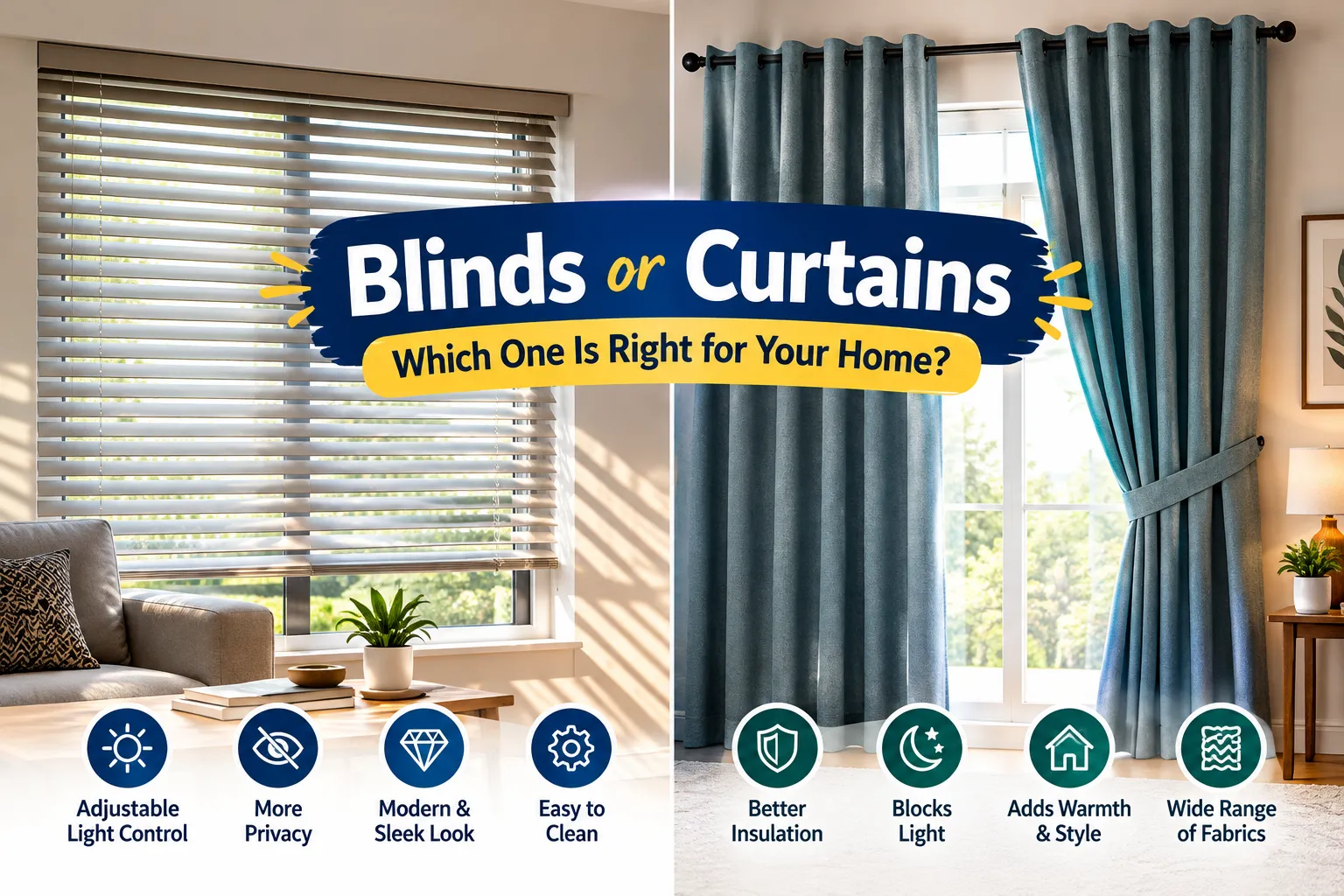
Blinds cover windows with slats or panels, while curtains use hanging fabric.
Imagine you are setting up your bedroom. You want privacy, less sunlight, and a nice look. At the store, you see blinds and curtains. Both cover windows, but they look and work in different ways. Which one should you choose?
Blinds are window covers made with slats or solid panels. You can raise, lower, or tilt many types of blinds. Curtains are pieces of fabric that hang from a rod or track. You can pull them open or close them.
People search for blinds or curtains because they want to make the right choice for their home. Some want a dark room for sleep. Others want soft fabric and a warm look. Some need an easy way to clean their windows.
The best choice depends on your room, budget, and needs. Blinds can offer neat light control. Curtains can add color and comfort. You can also use both together.
Pronunciation
| Word | US Pronunciation | UK Pronunciation |
| Blinds | BLYNDZ | BLYNDZ |
| Curtains | KUR-tənz | KUR-tənz |
Read More About https://orlymean.com/amd-or-intel/
Difference Between Blinds and Curtains
1. Design
- Blinds: Often have slats or solid panels.
- Curtains: Use hanging fabric.
Examples:
- Wooden blinds give a neat look.
- Long curtains add a soft touch.
2. Light Control
- Blinds: Many types let you tilt the slats.
- Curtains: You can open or close the fabric.
Examples:
- Tilt blinds to let in some light.
- Close thick curtains to darken a room.
3. Privacy
- Blinds: Closed slats can block views.
- Curtains: Closed fabric can cover the window.
Examples:
- Use blinds in a bathroom window.
- Use curtains in a bedroom.
4. Cleaning
- Blinds: Often need dusting or wiping.
- Curtains: Many types can be washed, based on their care label.
Examples:
- Wipe dust from vinyl blinds.
- Wash machine-safe cotton curtains.
5. Style
- Blinds: Often give a clean, simple look.
- Curtains: Can make a room feel soft and warm.
Examples:
- Choose blinds for a simple office.
- Choose patterned curtains for a living room.
6. Space
- Blinds: Fit close to the window.
- Curtains: Need room to hang and move.
Examples:
- Use blinds in a small study.
- Hang curtains beside a wide window.
7. Cost
- Blinds: Basic types can be affordable.
- Curtains: Simple curtains can also cost less.
Examples:
- Basic roller blinds may fit a small budget.
- Ready-made curtains may be a low-cost choice.
8. Safety
- Blinds: Some models have cords that may be unsafe for children.
- Curtains: Long fabric can also create risks if poorly placed.
Examples:
- Choose cordless blinds in a child’s room.
- Keep curtain fabric away from heaters.
9. Insulation
- Blinds: Some types help reduce heat loss.
- Curtains: Thick, lined curtains can help keep rooms warm.
Examples:
- Use cellular blinds in cold weather.
- Use lined curtains to reduce drafts.
10. Best Room
- Blinds: Often suit kitchens, offices, and small rooms.
- Curtains: Often suit bedrooms and living rooms.
Examples:
- Fit easy-to-clean blinds in a kitchen.
- Hang thick curtains in a bedroom.
Both options come in many styles. The best one depends on the window and room.
Nature and Behaviour of Blinds and Curtains
Nature of Blinds
Blinds offer a neat look and flexible light control. Many types let you change the angle of the slats. Materials include wood, metal, fabric, and plastic.
Nature of Curtains
Curtains add fabric, color, and texture to a room. They come in many lengths and styles. Thick curtains can block more light than thin ones.
Why People Get Confused About Blinds or Curtains
People get confused because both cover windows. Both can give privacy and reduce sunlight.
The main difference is how they are made and used. Blinds often have slats or panels. Curtains are made from hanging fabric. Some homes use both to get the benefits of each.
Comparison Table
| Feature | Blinds | Curtains |
| Material | Wood, metal, plastic, or fabric | Mostly fabric |
| Light control | Slats can tilt on many models | Open or close the fabric |
| Cleaning | Dust or wipe most types | Wash some types |
| Style | Neat and simple | Soft and decorative |
| Space | Fits close to the window | Needs hanging space |
| Privacy | Depends on design and fit | Depends on fabric and fit |
| Cost | Varies by type | Varies by fabric and size |
| Best use | Kitchens and offices | Bedrooms and living rooms |
The Origin of Blinds and Curtains
People have used fabric and other materials to cover windows for a long time. Early window covers helped block sunlight, wind, and outside views.
Curtains grew from the use of hanging cloth in homes and buildings. Blinds developed in many forms, including wooden slats and later metal and plastic designs.
Today, both types come in many styles. Modern options include roller blinds, Roman blinds, blackout curtains, and smart window covers.
British vs American English
The words blinds and curtains are used in both British and American English.
- US English: People commonly say “blinds” and “curtains.”
- UK English: People also use both words.
US example: “I bought new curtains for my bedroom.”
UK example: “We fitted blinds in the kitchen.”
The spelling stays the same in both forms of English.
Which One Should You Use?
- For bedrooms: Thick curtains or blackout blinds may help block light.
- For kitchens: Easy-to-clean blinds may be useful.
- For offices: Blinds can offer flexible light control.
- For living rooms: Curtains can add color and style.
- For small rooms: Blinds may save space.
- For any room: You can use both together.
Think about your budget, window size, and cleaning needs before you buy.
Common Mistakes
- Mistake: Thinking blinds and curtains are the same.
Correction: Blinds often use slats or panels; curtains use fabric. - Mistake: Thinking all blinds block all light.
Correction: Light control depends on the type and fit. - Mistake: Thinking all curtains can go in a washing machine.
Correction: Always check the care label. - Mistake: Choosing only by looks.
Correction: Check privacy, cleaning, and light control too.
Everyday Usage Examples
- Email: “Should we buy blinds or curtains for the new office?”
- Social media: “These new curtains make my room feel warm.”
- News: “Many homeowners choose window covers to manage light and privacy.”
- Formal writing: “Blinds and curtains offer different ways to cover windows.”
Usage Trends
Blinds and curtains remain common window covers in homes and offices. People choose them for privacy, light control, and style.
Some people prefer smart blinds that work with a remote or app. Others like simple fabric curtains. Choices depend on price, room design, and local needs.
Metaphors and Similes
Blinds and curtains can appear in creative writing.
- “A curtain of rain”: Rain that falls like a wall of fabric.
- “Draw the curtains”: Close the curtains.
- “Behind closed curtains”: Something kept private from others.
These phrases can make writing more vivid.
Connotative Meaning
The words can bring different ideas to mind.
- Blinds: May suggest order, control, and a clean style.
- Curtains: May suggest comfort, warmth, and home life.
- Neutral meaning: Both cover windows and help manage light and privacy.
These are common impressions, not fixed meanings.
Idioms and Proverbs
There are no famous proverbs that compare blinds and curtains directly. However, the word “curtain” appears in common phrases.
- “Draw the curtains”: Close the curtains to block light or views.
- “Behind the scenes”: What happens out of public view. This phrase is not about window curtains in its usual use.
Literature and Movies
Literature
The Secret Garden by Frances Hodgson Burnett is a children’s novel first published in 1911. Curtains and rooms appear in many home settings in classic stories, but they are not the main topic of this book.
Movies
The Others is a mystery and horror film released in 2001. It was made in Spain, France, and the United States. Its dark rooms and covered windows help create a mood, but the film is not about blinds versus curtains.
Why This Difference Matters
The right window cover can make a room more useful and comfortable. It can help control sunlight, give privacy, and support the room’s style.
Blinds may suit people who want easy light control and a simple look. Curtains may suit people who want fabric, color, and warmth. The best option also depends on cleaning needs and cost.
Choosing well can help you make better use of your space. You do not have to choose one for every window. Different rooms can use different covers.
Usefulness in Daily Life
- Sleep: Blackout curtains or blinds can help darken a room.
- Work: Blinds can help reduce glare on a screen.
- Privacy: Both can block outside views.
- Decor: Curtains can add color and texture.
- Cleaning: Pick a cover that fits your cleaning routine.
Situational Preference
Choose blinds when you want a neat look, flexible light control, and a cover that fits close to the window. They may work well in kitchens and offices. Choose curtains when you want soft fabric, color, and a warm feel. Thick curtains can help darken a room and reduce drafts. For a bedroom, you may want blackout curtains or suitable blackout blinds. For a living room, either can work well. Check your budget, window size, and cleaning needs before you decide.
Possible Short Questions
Are blinds better than curtains?
Neither is always better. The right choice depends on your needs and room.
Which is better for a bedroom?
Blackout curtains or blackout blinds can both help block light.
Are blinds easier to clean?
Many blinds are easy to dust or wipe. The best method depends on the material.
Do curtains give more privacy?
Both can give privacy when they fit well and are closed.
Can I use blinds and curtains together?
Yes. Using both can improve light control and add style.
Which costs less?
Both have low-cost and high-cost options. Compare the full price, including fitting.
Which is better for a small room?
Blinds often take up less space. Curtains can still work if there is room to hang them.
Conclusion
Blinds and curtains both help cover windows, but they offer different benefits. Blinds often have slats or panels. They can give flexible light control and a neat look. Curtains use hanging fabric. They can add color, warmth, and style to a room.
The best choice depends on where you want to use them. Blinds may work well in kitchens, offices, and small rooms. Curtains may suit bedrooms and living rooms. Thick curtains and some special blinds can help block light. Both can give privacy when fitted well.
Before you buy, think about your budget, window size, and cleaning needs. Check how much light you want to block. You can also use blinds and curtains together.
In the end, blinds or curtains is not a choice with one answer for everyone. Pick the option that works best for your home. A good window cover should look nice and meet your daily needs.

I’m Ghafoor Khan, a content writer and blogger at Orly. I write simple, engaging articles on English grammar, word meanings, synonyms, antonyms, and vocabulary to help readers improve their English skills.









1 thought on “Blinds or Curtains: Which Is Better for Your Home?”