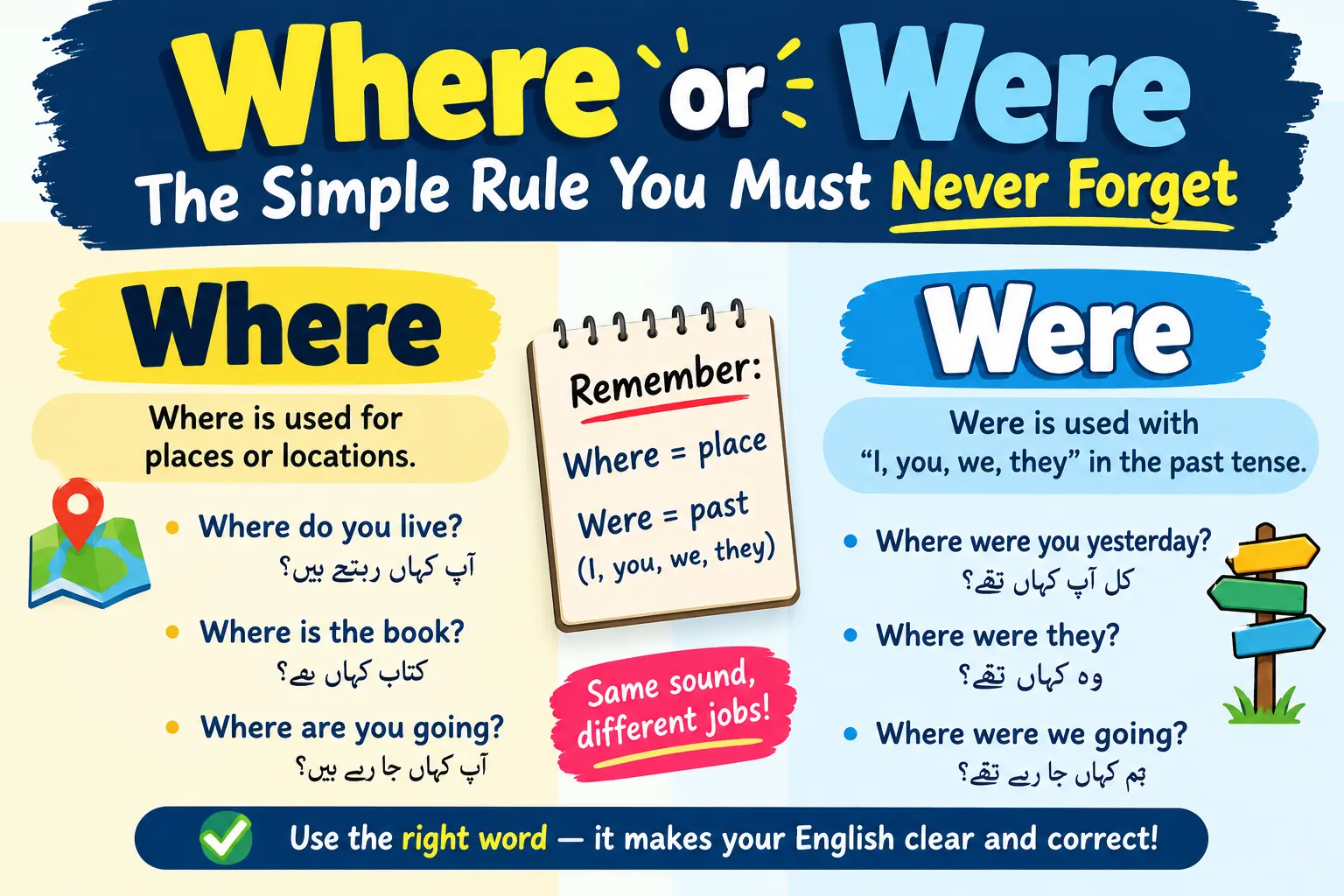
“Where” asks about a place. “Were” is a past tense form of the verb “be.” They sound almost the same, but they mean very different things.
Last month, my cousin sent a message asking, “Were are you right now?” I read it twice. Something felt off. She meant to ask about my location, not the past. I replied, “You mean where, not were!” She laughed and said she always mixes them up. This happens to so many people, every single day, in emails, texts, and even school essays.
“Where” points to a location. It asks or shows a place, like “Where is the store?” “Were” shows a past action or state. It works with plural subjects or “you,” like “They were happy” or “You were late.” People search for “where or were” because these two words sound alike when spoken fast. This small sound similarity creates big confusion in writing. Many learners and even native speakers type one word when they mean the other. Understanding the real difference between where and were helps you write clearly and avoid awkward mistakes in daily communication.
Pronunciation
Where
- US English: /wɛr/ (sounds like “wair”)
- UK English: /wɛə/ (sounds like “wehr”)
Were
- US English: /wɜr/ (sounds like “wur”)
- UK English: /wɜː/ (sounds like “wur,” slightly longer)
- Read More About https://orlymean.com/fact-or-fiction/
Difference Between Where and Were
1. Part of Speech
“Where” is an adverb or conjunction used to ask or show location. “Were” is a verb, the past tense of “be.”
- Example: Where do you live?
- Example: We were at the park.
2. Meaning
“Where” means “in what place.” “Were” means something existed or happened in the past.
- Example: Where is my phone?
- Example: They were tired after the trip.
3. Sentence Role
“Where” often starts a question. “Were” often comes after a subject in a sentence.
- Example: Where did you go?
- Example: You were right about that.
4. Tense Connection
“Where” has no tense. “Were” always shows past tense.
- Example: Where will the meeting happen? (no tense change)
- Example: The kids were playing outside. (past tense)
5. Subject Agreement
“Were” pairs with plural subjects or “you.” “Where” has no subject rule at all.
- Example: We were late.
- Example: Where are we going?
6. Common Pairing
“Were” often pairs with “if” in conditional sentences. “Where” often pairs with question words like “is” or “do.”
- Example: If I were you, I would rest.
- Example: Where is the nearest cafe?
7. Sound Similarity
Both words sound close but not identical. This causes many spelling mistakes in fast typing.
- Example: Where are you? (correct)
- Example: Were are you? (incorrect)
8. Usage in Questions
“Where” leads location questions. “Were” leads past-tense yes-no questions.
- Example: Where did she park the car?
- Example: Were you at the party last night?
9. Grammar Function
“Where” can also join clauses, like a linking word. “Were” only works as a verb, never as a linking word.
- Example: This is the town where I was born.
- Example: They were kind to strangers.
10. Spelling Pattern
“Where” has five letters and starts with “wh.” “Were” has four letters and starts with “we.”
- Example: Where — w-h-e-r-e.
- Example: Were — w-e-r-e.
Nature and Behaviour of Where and Were
Where behaves like a direction pointer in a sentence. It always relates to a place, real or imagined, and often opens a question or connects two ideas about location. It never changes based on time.
Were behaves like a time marker. It shows that something happened before now, and it changes based on the subject in the sentence. It only appears with plural nouns, “you,” or in special conditional sentences like “If I were.”
Why People Get Confused About Where and Were
Both words share three letters, “w,” “e,” and “r.” They also sound similar when spoken quickly in casual talk. Many people type by sound instead of by meaning, especially in text messages. Since English learners often hear these words before they read them, the confusion grows. This mix-up rarely causes total misunderstanding, but it does make writing look careless.
Comparison Table
| Feature | Where | Were |
| Part of speech | Adverb/conjunction | Verb |
| Shows location | Yes | No |
| Shows past tense | No | Yes |
| Used in questions | Yes | Yes |
| Used with plural subjects | No | Yes |
| Common in conditionals | No | Yes (“If I were”) |
| Sounds similar | Yes | Yes |
The Origin of Where
“Where” comes from Old English “hwær,” meaning “at which place.” It has stayed close to this meaning for over a thousand years. Early English speakers used it to ask about location, just as we do today. Over time, spelling shifted slightly, but the core meaning never changed.
British vs American English
Both British and American English spell “where” and “were” the same way. There is no regional spelling difference. Pronunciation shows small variation, with British speakers often using a softer, shorter vowel sound for both words.
- Example (US): Where are you headed?
- Example (UK): Where are you headed?
- Example (US): We were excited.
- Example (UK): We were excited.
Which One Should You Use?
Use “where” whenever you ask about or describe a place. Use “were” whenever you describe a past action with a plural subject, “you,” or a conditional idea. This rule stays the same across the US, the UK, and every English-speaking country. There is no regional exception.
Common Mistakes
- Wrong: Were is the library? Correct: Where is the library?
- Wrong: They where late for the show. Correct: They were late for the show.
- Wrong: I don’t know were she went. Correct: I don’t know where she went.
- Wrong: If I where you, I would leave now. Correct: If I were you, I would leave now.
Everyday Usage Examples
Email: “Where should I send the report? Let me know by Friday.”
Social Media: “We were so proud of the team last night!”
News: “Officials were unable to confirm where the storm would hit next.”
Formal Writing: “The committee members were asked where the funds had gone.”
Usage Trends
Both words appear constantly in daily English, across speech, writing, and search engines. Many people search for the difference between “where” and “were” because autocorrect sometimes fails to catch the mistake. This keeps the topic popular among students, writers, and English learners worldwide.
Metaphors and Similes
“Where the heart is” means home, as in the saying, “Home is where the heart is.” “Were” rarely appears in metaphors, but the phrase “if I were you” often introduces gentle advice, almost like stepping into someone else’s shoes for a moment.
Connotative Meaning
Positive: “Where dreams come true” feels hopeful and warm.
Negative: “Where things went wrong” feels regretful.
Neutral: “Where is the exit?” simply states a fact-based question.
For “were”: Positive: “We were victorious” feels proud. Negative: “They were punished” feels harsh. Neutral: “We were at home” is a plain statement.
Idioms and Proverbs
“Home is where the heart is” shows love for one’s home. Example: “No matter where I travel, home is where the heart is.”
“If I were in your shoes” shows empathy. Example: “If I were in your shoes, I would ask for help too.”
Literature and Movies
In literature, the phrase “where the wild things are” comes from a famous children’s picture book by Maurice Sendak, published in 1963, blending fantasy and adventure genres. The word “were” appears often in classic storytelling, especially in past-tense narration common in novels from the 19th and 20th centuries.
In movies, location-based titles using “where” are common, such as American films from recent decades that explore mystery and travel themes. The word “were” often appears in dialogue describing past events, especially in dramas and historical films made in both the US and UK.
Why This Difference Matters
Confusing “where” and “were” can distract readers from your main point. For learners, mastering this pair builds a strong foundation for understanding verb tenses and question words. For society, clear writing supports better communication in schools, workplaces, and public life, where small errors can create big misunderstandings.
Usefulness in Daily Life
You use both words constantly, from asking directions to describing past events. Knowing the difference helps you write clear texts, emails, and reports without pausing to second-guess your spelling.
Situational Preference
Choose “where” whenever your sentence asks about or describes a location, whether real or imagined. Choose “were” whenever your sentence describes a past action, state, or condition, especially with plural subjects or “you.” In questions about location, always start with “where.” In past-tense statements about groups of people, always use “were.” Keeping this rule in mind helps you avoid quick typing mistakes, especially in text messages and emails written in a hurry.
Possible Short Questions
Is “were” ever used for singular subjects? Yes, in conditional sentences like “If I were you.”
Does “where” ever show time instead of place? No, “where” always relates to location, never time.
Can “were” start a question? Yes, as in “Were you at the meeting?”
Why do these words sound so similar? They share close vowel sounds and only differ by one letter pattern, which causes common mix-ups in speech and writing.
Is one word more formal than the other? No, both words work in formal and informal writing equally.
Can “where” join two sentences together? Yes, as in “This is the house where I grew up.”
How can I remember the difference? Think “where” for place, and “were” for the past. Both start with “w,” but only “were” shows time.
Conclusion
“Where” and “were” look similar and sound close, but they serve very different purposes. “Where” always points to a place, real or imagined. “Were” always shows a past action or state, often with plural subjects or “you.” This small but important difference causes confusion because both words share letters and sounds, especially in fast speech or quick typing.
Once you understand this rule, you can use both words with confidence. Remember that “where” answers the question “in what place,” while “were” answers questions about the past. Whether you write a text message, a school essay, or a business email, keeping this rule in mind helps you avoid common errors.
Practice using both words in simple sentences until the difference feels natural. Over time, you will stop mixing them up, and your writing will feel clearer and more confident.

I’m Ghafoor Khan, a content writer and blogger at Orly. I write simple, engaging articles on English grammar, word meanings, synonyms, antonyms, and vocabulary to help readers improve their English skills.








1 thought on “Where or Were: Master This Tricky Word Pair Today”