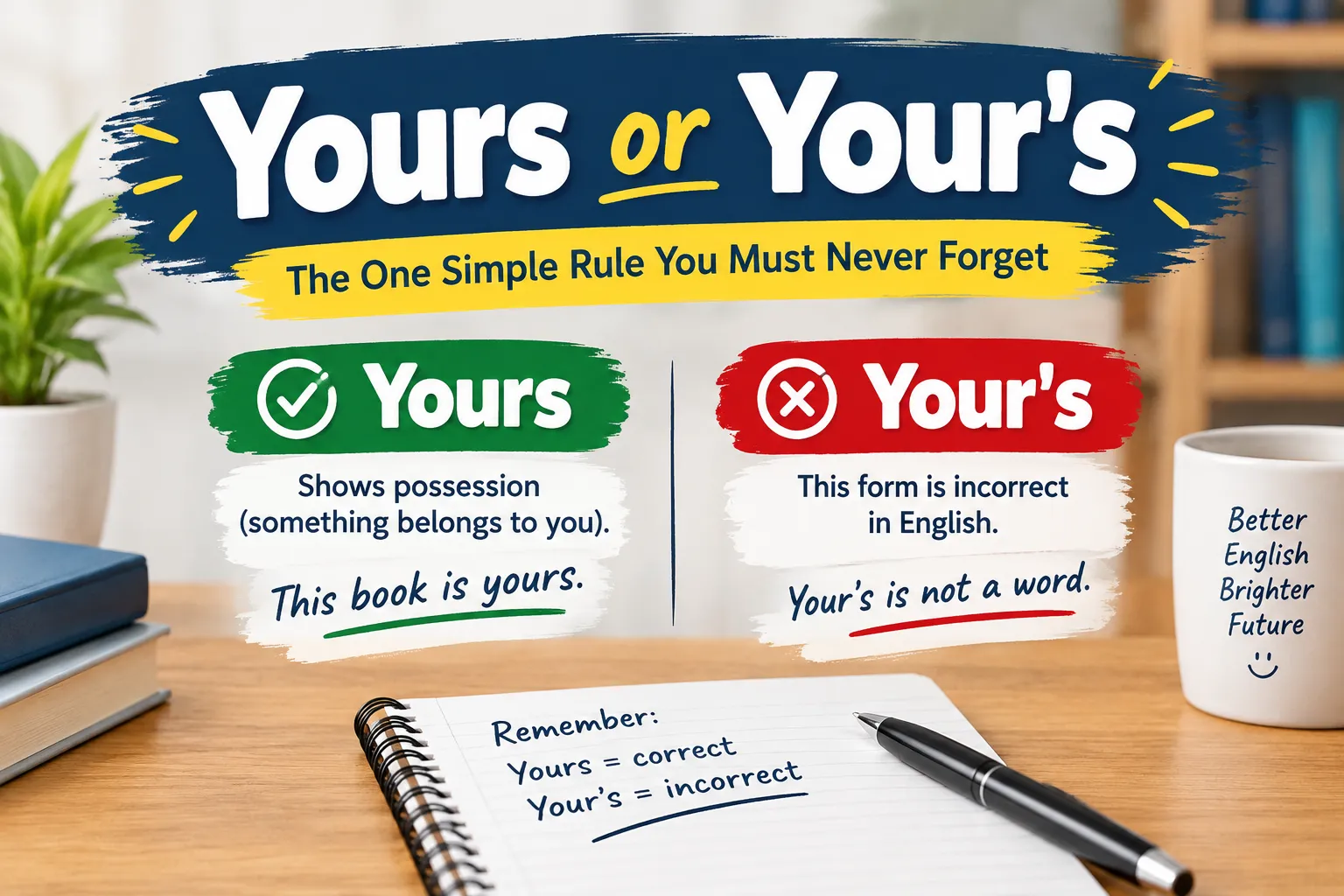
“Yours” is correct. “Your’s” is always wrong. There is no apostrophe in “yours.”
Last week, my friend Sam sent me a text. It said, “Is this bag your’s?” I stared at it for a second. Something looked odd. I typed back, “It’s yours now, buddy — but that apostrophe isn’t.” He laughed. Then he asked, “Wait, why isn’t there an apostrophe?” That’s a fair question. Many people ask it every day.
“Yours” is a possessive pronoun. It shows that something belongs to you. “Your’s” is not a real word. It just looks like it should be real, because we add apostrophes to show ownership in other cases, like “Sam’s bag.” But yours does not follow that rule. This mix-up is one of the most common writing errors in English today.
People search for “yours or your’s” because they feel unsure. They see “it’s” and “your’s” and think they follow the same pattern. They don’t. This small mix-up can make writing look careless, even when the ideas are smart. Understanding yours helps you write with more confidence. Once you learn this rule, you will never doubt yours again.
Pronunciation
Yours
- US English: /jʊrz/ (sounds like “yoorz”)
- UK English: /jɔːz/ (sounds like “yawz”)
Your’s (not a real word, but often mispronounced the same way)
- US English: /jʊrz/
- UK English: /jɔːz/
- Read More About https://orlymean.com/yall-or-yall/
Difference Between Yours and Your’s
1. Correct vs Incorrect Spelling
“Yours” is the correct spelling. “Your’s” is a spelling mistake.
- Example: This pen is yours. ✅
- Example: This pen is your’s. ❌
2. Part of Speech
“Yours” is a possessive pronoun. “Your’s” is not a recognized part of speech at all.
- Example: The choice is yours.
- Example: (There is no correct use for “your’s” in any sentence.)
3. Apostrophe Rule
Possessive pronouns like “yours,” “his,” “hers,” and “its” never take an apostrophe.
- Example: The dog wagged its tail. (not “it’s tail”)
- Example: The win was hers, not yours.
4. Dictionary Status
“Yours” appears in every English dictionary. “Your’s” appears in none.
- Example: Merriam-Webster lists “yours” as standard English.
- Example: You will not find “your’s” listed anywhere.
5. Formal Writing Use
“Yours” is used in formal letters and emails. “Your’s” should never appear in formal writing.
- Example: Yours sincerely, John.
- Example: Your’s sincerely, John. ❌
6. Common Confusion Source
People confuse “your’s” with “it’s” because both look like contractions.
- Example: It’s raining today. (contraction of “it is”)
- Example: Yours is raining today. (wrong idea, but shows the mixed logic)
7. Grammar Checkers
Most grammar tools flag “your’s” as an error. They do not flag “yours.”
- Example: Typing “your’s” in Word shows a red underline.
- Example: Typing “yours” shows no error.
8. Sentence Function
“Yours” replaces a noun phrase, like “your book.” “Your’s” cannot do this correctly.
- Example: Is this book yours? (means “your book”)
- Example: Is this book your’s? (confusing and wrong)
9. Historical Usage
Old English never used an apostrophe for this word. The apostrophe error is a modern mistake.
- Example: Early texts show “yours” without punctuation.
- Example: “Your’s” only shows up in casual, careless modern writing.
10. Native Speaker Habits
Even native speakers sometimes write “your’s” by accident. Non-native learners often copy this error.
- Example: A tired writer types “your’s” in a text message.
- Example: A student learning English repeats the same mistake after seeing it online.
Nature and Behaviour of Yours and Your’s
Yours behaves like a strong, independent pronoun. Stands alone in a sentence. Does not need a noun after it. Shows ownership clearly and simply. For example, “That seat is yours” needs no other word to make sense.
Your’s has no real nature or behavior, because it is not a word.This looks like a typo. It often appears when someone types fast or is unsure about apostrophe rules. It has no fixed grammar role because it is not a real English word.
Why People Get Confused About Yours and Your’s
English has many apostrophe rules. Some words use an apostrophe to show possession, like “Sam’s book.” Other words use an apostrophe to show a contraction, like “it’s” for “it is.” People see this pattern and think all possessive words need an apostrophe. But possessive pronouns break this rule. Words like “yours,” “his,” “hers,” “its,” “ours,” and “theirs” never take an apostrophe. This one exception causes most of the confusion.
Comparison Table
| Feature | Yours | Your’s |
| Correct spelling | Yes | No |
| Found in dictionary | Yes | No |
| Grammar type | Possessive pronoun | Not a word |
| Formal writing use | Yes | Never |
| Apostrophe needed | No | N/A (incorrect) |
| Common in texting errors | No | Yes |
| Accepted in academic writing | Yes | No |
The Origin of Yours
“Yours” comes from Old English. It grew from the word “eower,” which meant “of you.” Over centuries, English speakers shaped it into “your” and then added “s” to form the possessive pronoun “yours.” This change matched other possessive pronouns like “hers” and “ours.” The word settled into its final form without an apostrophe, long before modern punctuation rules existed. “Your’s” never had a historical root. It appeared only recently, as writers mistakenly applied apostrophe rules from other words.
British vs American English
Both British and American English spell “yours” the same way. There is no British version and no American version of this word. The spelling stays fixed across both regions.
- Example (US): This laptop is yours.
- Example (UK): This laptop is yours.
The apostrophe mistake, “your’s,” also appears in both regions equally. It is not a regional style choice. It is simply an error, no matter where the writer lives.
Which One Should You Use?
Always use “yours.” This applies in the US, the UK, Australia, Canada, and every other English-speaking region. There is no situation, formal or casual, where “your’s” is correct. Whether you write an email, a text message, a school essay, or a business letter, choose “yours” every time.
Common Mistakes
- Wrong: This chair is your’s. Correct: This chair is yours.
- Wrong: Your’s sincerely. Correct: Yours sincerely.
- Wrong: Is that coffee your’s? Correct: Is that coffee yours?
- Wrong: The idea was your’s first. Correct: The idea was yours first.
Everyday Usage Examples
Email: “Please find the attached file. Let me know if it matches yours.”
Social Media: “This song is officially yours now. Play it loud!”
News: “The award for Best Actor is yours, said the host, calling the winner’s name.”
Formal Writing: “The responsibility for this decision remains yours.”
Usage Trends
“Yours” is used constantly across all forms of English writing, from casual chats to formal reports. Search data shows many people typing “your’s” by mistake, then searching to check if it is correct. This shows the error is common but shrinking as more people learn the rule through spellcheckers and grammar apps.
Metaphors and Similes
“The stage is yours” means it is your turn to speak or perform, like an actor stepping into the spotlight. “Yours to lose” means you already have an advantage, similar to holding a winning hand in a card game that only you can throw away.
Connotative Meaning
Positive: “This victory is yours” feels warm and celebratory.
Negative: “This mess is yours to clean up” feels like blame.
Neutral: “This seat is yours” simply states a fact without emotion.
Idioms and Proverbs
“Finders keepers, losers weepers” relates to the idea of something becoming yours by chance. Example: “I found the ticket first, so it’s finders keepers — it’s yours now.”
“What’s mine is yours” shows generosity and sharing. Example: “Take anything you need from my kitchen — what’s mine is yours.”
Literature and Movies
In literature, letters often end with the phrase “Yours faithfully” or “Yours truly,” a style common in classic British novels from the 19th century, including works by Charles Dickens. This closing line shows respect and warmth between the writer and reader.
In movies, the word “yours” often appears in dramatic dialogue about choice and fate. For example, in many American films from the 2000s, characters say lines like “The future is yours” to show hope and personal power.
Why This Difference Matters
Small grammar mistakes can shape how people see your writing. A wrong apostrophe might seem tiny, but it can make a resume, email, or school paper look less careful. For English learners, mastering “yours” builds confidence in other possessive pronouns too, like “his,” “hers,” and “theirs.” Getting this right supports clearer communication in school, work, and daily life.
Usefulness in Daily Life
You use “yours” constantly, often without noticing. It shows up in casual talk, business emails, legal documents, and friendly notes. Knowing the correct form saves you from small errors that can distract readers from your main message.
Situational Preference
Always choose “yours” in every situation. There is no case where “your’s” fits better. Whether you write a quick text to a friend, a formal email to your boss, a school essay, or a legal letter, “yours” is the only correct choice. Consistency matters here because using the wrong form even once can confuse readers or make your writing look unpolished. Stick with “yours” everywhere, every time, without exception.
Possible Short Questions
Is “your’s” ever correct? No. “Your’s” is never correct in any form of English.
Why do people add an apostrophe to “yours”? They confuse it with contractions like “it’s,” which use an apostrophe for a different reason.
Does British English spell it differently? No. British and American English both use “yours” without an apostrophe.
Can I use “yours” to end a letter? Yes. “Yours sincerely” and “Yours truly” are both standard letter closings.
Is “yours” formal or informal? “Yours” works in both formal and informal writing.
What other possessive pronouns skip the apostrophe? “His,” “hers,” “its,” “ours,” and “theirs” all skip the apostrophe too.
How can I remember this rule? Think of “yours” like “hers” and “his.” None of these possessive pronouns use an apostrophe.
Conclusion
“Yours” is the only correct spelling. “Your’s” is a common mistake, not a real word. This confusion happens because English uses apostrophes for contractions, like “it’s,” but not for possessive pronouns, like “yours,” “his,” “hers,” “ours,” and “theirs.” Once you understand this one exception, the rule becomes easy to remember and use.
Whether you write a text message, a business email, or a formal letter, always choose “yours.” It works the same way in both American and British English, in casual chats and formal documents. Mastering this small rule helps your writing look more polished and confident. It also strengthens your grasp of other possessive pronouns that follow the same pattern.

I’m Ghafoor Khan, a content writer and blogger at Orly. I write simple, engaging articles on English grammar, word meanings, synonyms, antonyms, and vocabulary to help readers improve their English skills.





1 thought on “Yours or Your’s: The One Simple Rule You Must Never Forget”