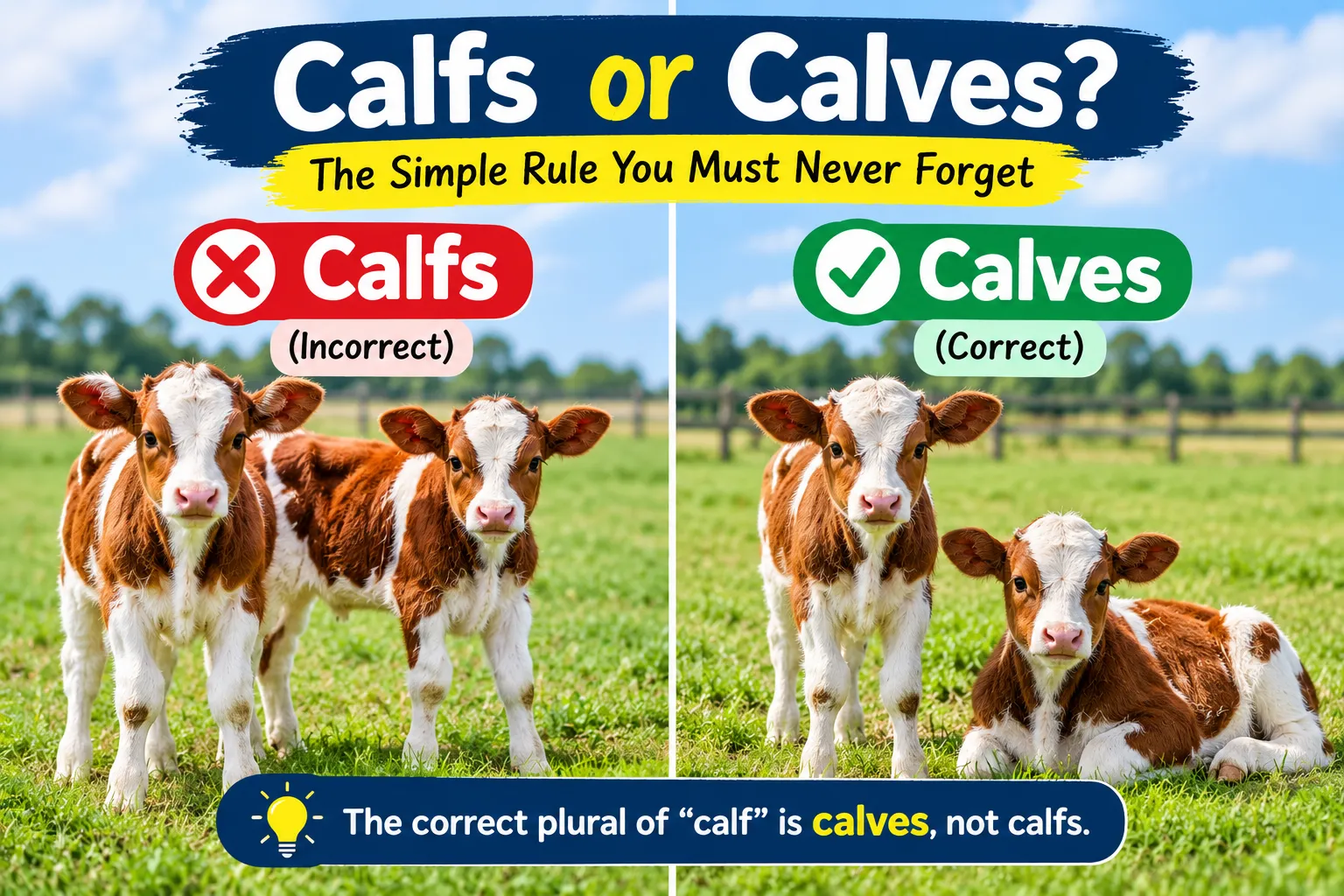
“Calves” is correct. “Calfs” is always wrong. The word “calf” changes its ending when it becomes plural.
Last summer, I visited my uncle’s farm. He pointed at a field and said, “Look at those calves running around.” I smiled and asked, “Why not calfs?” He laughed and said, “Some words just don’t follow the normal rule.” That stuck with me. English often breaks its own pattern, and “calf” is one clear example.
“Calf” means a baby cow. It can also mean the back part of your leg, below the knee. When you talk about more than one, you don’t add “s” like most words. You change the ending to “ves.” So “calf” becomes “calves,” never “calfs.” People search for “calfs or calves” because English usually adds a simple “s” for plurals, like “cats” or “dogs.” This word breaks that pattern, and that surprises many learners and even native speakers. Understanding calves helps you avoid a common spelling mistake in both farm talk and body talk. Once you learn this rule, “calfs” will never confuse you again.
Pronunciation
Calf
- US English: /kæf/ (sounds like “kaf”)
- UK English: /kɑːf/ (sounds like “kahf”)
Calves
- US English: /kævz/ (sounds like “kavz”)
- UK English: /kɑːvz/ (sounds like “kahvz”)
- Read More About https://orlymean.com/yours-or-yours/
Difference Between Calfs and Calves
1. Correct vs Incorrect Spelling
“Calves” is the correct plural. “Calfs” is a spelling mistake.
- Example: The farmer fed three calves. ✅
- Example: The farmer fed three calfs. ❌
2. Word Ending Rule
Words ending in “f” often change to “ves” in plural form. “Calf” follows this rule.
- Example: Leaf becomes leaves.
- Example: Calf becomes calves.
3. Body Part Meaning
“Calf” also means the muscle at the back of your lower leg. Its plural still follows the same rule.
- Example: My calf hurts after running.
- Example: Both of my calves feel sore.
4. Animal Meaning
“Calf” means a baby cow, buffalo, or even a baby whale or elephant. The plural stays “calves” in every case.
- Example: The cow gave birth to a calf.
- Example: Two calves were born on the same day.
5. Dictionary Status
“Calves” appears in every English dictionary as the correct plural. “Calfs” does not appear as a correct form.
- Example: Merriam-Webster lists “calves” as the plural of “calf.”
- Example: “Calfs” shows up only as a common user mistake.
6. Grammar Checkers
Spellcheck tools flag “calfs” as wrong. They accept “calves” without any warning.
- Example: Typing “calfs” in Word shows a red underline.
- Example: Typing “calves” shows no error.
7. Similar Word Patterns
Other words follow the same “f” to “ves” pattern, like “wolf” to “wolves” and “knife” to “knives.”
- Example: One wolf, many wolves.
- Example: One knife, many knives.
8. Common Error Source
People often add just an “s” to “calf” because that’s the normal English rule for plurals.
- Example: Cat becomes cats. (normal rule)
- Example: Calf becomes calfs. (wrong, breaks the rule)
9. Formal Writing Use
“Calves” is used in farming reports, medical writing, and school textbooks. “Calfs” should never appear in formal writing.
- Example: The vet checked all the calves for health issues.
- Example: The vet checked all the calfs for health issues. ❌
10. Native Speaker Habits
Even native speakers sometimes write “calfs” by mistake, especially kids still learning spelling rules. Non-native learners often make the same slip.
- Example: A child writes “calfs” in a school essay.
- Example: A tired writer types “calfs” in a quick note.
Nature and Behaviour of Calfs and Calves
Calves behaves like a normal plural noun once you learn the “f” to “ves” rule. It fits smoothly into sentences about animals or body parts, and it never changes shape again once you use it correctly.
Calfs has no real grammar role, because it is not a correct word. It behaves like a common typo, most often made by people who trust the usual “add an s” rule without checking for exceptions.
Why People Get Confused About Calfs and Calves
Most English plurals just add “s,” like “dogs” or “chairs.” This makes the rule feel automatic. But some words ending in “f” or “fe” change their ending instead, like “half” to “halves” and “leaf” to “leaves.” “Calf” follows this smaller, less common rule. Since this pattern shows up less often, many people forget it and default to adding “s,” creating the wrong word “calfs.”
Comparison Table
| Feature | Calfs | Calves |
| Correct spelling | No | Yes |
| Found in dictionary | No | Yes |
| Grammar type | Not a word | Plural noun |
| Formal writing use | Never | Yes |
| Follows “f” to “ves” rule | No | Yes |
| Common in spelling errors | Yes | No |
| Accepted in academic writing | No | Yes |
The Origin of Calf
“Calf” comes from Old English “cealf,” meaning a young cow. Its plural form shifted over centuries, following a broader pattern in English where many words ending in “f” softened to a “v” sound in plural form. This same shift shaped words like “wife” to “wives” and “shelf” to “shelves.” “Calves” settled into its current spelling long before modern grammar rules were written down. “Calfs” never had a place in this history. It appears only as a modern error made by people unaware of the older sound-shift pattern.
British vs American English
Both British and American English spell “calves” the same way. There is no regional version of this plural. The spelling stays fixed everywhere.
- Example (US): The farm has ten calves.
- Example (UK): The farm has ten calves.
The mistake “calfs” also appears in both regions equally. It is not a style difference between British and American writers. It is simply incorrect, no matter where the writer lives.
Which One Should You Use?
Always use “calves.” This applies in the US, the UK, Australia, Canada, and every other English-speaking region. There is no situation, formal or casual, where “calfs” is correct. Whether you write about farm animals, leg muscles, or a school science report, choose “calves” every time.
Common Mistakes
- Wrong: The farmer has five calfs. Correct: The farmer has five calves.
- Wrong: My calfs hurt after the run. Correct: My calves hurt after the run.
- Wrong: The zoo welcomed two elephant calfs. Correct: The zoo welcomed two elephant calves.
- Wrong: Stretch your calfs before exercise. Correct: Stretch your calves before exercise.
Everyday Usage Examples
Email: “Please confirm the number of calves ready for transport this week.”
Social Media: “Just finished a leg day workout, and my calves are burning!”
News: “Farmers report a healthy season, with over two hundred new calves this spring.”
Formal Writing: “The report tracks calf growth rates and overall herd health across the region.”
Usage Trends
“Calves” appears often in farming reports, fitness content, and biology lessons. Search data shows many people typing “calfs” by mistake, then searching to check the correct spelling. This shows the error is common, especially among students and casual writers, but shrinking as spellcheckers catch the mistake more often.
Metaphors and Similes
“As playful as a calf in spring” describes someone full of energy and joy, like a young calf jumping around a field. “Legs like tree trunks” sometimes describes strong calves, comparing thick leg muscles to solid, sturdy wood.
Connotative Meaning
Positive: “A healthy calf” feels warm and hopeful, often tied to new life on a farm.
Negative: “Weak calves” feels concerning, often linked to poor fitness or injury.
Neutral: “Two calves in the barn” simply states a fact without emotion.
Idioms and Proverbs
“Kill the fatted calf” comes from an old story about celebrating a special return or event with a big feast. Example: “When my brother came home after years abroad, we killed the fatted calf and threw a huge party.”
“Cow-eyed” is not directly about calves, but softness in expression, often linked to gentle, young animals like calves, appears in descriptions of innocence. Example: “She looked at the newborn calf with a cow-eyed gaze of wonder.”
Literature and Movies
In literature, farm life and young animals like calves often appear in classic rural fiction, including pastoral poetry from English writers in the 18th and 19th centuries, which often celebrated simple country scenes. Calves also appear in children’s picture books that focus on farm animals and gentle life lessons.
In movies, farm-based films often show calves as symbols of new beginnings. Family-friendly movies made in the United States, especially those set on farms, often feature scenes with calves to show growth, care, and rural life in a warm light.
Why This Difference Matters
Getting “calves” right matters for anyone writing about farming, fitness, biology, or everyday leg health. A small spelling slip like “calfs” can make writing look careless, especially in reports, school essays, or professional documents. For English learners, mastering this word builds confidence with other tricky plurals that follow the same “f” to “ves” pattern, like “wolves,” “leaves,” and “halves.”
Usefulness in Daily Life
You use “calves” more than you might think, whether talking about sore leg muscles after a workout, describing baby animals on a farm, or reading a biology textbook. Knowing the correct form helps you avoid small errors that can distract from your main point.
Situational Preference
Always choose “calves” in every situation, whether you’re describing farm animals, leg muscles, or writing a formal report. There is no case where “calfs” fits better. Whether you write a quick note to a friend, a fitness log, a farming report, or a school assignment, “calves” is the only correct choice. This consistency matters because using the wrong form even once can confuse readers or make your writing look unpolished. Stick with “calves” everywhere, every time, without exception.
Possible Short Questions
Is “calfs” ever correct? No. “Calfs” is never correct in any form of English.
Why does “calf” change to “calves” instead of just adding “s”? Many English words ending in “f” shift to “ves” in plural form, following an old sound pattern from earlier English.
Does British English spell it differently? No. British and American English both use “calves” as the plural form.
Can “calf” mean something other than a baby cow? Yes. It also means the muscle at the back of your lower leg.
What other words follow the same “f” to “ves” rule? “Leaf” becomes “leaves,” “wolf” becomes “wolves,” and “half” becomes “halves.”
Is “calves” used in medical writing? Yes. Doctors and fitness experts use “calves” when discussing leg muscles.
How can I remember this rule? Think of “leaf” turning into “leaves.” “Calf” follows the exact same pattern.
Conclusion
“Calves” is the only correct plural form. “Calfs” is a common mistake, not a real word. This confusion happens because most English plurals simply add an “s,” but some words ending in “f” shift to “ves” instead, following an older pattern from early English. Once you understand this exception, the rule becomes easy to remember and use correctly every time.
Whether you write about baby cows, sore leg muscles, or a farming report, always choose “calves.” It works the same way in both American and British English, in casual writing and formal documents. Mastering this small rule helps your writing look more polished and confident. It also strengthens your grasp of other tricky plurals that follow the same shift, like “wolves,” “leaves,” and “halves.”

I’m Ghafoor Khan, a content writer and blogger at Orly. I write simple, engaging articles on English grammar, word meanings, synonyms, antonyms, and vocabulary to help readers improve their English skills.










1 thought on “Calfs or Calves: The Correct Plural You Need to Know”