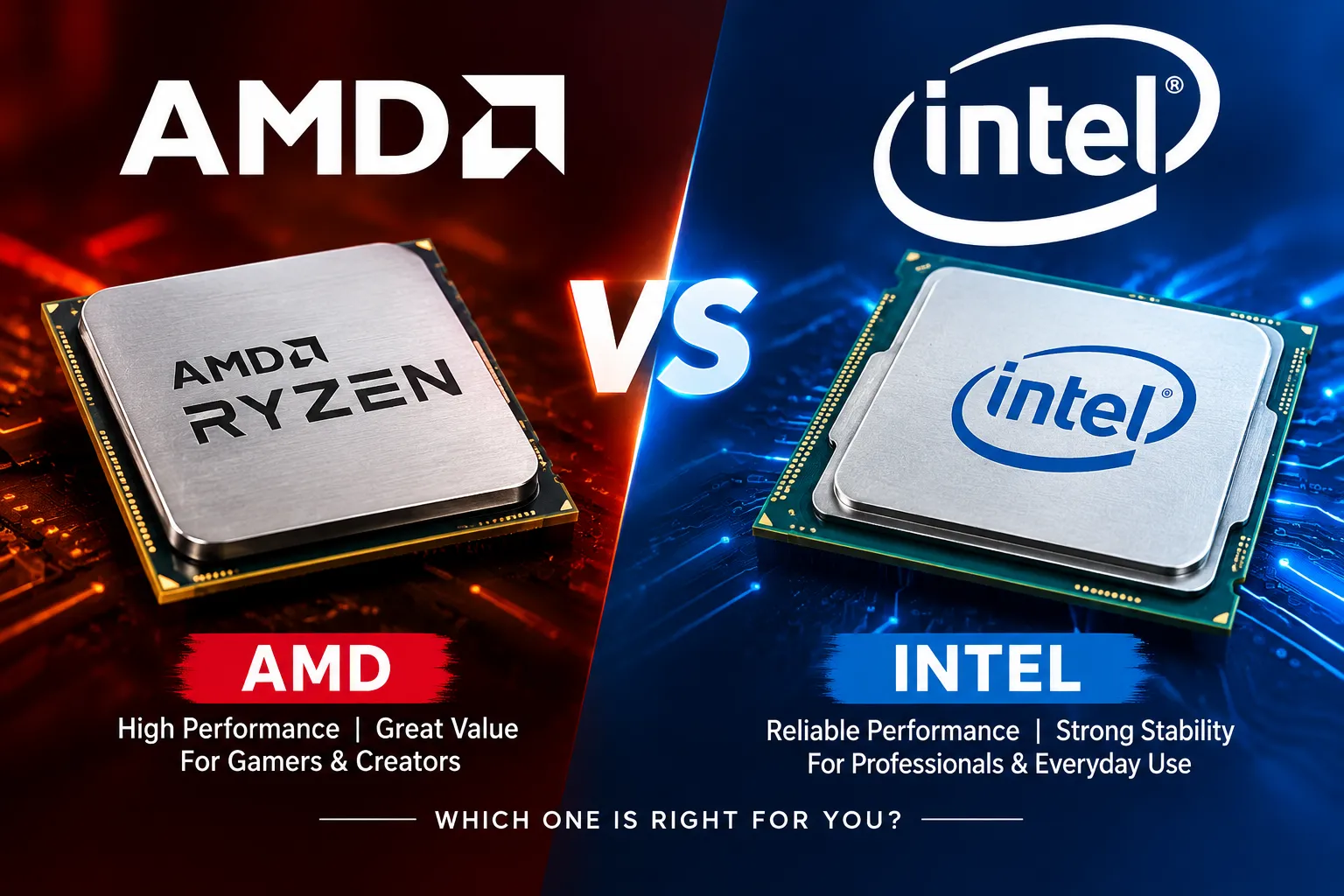
AMD often gives great value, while Intel offers many strong choices for work and gaming.
Imagine you want to buy a new computer. You visit a shop and see two laptops. One has an AMD processor, and the other has an Intel processor. Both look good. Both can run apps and games. So, which one should you choose?
AMD and Intel are two major companies that make computer processors. A processor is also called a CPU. It helps your computer run programs and complete tasks.
People search for AMD or Intel because they want the best computer for their money. Some need a computer for school or office work. Others want to play games or edit videos. Each task may need different features.
The best choice depends on your budget, the processor model, and your needs. AMD can be a good choice for gaming and daily tasks. Intel also offers strong options for work and gaming. Neither brand wins in every case.
In this guide, you will learn the main differences between AMD and Intel. You will also see how to choose the right processor.
Pronunciation
| Word | US Pronunciation | UK Pronunciation |
| AMD | A-M-D | A-M-D |
| Intel | IN-tel | IN-tel |
Read More About https://orlymean.com/medford-or-weather/
Difference Between AMD and Intel
1. Company
AMD and Intel are different companies. Both make computer processors.
- AMD: Makes Ryzen processors.
- Intel: Makes Core processors and other CPU lines.
Examples:
- An AMD Ryzen 5 processor.
- An Intel Core i5 processor.
2. Price
Prices depend on the model and the computer.
- AMD: Offers budget, mid-range, and high-end options.
- Intel: Also offers choices at many price levels.
Examples:
- A budget AMD laptop.
- A mid-range Intel desktop.
3. Gaming
Both brands can run modern games. The results depend on the CPU, graphics card, and game.
- AMD: Some Ryzen chips are great for gaming.
- Intel: Some Core chips also give high gaming speeds.
Examples:
- A Ryzen gaming PC.
- A Core gaming laptop.
4. Speed
No brand is always faster. Each model has different strengths.
- AMD: Some chips are strong at heavy tasks.
- Intel: Some chips are strong at quick tasks and games.
Examples:
- Editing video on a Ryzen PC.
- Running apps on a Core PC.
5. Power Use
Power use changes from one model to another.
- AMD: Some chips use little power.
- Intel: Some chips also offer good power use.
Examples:
- A low-power laptop CPU.
- A desktop CPU built for heavy work.
6. Heat
Processors make heat while working. Cooling helps control it.
- AMD: Needs proper cooling for its power level.
- Intel: Also needs proper cooling.
Examples:
- A laptop with a good fan.
- A desktop with a strong cooler.
7. Office Work
Both brands work well for common office tasks.
- AMD: Can run Word, web pages, and video calls.
- Intel: Can do the same tasks.
Examples:
- Writing school work on a Ryzen laptop.
- Making a report on a Core laptop.
8. Video Editing
Video editing needs a suitable CPU, memory, and graphics setup.
- AMD: Some models work well for editing.
- Intel: Some models also work well for editing.
Examples:
- Editing clips on a Ryzen desktop.
- Making videos on an Intel laptop.
9. Built-in Graphics
Some processors have graphics built in. Others need a separate graphics card.
- AMD: Many models offer built-in graphics.
- Intel: Many models also offer built-in graphics.
Examples:
- A PC using Ryzen built-in graphics.
- A laptop using Intel built-in graphics.
10. Computer Choice
You must check the full computer, not just the brand.
- AMD: Check the exact CPU and other parts.
- Intel: Check the exact CPU and other parts.
Examples:
- A Ryzen laptop with enough memory.
- A Core laptop with a good screen.
Nature and Behaviour of AMD and Intel
AMD
AMD makes processors for laptops and desktop computers. Its Ryzen family includes chips for daily work, gaming, and heavy tasks.
Some AMD processors offer strong gaming results. Others focus on low power use or lower prices. The exact model matters most.
Intel
Intel makes processors for laptops, desktops, and other devices. Its Core family includes models for basic work and high-speed tasks.
Some Intel chips are good for gaming and work. Others are made for thin laptops and low power use. Results depend on the model.
Why People Get Confused About AMD or Intel
People often think one brand is always better. This is not true.
A high-end AMD chip may beat a basic Intel chip. A high-end Intel chip may also beat a basic AMD chip. The price and model matter more than the name alone.
Comparison Table
| Feature | AMD | Intel |
| Main CPU line | Ryzen | Core and other lines |
| Gaming | Strong options | Strong options |
| Office work | Very good options | Very good options |
| Video editing | Depends on model | Depends on model |
| Built-in graphics | Available on some models | Available on some models |
| Price | Many price levels | Many price levels |
| Best choice | Depends on your needs | Depends on your needs |
The Origin of AMD and Intel
Intel began in 1968. It became a major name in computer chips.
AMD began in 1969. It also grew into a major chip maker. Both companies have helped shape the computer industry.
Today, they make processors for many types of computers. Their products keep changing as new models come out.
British vs American English
AMD and Intel are company names. Their spelling is the same in British and American English.
- US English: “I am buying an AMD laptop.”
- UK English: “I am buying an Intel laptop.”
The main difference is not English spelling. It is the processor model and its features.
Which One Should You Use?
- For school: Either brand can work well.
- For office work: Choose a model that fits your budget.
- For gaming: Compare gaming tests for the exact CPU.
- For video editing: Check the CPU, memory, and graphics card.
- For travel: Look at battery life and laptop weight.
There is no single winner for everyone.
Common Mistakes
- Mistake: AMD is always faster.
Correction: Speed depends on the model. - Mistake: Intel is always better for gaming.
Correction: Both brands make strong gaming CPUs. - Mistake: A costly CPU makes every computer better.
Correction: Memory, storage, cooling, and graphics also matter. - Mistake: All Ryzen chips have built-in graphics.
Correction: Check the exact model.
Everyday Usage Examples
- Email: “Should I buy an AMD or Intel laptop?”
- Social media: “Which CPU is better for gaming?”
- News: “AMD and Intel have released new processor models.”
- Formal writing: “The best processor depends on the user’s needs and budget.”
Usage Trends
AMD and Intel remain major names in the CPU market. Both companies release new products over time.
Buyers often compare speed, price, power use, and gaming results. New models can change which chip offers better value. Check recent tests before buying.
Metaphors and Similes
These are simple ways to describe the brands. They are not official technical terms.
- AMD is like a toolbox: It offers many choices for different tasks.
- Intel is like a toolbox: It also offers many choices.
- Example: “Both brands are like runners. The winner depends on the race.”
Connotative Meaning
AMD and Intel are brand names. They have no special dictionary meaning.
- AMD: Some buyers link it with good value and gaming.
- Intel: Some buyers link it with familiar office and home computers.
- Neutral meaning: Both make processors for many needs.
These are common impressions, not rules.
Idioms and Proverbs
There are no common English idioms about AMD or Intel.
You can use normal phrases when talking about them:
- “Compare apples to apples.” Compare similar processor models.
- “Get the best bang for your buck.” Find good value for your money.
Literature and Movies
Literature
The Intel Trinity by Michael S. Malone is a history book about Intel and its early leaders. It was published in 2014.
Movies
There is no widely known movie focused only on AMD versus Intel. Technology documentaries may cover the wider computer chip industry.
Why This Difference Matters
Choosing the right processor can save money and time. A student may need a simple laptop for school. A gamer may need a fast CPU and a good graphics card.
Knowing the difference helps you compare computers fairly. Do not buy a computer based only on its brand. Check the exact processor, price, memory, storage, and battery life.
Usefulness in Daily Life
AMD and Intel processors can support many daily tasks.
- Study: Write notes and attend online classes.
- Work: Use office apps and video calls.
- Gaming: Play games with suitable hardware.
- Creative work: Edit photos and videos.
- Home use: Browse the web and watch videos.
Choose the full computer that meets your needs.
Situational Preference
Choose AMD if a particular Ryzen model offers the speed and price you want. Choose Intel if a particular Core model better fits your needs. Gaming needs a processor tested with your favorite games. School or office work may need only a basic modern processor. Video editing needs a good CPU, graphics, and memory. If you travel often, check battery life and weight. Always compare similar models at similar prices. The best choice is the one that does your work well and fits your budget.
Possible Short Questions
Is AMD better than Intel?
Not always. The best choice depends on the model and your needs.
Is Intel better for gaming?
Not in every case. Both brands make strong gaming processors.
Which is cheaper, AMD or Intel?
Prices vary by model, shop, and country.
Which is better for students?
Both can work well for school and college tasks.
Which is better for video editing?
Compare the exact CPUs, graphics, memory, and software needs.
Do AMD and Intel make laptops?
Both companies make processors used in laptops. Other companies build the laptops.
How do I choose the right processor?
Set your budget, list your needs, and compare recent tests and prices.
Conclusion
AMD and Intel are two major computer chip makers. Both offer processors for school, office work, gaming, and video editing. AMD Ryzen chips can offer great speed and value. Intel Core chips also provide strong options for many users.
There is no single winner for every task. One model may be faster in a game. Another may use less power or cost less. This is why you should compare exact models instead of choosing by brand alone.
Think about what you need from your computer. Check the price, speed, memory, graphics, and battery life. If you want a gaming PC, read tests for your favorite games. If you need a school laptop, focus on value and battery life.
In the end, AMD or Intel depends on your needs and budget. Compare the full computer before you buy. That is the best way to make a smart choice.

I’m Ghafoor Khan, a content writer and blogger at Orly. I write simple, engaging articles on English grammar, word meanings, synonyms, antonyms, and vocabulary to help readers improve their English skills.












1 thought on “AMD or Intel: Which Processor Is Better for Your Computer?”