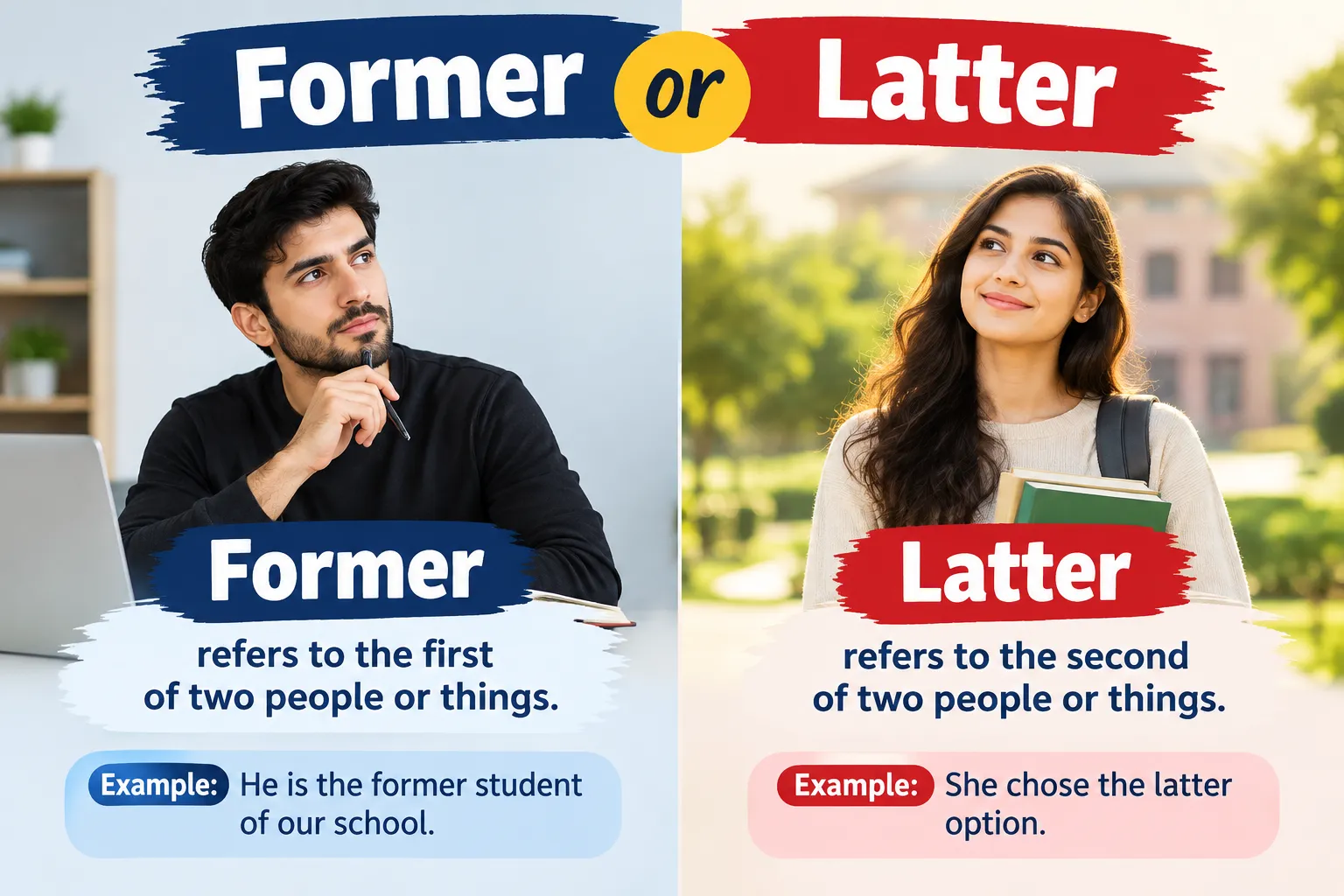
“Former” means the first of two things. “Latter” means the second of two things.
Last week, my sister looked at two job offers. She said, “One pays more. The other has better hours. I’ll take the former.” I stopped and asked, “Wait, which one is that?” She laughed. She said “former” meant the higher-paying job, since she named it first. This mix-up happens a lot. People jump to “former” or “latter” without checking which one came first.
“Former” points back to the first item in a list of two. “Latter” points back to the second item. People search for “former or latter” because you have to remember the order of the words. That can feel hard, most of all in long sentences. This mix-up shows up in essays, work emails, and daily talk, any time someone compares two things. Knowing former and latter helps you speak and write with more clear meaning.
Pronunciation
Former
- US English: /ˈfɔːrmər/ (say “FOR-mer”)
- UK English: /ˈfɔːmə/ (say “FOR-muh”)
Latter
- US English: /ˈlætər/ (say “LAT-er”)
- UK English: /ˈlætə/ (say “LAT-uh”)
- Read More About https://orlymean.com/ninty-or-ninety/
Difference Between Former and Latter
1. Basic Meaning
“Former” means the first of two things. “Latter” means the second of two things.
- Example: Between tea and coffee, I like the former (tea).
- Example: Between tea and coffee, I like the latter (coffee).
2. Place in a List
“Former” points to the first thing named. “Latter” points to the second thing named.
- Example: “Anna and Ben both applied; the former got the job.” (Anna got it)
- Example: “Anna and Ben both applied; the latter got the job.” (Ben got it)
3. Number of Items Needed
Both words work best with just two items.
- Example: “The cat and dog slept; the former looked calm.” (clear, two items)
- Example: “The cat, dog, and bird slept; the former looked calm.” (not clear, three items)
4. How Formal It Feels
Both words feel formal. You see them more in school papers or work reports than in casual talk.
- Example: “The report likes the latter plan.” (formal)
- Example: “I like the second one better.” (plain)
5. Time Meaning
“Former” can also mean something from the past. “Latter” does not have this extra meaning.
- Example: “The former mayor spoke today.” (used to be mayor)
- Example: “The latter mayor” is not a normal phrase.
6. Where It Sits in a Sentence
Both words show up after you name both items.
- Example: “Books and movies both entertain me, though I like the former more.”
- Example: “Books and movies both entertain me, though I like the latter more.”
7. Words They Go With
“Former” often pairs with “latter” in the same sentence.
- Example: “The former was pricey; the latter was cheap.”
- Example: “The former felt rushed; the latter felt calm.”
8. Memory Load for the Reader
Both words ask the reader to recall the first order. This can be hard in a long sentence.
- Example: A short line stays clear: “Pizza and salad; I chose the latter.”
- Example: A long line can lose the reader: “After thinking about pizza, salad, and the mood in the room, I chose the latter.”
9. Written vs Spoken Use
Both words show up more in writing than in spoken talk.
- Example: A report might say, “The latter plan works better.”
- Example: In talk, people often just say, “the second one.”
10. Style and Feel
Using “former” and “latter” gives writing a neat, sharp feel, most of all in essays and reports.
- Example: “The former plan failed, while the latter worked.” (neat)
- Example: “The first one failed, but the second one worked.” (plain)
How Former and Latter Act
Former acts like a pointer back to the start of a list. It points to the item named first. It can also mean something from the past, like a former job.
Latter acts like a pointer to the second item in the same pair. It does not carry the “past” meaning that “former” has.
Why People Mix Up Former and Latter
The mix-up happens because both words ask you to hold on to the order named before. If a sentence lists more than two items, or the items sit far apart, it’s easy to lose track. Since neither word says the item’s name again, you must think back to check the right meaning.
Comparison Table
| Feature | Former | Latter |
| Points to | First item named | Second item named |
| Works with | Two items only | Two items only |
| Extra meaning | Can mean “past” | No extra meaning |
| Formal level | Formal | Formal |
| Common use | Essays, reports | Essays, reports |
| Often paired with | Latter | Former |
The History of Former and Latter
“Former” comes from Old English “forma,” meaning “first” or “earliest.” It ties to the word “fore,” which means something that comes before. Over time, “former” grew to mean both the first item in a list and something from the past. “Latter” comes from Old English “lætra,” a word close to “late,” meaning something that comes after. Both words grew through old English forms into the spelling we use today.
British vs American English
Both British and American English spell “former” and “latter” the same way. Both places use these words mostly in formal writing. There is no gap in meaning or spelling between the two.
- Example (US): “The former plan cost too much.”
- Example (UK): “The latter plan felt safer.”
Which One Should You Use?
Use “former” and “latter” only when you compare two named items. Using them with three or more items makes things unclear. This rule is the same in the US, the UK, and all English-speaking places. In plain talk, “the first one” or “the second one” often works better and sounds more natural.
Common Mistakes
- Wrong: Using “former” or “latter” with three or more items. Correct: Use them only with two items.
- Wrong: Mixing up which item is “former” and which is “latter.” Correct: Check the first order before you pick “former” or “latter.”
- Wrong: Using “latter” to mean “the past,” like “former” can. Correct: Only “former” carries that past meaning.
- Wrong: Using “former” and “latter” too much in daily talk. Correct: Save these words for formal writing.
Everyday Usage Examples
Email: “We checked both vendors; the latter gave a better price.”
Social Media: “Coffee or tea in the morning? I’m firmly in the former camp.”
News: “Two people spoke; the former talked about jobs, the latter about health care.”
Formal Writing: “This study compares two teaching styles, and picks the latter for better long-term results.”
What’s Popular Now
“Former” and “latter” still show up a lot in school papers, news, and work reports, most of all when comparing two clear choices. In plain talk and texts, people tend to say “the first one” or “the second one” instead.
Fun Comparisons
“Like a former glory now faded” describes something that used to be great but is not great anymore. This ties to “former’s” past meaning. There’s no strong saying built around “latter,” but you might hear “the latter path” to talk about a final choice.
How People Feel About Each Word
Positive: “The former champion” can feel warm, honoring someone’s past win.
Negative: “The former friend” can feel sad, hinting at a broken bond.
Neutral: “The latter choice” just states a plain fact.
Sayings
There’s no well-known saying built just for “former” or “latter,” since both are tools for clear, formal comparison. But phrases like “in days of yore” carry a past feel close to “former.” Example: “In days of yore, in his former glory, the king ruled with care.”
Books and Movies
In books, “former” and “latter” show up a lot in essays. This style goes back to old English writers from the 1600s and 1700s, who used these words to build clear, sharp points. This style stays common in nonfiction writing today.
In movies, “former” often shows up in a title, like “former detective” or “former soldier.” This is common in American crime films, to hint at a person’s past life. “Latter” shows up less in movie talk, since it fits better in formal writing.
Why This Matters
Knowing “former” and “latter” helps writers make clear, neat points without saying the same word twice. For students and workers, these words add sharp, clean style to essays and reports. For readers, spotting these words fast stops confusion when reading a formal piece.
How This Helps in Daily Life
While rare in daily talk, “former” and “latter” show up in work emails, news, and school papers. Knowing how to use them helps you sound clear and sharp when you compare two things in writing.
Which Fits Your Sentence
Use “former” and “latter” in formal writing, like reports, essays, and work emails, when you compare two clear items. Skip them in daily talk or texting, where “the first one” or “the second one” sounds more natural. In long or tricky sentences, name the item again instead of using “former” or “latter,” to keep things clear for your reader.
Possible Short Questions
Can I use “former” and “latter” with three or more items? No, they work best with just two items.
Does “former” always mean “the past”? Not always. It can mean “the first item named” or “something from the past.”
Can “latter” mean “the past” too? No, only “former” carries that meaning.
Are these words common in spoken talk? They show up more in writing than in daily speech.
Do I need to name two items first before using these words? Yes, both words need two named items before them in the sentence.
Is it wrong to say “the first one” instead of “former”? No, that’s a fine, more casual choice.
Why do these words sound formal? They come from old English forms and are often used in neat, structured writing.
Conclusion
“Former” and “latter” are sharp words used to point back to two named items. “Former” means the first item. “Latter” means the second item. Mix-ups happen because both words need the reader to recall the first order, most of all in long or tricky sentences.
Knowing this rule helps you write clean, clear points in essays, reports, and work writing. These words fit best in formal writing, but knowing them also helps you follow news and old books with ease. Just remember: “former” points to what came first, and “latter” points to what came second. Use them only when you compare two clear items.

I’m Ghafoor Khan, a content writer and blogger at Orly. I write simple, engaging articles on English grammar, word meanings, synonyms, antonyms, and vocabulary to help readers improve their English skills.




2 thoughts on “Former or Latter: The Two Words That Point Back in Time”