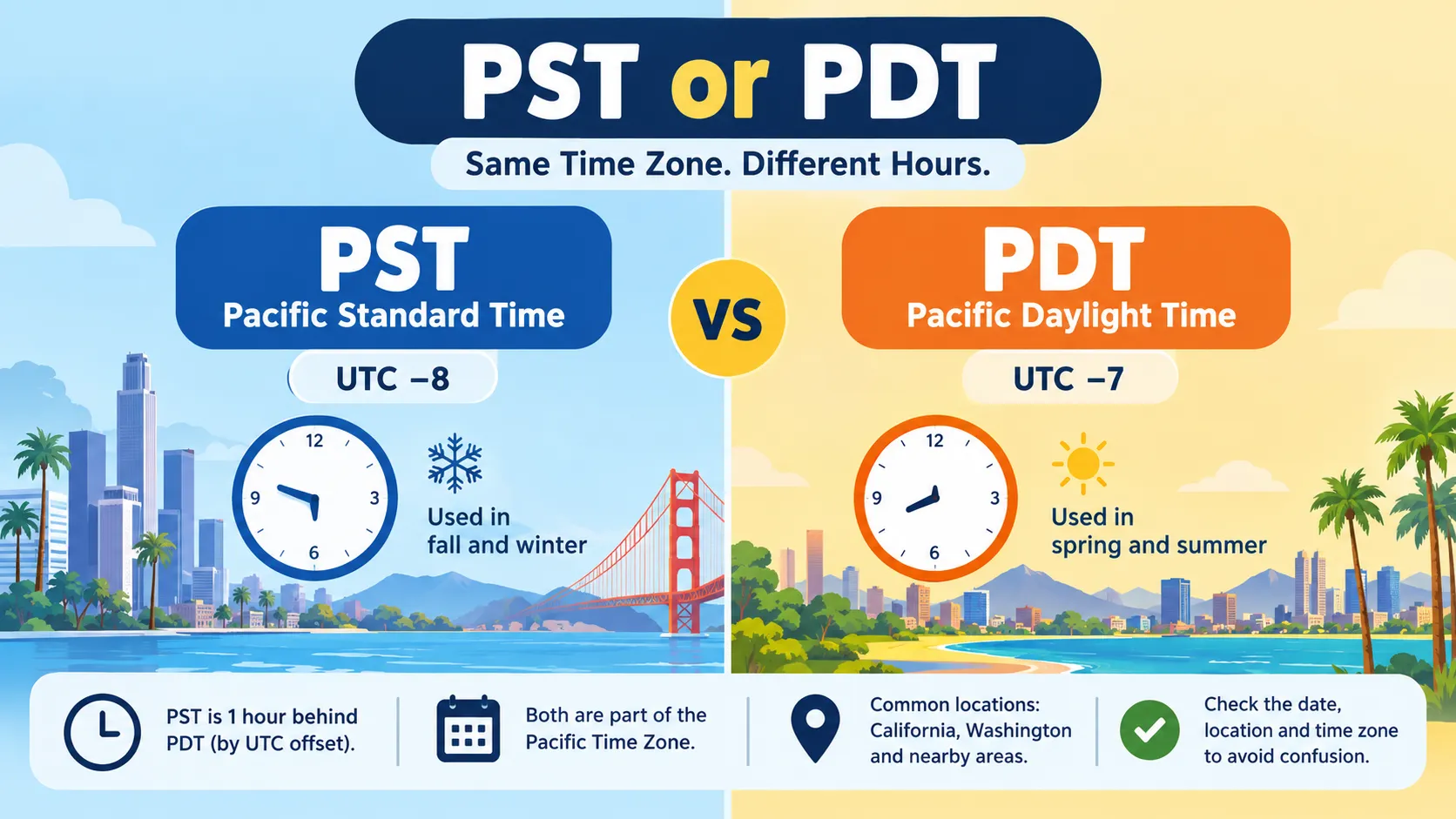
PST is Pacific Standard Time, used in winter. PDT is Pacific Daylight Time, used in summer. They are the same region, but a different time of year.
Last spring, I set up a video call with a friend in Los Angeles. I wrote “3 PM PST” in the invite. She replied, “It’s PDT now, not PST.” I felt confused. I thought PST was just the west coast time zone, full stop. Turns out, the name changes twice a year, even though the place stays the same.
This mix-up happens to many people. PST stands for Pacific Standard Time. PDT stands for Pacific Daylight Time. Both describe time on the west coast of the United States and parts of Canada, but they apply at different times of the year. PST runs during the colder months. PDT runs during the warmer months, when clocks move forward one hour for daylight saving time. People search for “PST or PDT” because meetings, flights, and online events often list one or the other, and it’s easy to use the wrong one without noticing. Knowing the real difference between PST and PDT helps you avoid missed calls, late arrivals, and confused messages across time zones.
Pronunciation
| Word | US Pronunciation | UK Pronunciation |
|---|---|---|
| PST | Pee-Ess-Tee | Pee-Ess-Tee |
| PDT | Pee-Dee-Tee | Pee-Dee-Tee |
Both abbreviations are usually spoken by saying each letter. The pronunciation is nearly the same in American and British English.
Read More About https://orlymean.com/former-or-latter/
Difference Between PST and PDT
1. Full Name
PST stands for Pacific Standard Time. PDT stands for Pacific Daylight Time.
- Example: “The meeting starts at 9 AM PST” means standard winter time.
- Example: “The meeting starts at 9 AM PDT” means daylight summer time.
2. Time of Year
PST applies in fall and winter. PDT applies in spring and summer.
- Example: In January, the west coast uses PST.
- Example: In July, the west coast uses PDT.
3. Clock Difference from UTC
PST is 8 hours behind UTC. PDT is 7 hours behind UTC.
- Example: Noon UTC is 4 AM PST.
- Example: Noon UTC is 5 AM PDT.
4. Daylight Saving Connection
PST is used when daylight saving time is off. PDT is used when daylight saving time is on.
- Example: Clocks “fall back” in November, starting PST.
- Example: Clocks “spring forward” in March, starting PDT.
5. Regions That Use It
Both PST and PDT apply to the same regions, including California, Washington, Oregon, and parts of Nevada.
- Example: San Francisco uses PST in winter.
- Example: San Francisco uses PDT in summer.
6. Everyday Confusion
People often use “PST” all year long by habit, even during PDT months.
- Example: An email says “3 PM PST” in July, but it should say PDT.
- Example: A website lists office hours as “9 AM PST” without updating for summer.
7. Airline and Travel Listings
Flight schedules and travel apps switch automatically between PST and PDT based on the date.
- Example: A flight in December shows arrival time in PST.
- Example: A flight in June shows arrival time in PDT.
8. Business Communication
Companies often just say “Pacific Time” to avoid picking between PST and PDT.
- Example: “Join us at 10 AM Pacific Time” works year-round.
- Example: “Join us at 10 AM PST” only works correctly in winter.
9. International Meetings
Global teams must adjust their own local time based on whether the west coast is in PST or PDT.
- Example: A London team adds 8 hours to convert from PST.
- Example: A London team adds 7 hours to convert from PDT.
10. Length of Use
PST covers about four to five months of the year. PDT covers about seven to eight months of the year, since daylight saving time runs longer than standard time.
- Example: PST runs roughly from early November to mid-March.
- Example: PDT runs roughly from mid-March to early November.
Nature and Behaviour of PST and PDT
PST acts like the region’s default winter setting. It appears automatically once daylight saving time ends each fall, and it stays in place until spring.
PDT acts like the region’s summer boost. It shifts clocks one hour ahead to make better use of evening daylight, and it stays active through most of spring, summer, and early fall.
Why People Get Confused About PST and PDT
Most people don’t think about time zones changing twice a year. They learn “PST” as the name for west coast time and keep using it, even after clocks shift in March. Since the actual location never changes, only the season does, the mix-up feels small but causes real scheduling problems, especially for international calls and online events.
Comparison Table
| Feature | PST | PDT |
| Full name | Pacific Standard Time | Pacific Daylight Time |
| Season used | Fall and winter | Spring and summer |
| Offset from UTC | UTC minus 8 hours | UTC minus 7 hours |
| Daylight saving active | No | Yes |
| Typical months | Nov to March | March to Nov |
| Region | US and Canada west coast | US and Canada west coast |
| Common in | Winter schedules, flights | Summer schedules, flights |
The History of PST and PDT
Standard time zones, including Pacific Standard Time, were set up in the late 1800s to help railroads run on a consistent schedule across the United States. Daylight saving time came later, first used during World War I to save energy by using more natural daylight in the evening. Pacific Daylight Time became a regular yearly practice through laws like the Uniform Time Act of 1966, which set consistent start and end dates for daylight saving across most of the US.
Which One Should You Use?
Use PST only during fall and winter months, roughly from early November to mid-March. Use PDT during spring and summer months, roughly from mid-March to early November. If you’re unsure of the exact date, or writing something that will stay posted year-round, use the safer label “Pacific Time” instead of picking PST or PDT directly. This advice applies whether you’re scheduling something for the US, Canada, or an international team working with west coast partners.
Common Mistakes
- Wrong: Writing “3 PM PST” for a July meeting. Correct: Writing “3 PM PDT” for a July meeting.
- Wrong: Assuming PST and PDT are the same offset from UTC. Correct: Remembering PST is UTC minus 8, and PDT is UTC minus 7.
- Wrong: Using “PST” as a general year-round label. Correct: Using “Pacific Time” when the season isn’t clear.
- Wrong: Forgetting that daylight saving shifts the clock forward, not backward. Correct: Remembering clocks move ahead one hour for PDT.
Everyday Usage Examples
Email: “The webinar starts at 2 PM PDT on Thursday, July 10th.”
Social Media: “Tune in live at 6 PM PST this Friday for our winter event!”
News: “The press conference is scheduled for 10 AM PDT from Los Angeles.”
Formal Writing: “All submission deadlines are listed in Pacific Standard Time (PST) unless stated otherwise.”
Usage Trends
PST and PDT show up constantly in tech company announcements, streaming schedules, and airline bookings, since many major US companies operate from the west coast. Search interest in “PST or PDT” often rises around daylight saving changes in March and November, when people double check which label to use.
Why This Difference Matters
Getting PST and PDT right matters for anyone working across time zones, booking flights, or joining online events. A wrong label can cause someone to join a call an hour early or late, miss a flight connection, or misread a deadline. For international teams, understanding this shift helps avoid repeated scheduling errors twice a year.
Usefulness in Daily Life
You run into PST and PDT often, whether checking flight times, joining a video call with west coast colleagues, or watching a live-streamed event. Knowing which one applies helps you avoid small but frustrating scheduling mistakes.
Situational Preference
Use PST specifically when referring to a date between early November and mid-March. Use PDT specifically when referring to a date between mid-March and early November. If you’re writing content that will stay online for a long time, such as a website footer or a recurring event listing, use “Pacific Time” instead, since it stays accurate no matter the season. For one-time events with a fixed date, always match the label to the correct season to avoid confusion.
Possible Short Questions
Is PST the same as Pacific Time? Not exactly. “Pacific Time” is a general term that includes both PST and PDT, depending on the season.
Why does the time zone name change twice a year? Because daylight saving time shifts clocks forward in spring and back in fall, changing PST to PDT and back again.
Does Arizona use PST or PDT? Most of Arizona stays on standard time year-round and does not observe daylight saving time, so it stays close to PST all year.
How many hours behind is PDT from UTC? PDT is 7 hours behind UTC.
Do all US states switch between PST and PDT? No. Only regions that observe daylight saving time switch. A few areas, like most of Arizona, do not change.
Is it safe to just say “Pacific Time” instead of choosing PST or PDT? Yes, especially for recurring events or content that stays online across seasons.
When exactly does PST switch to PDT each year? It usually switches in mid-March, when daylight saving time begins, and switches back in early November.
Conclusion
PST and PDT both describe time on the same west coast region, but they apply during different seasons. PST stands for Pacific Standard Time and covers fall and winter. PDT stands for Pacific Daylight Time and covers spring and summer, when clocks move one hour ahead for daylight saving. This small shift causes real confusion because people often use one label out of habit, even after the season changes.
Understanding this difference helps you avoid missed meetings, wrong flight times, and confusing schedules, especially when working with international teams. If you’re ever unsure which one to use, the term “Pacific Time” works safely in both seasons. Keep this rule in mind: PST for the colder months, PDT for the warmer months, and you’ll never mix them up again.

I’m Ghafoor Khan, a content writer and blogger at Orly. I write simple, engaging articles on English grammar, word meanings, synonyms, antonyms, and vocabulary to help readers improve their English skills.