Prilosec builds up slowly and lasts long. Pepcid works fast but fades sooner.
Sam feels a burning pain in his chest after dinner. He goes to the store. He sees two rows of heartburn pills. One box says Prilosec. One box says Pepcid. He stops. He does not know which one to pick. Many people feel the same way.
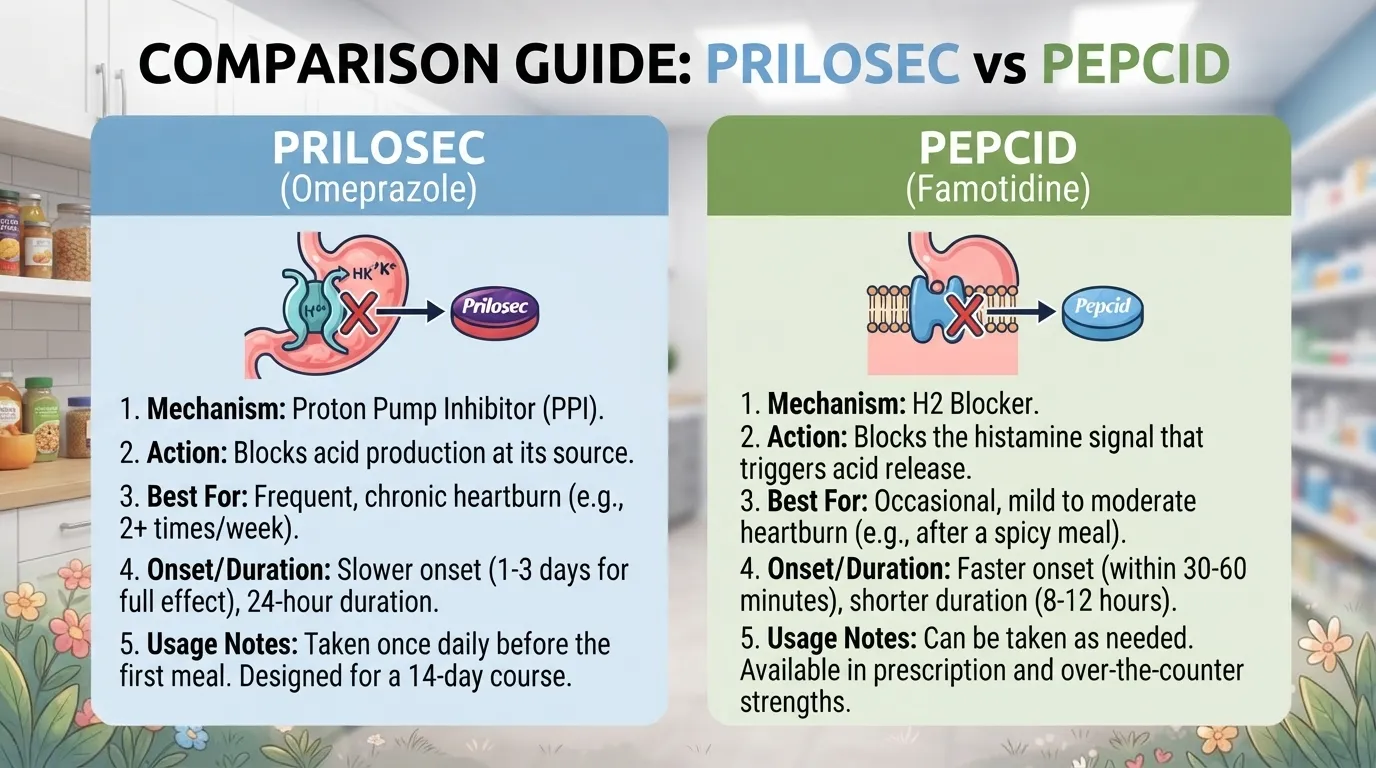
Prilosec and Pepcid both treat heartburn and acid reflux. Doctors call this GERD when it happens often. But Prilosec and Pepcid do not work the same way. Prilosec comes from a drug group called proton pump inhibitors, or PPIs. Pepcid comes from a group called H2 blockers. This one fact explains most of the mix-up between Prilosec and Pepcid.
People search “Prilosec vs Pepcid” because both sit on the same shelf. Both treat the same pain. But they act in different ways, and they work on different time frames. This mix-up sends many shoppers to check facts before they even pay.
Pronunciation
Prilosec
- US: “PRY-luh-sek”
- UK: “PRY-luh-sek” (same sound)
Pepcid
- US: “PEP-sid”
- UK: “PEP-sid” (same sound)
Difference Between Prilosec and Pepcid
1. Drug class
Prilosec is a proton pump inhibitor. Pepcid is an H2 blocker. This is the core difference.
- Example: Prilosec shuts down acid pumps in the stomach.
- Example: Pepcid blocks histamine signals that trigger acid.
2. Speed of relief
Pepcid works fast. Prilosec works slow but strong.
- Example: Pepcid can ease burning in 30–60 minutes.
- Example: Prilosec may take 1–4 days for full effect.
3. Duration of action
Pepcid lasts hours. Prilosec lasts a full day.
- Example: Pepcid covers a big dinner tonight.
- Example: Prilosec covers all-day acid control.
4. Best use case
Pepcid suits occasional flare-ups. Prilosec suits frequent, chronic heartburn.
- Example: Pepcid before a spicy meal.
- Example: Prilosec taken daily for two weeks straight.
5. Onset pattern
Prilosec needs steady daily use to reach full strength. Pepcid works the same each single dose.
- Example: Day 1 of Prilosec may feel weak.
- Example: Pepcid feels the same on day 1 and day 10.
6. Strength of acid suppression
Prilosec blocks acid more completely. Pepcid blocks acid partially.
- Example: Prilosec near-stops acid production.
- Example: Pepcid lowers acid but doesn’t stop it fully.
7. OTC dosing course
OTC Prilosec is meant for a 14-day course. OTC Pepcid can be used more as-needed.
- Example: Prilosec box says “one pill a day for 14 days.”
- Example: Pepcid box allows dosing when symptoms hit.
8. Drug interactions
Prilosec can affect how some other drugs absorb. Pepcid has fewer such interactions.
- Example: Prilosec can change absorption of certain heart or HIV drugs.
- Example: Pepcid is often chosen when a person takes many other medicines.
9. Withdrawal / rebound effect
Stopping Prilosec suddenly after long use can cause rebound acid. Pepcid has less rebound.
- Example: Someone stops Prilosec and feels worse acid for a few days.
- Example: Someone stops Pepcid and symptoms just fade normally.
10. Typical user
Prilosec suits someone with frequent, chronic symptoms. Pepcid suits someone with occasional symptoms or fast relief needs.
- Example: A person with heartburn most days picks Prilosec.
- Example: A person who gets heartburn only after big meals picks Pepcid.
Nature and Behaviour of Prilosec and Pepcid
Prilosec acts slow and steady. It blocks active acid pumps in the stomach, but the body keeps making new pumps each day. This is why it can take up to 4 days to reach full effect. Once it works, though, it keeps acid low for up to 3 days.
Pepcid acts fast. It blocks one signal, histamine, that tells the stomach to make more acid. It reaches its peak in just 1 to 3 hours, but its effect fades within about half a day, so it often needs a second dose.
Why People Get Confused About Prilosec and Pepcid
You can find both in the same store aisle. They come as pills and can help relieve heartburn.Since they look alike and treat the same pain, people think they are the same type of medicine. But they come from two different drug groups, with different speeds, different lengths of relief, and different side effects.
Comparison Table
| Feature | Prilosec (Omeprazole) | Pepcid (Famotidine) |
| Drug type | Proton pump inhibitor | H2 blocker |
| Typical dose | 20 mg once a day | 20 mg twice a day |
| Time to peak | Up to 4 days for full effect | 1 to 3 hours |
| How long it lasts | Up to 72 hours | About 10–12 hours |
| Often used for | Ongoing GERD | Occasional heartburn, or added at night |
| Similarity | Both lower stomach acid | Both lower stomach acid |
| Sold over the counter | Yes, short-term use only | Yes, short-term use only |
The Origin of Prilosec
Omeprazole, the main part in Prilosec, came from a Swedish drug company in the 1980s. It was one of the first proton pump inhibitors sold to people. Prilosec first needed a doctor’s note. Later, in the early 2000s, it moved to store shelves for anyone to buy.
Famotidine, the main part in Pepcid, also came from research in the 1980s. It gave people a stronger, easier H2 blocker option. Pepcid moved to store shelves in the 1990s.
British vs American English
There is no spelling change for these brand names in US or UK English, since both are trademark names.
- US: “I took Prilosec this morning.”
- UK: “I took Prilosec this morning.” (though UK stores often use the plain name omeprazole more than the brand name)
General Guidance on Choosing Between the Two
This part gives general facts, not personal advice.
- For ongoing GERD: Doctors often prefer PPIs like Prilosec, since they tend to help the esophagus heal better over time.
- For fast, short-term relief: Pepcid can work within a few hours, which helps with sudden or occasional heartburn.
- For nighttime symptoms: A doctor may add Pepcid to a daily Prilosec plan.
- When unsure: A pharmacist or doctor can look at your health history and pick the best fit.
Common Mistakes
- Wrong: Taking Prilosec and hoping for fast, same-hour relief. Right: Prilosec can take up to 4 days for full effect. It is not a quick fix.
- Wrong: Using either medicine past 2 weeks OTC with no doctor check. Right: Longer use should involve a doctor’s advice.
- Wrong: Thinking both drugs work the exact same way. Right: They come from two different drug groups with different actions and risks.
Everyday Usage Examples
Email: “Hi Dr. Lee, I’ve taken Prilosec every morning for two weeks. Should I keep going?”
Social Media: “Doctor added Pepcid at night since my Prilosec wasn’t enough. Feeling better now!”
News: “Experts remind shoppers that Prilosec and Pepcid work in different ways and have different risks.”
Formal Writing: “Patients using Prilosec should know full relief may take up to four days.”
Usage Trends
Both stay popular search terms, mostly around holidays and big meals, when heartburn cases rise. Prilosec searches often go up for daily, ongoing symptoms. Pepcid searches often go up for fast relief.
Metaphors and Similes
“Prilosec works like a slow-closing valve, turning down acid bit by bit.” “Pepcid works like a quick switch, shutting off one acid signal fast.” These are simple pictures, not exact science.
Connotative Meaning
Prilosec
- Neutral: “Prilosec is a common heartburn pill.”
- Positive: “Prilosec gave her steady relief that lasted for days.”
- Negative: “She felt tired of waiting for Prilosec to fully kick in.”
Pepcid
- Neutral: “Pepcid is sold in most stores.”
- Positive: “Pepcid helped him feel better within a few hours.”
- Negative: “Pepcid’s relief faded faster than he wanted.”
Idioms and Proverbs
There are no old idioms built around Prilosec or Pepcid, since both are modern brand names. Some people use a casual phrase like “pop a Pepcid” to mean quick relief, as in “He just popped a Pepcid and went back to the party.”
Literature and Movies
Brand names like Prilosec and Pepcid do not show up in old books or big movies, since both are modern drugs. But health and wellness writing, a popular style since the early 2000s, often talks about both drugs for everyday readers.
Why This Difference Matters
Knowing the difference helps people pick the right pill and use it the right way. It helps them see why one drug takes days to work, while the other acts within hours.
Usefulness in Daily Life
- Helps shoppers read store labels with more care.
- Helps people build smart questions for the doctor.
- Helps people avoid the wrong pill for their type of pain.
Situational Preference
People with heartburn most days often use daily PPIs like Prilosec, since studies show they help the esophagus heal better over time. People with occasional or sudden heartburn may reach for Pepcid, since it works within a few hours. Some people use both, with Prilosec in the morning and Pepcid at night, but only under a doctor’s care. The right choice always depends on each person’s own health, other medicines, and how often symptoms happen.
Possible Short Question
Q1: Are Prilosec and Pepcid the same type of medicine? No. Prilosec is a proton pump inhibitor. Pepcid is an H2 blocker. They lower stomach acid in different ways.
Q2: Which one works faster? Pepcid usually works faster, reaching peak effect in 1 to 3 hours. Prilosec can take up to 4 days for full effect.
Q3: Can I take both at the same time? Yes, in some cases. A doctor may add Pepcid at night if daily Prilosec does not fully control symptoms.
Q4: Is one drug more effective than the other? Studies show PPIs like Prilosec often work better for healing the esophagus in ongoing GERD. Pepcid is still FDA approved and effective for many people.
Q5: How long can I use these over the counter? Both are meant for short-term use, often up to 2 weeks, without a doctor’s OK for longer use.
Q6: Do they have different side effects? Yes. Pepcid can cause agitation, especially in infants. Prilosec can cause gas. Long-term Prilosec use has also been linked to low vitamin B12, low magnesium, and higher fracture risk.
Q7: Should I ask a doctor before I choose? Yes. A doctor or pharmacist can check your health history and other medicines before picking the best option for you.
Conclusion
Prilosec and Pepcid sit on the same store shelf, but they are not the same. Prilosec is a slow-building PPI that can take days to reach full strength, but it then lasts up to 3 days. Pepcid is a fast-acting H2 blocker that starts within hours but fades within about half a day. This one fact explains most of the mix-up shoppers feel when they stand in the drugstore aisle.Knowing how each pill works helps people make smart choices and use each one the right way. It also helps them watch for side effects and drug interactions, since both can affect how the body absorbs other medicines. Since studies often show Prilosec works better for healing ongoing GERD, while Pepcid offers fast, short-term relief, the right pick depends on how often the pain happens and each person’s own health.This article gives general facts only, not medical advice. Anyone with ongoing or serious heartburn should talk to a doctor or pharmacist before choosing between Prilosec and Pepcid, to find the safest and best fit for their body.

I’m Ghafoor Khan, a content writer and blogger at Orly. I write simple, engaging articles on English grammar, word meanings, synonyms, antonyms, and vocabulary to help readers improve their English skills.