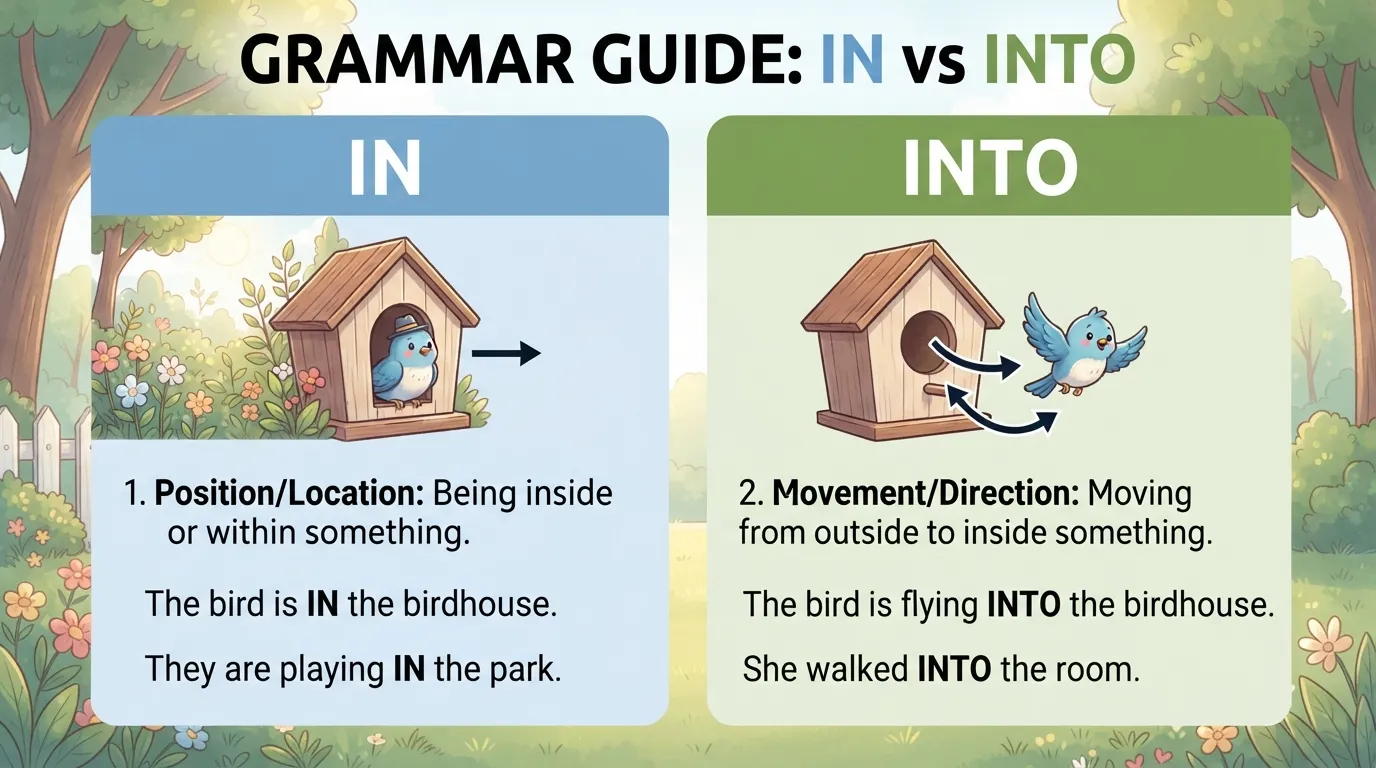
“In” shows a place. “Into” shows movement toward a place.
Tom walked in the kitchen. His mom stopped him. “You mean you walked into the kitchen,” she said. Tom paused. He didn’t get it. Aren’t “in” and “into” the same word?
They are not. “In” tells you where something already is. “Into” tells you where something is going. This small change can shift the whole meaning of a sentence.
People search for “in vs into” because these two words look almost the same. They sound alike. They even mean close things. But mixing them up can make writing sound off. Some sentences need “in.” Some need “into.” A few sentences can use either one, but the meaning still shifts a little.
Once you learn the pattern, you will use in and into the right way every time. You will also spot the small difference between in and into in books, emails, and everyday talk.
Pronunciation
In
- US: “in” (/ɪn/)
- UK: “in” (/ɪn/) — same sound
Into
- US: “IN-too” (/ˈɪntuː/)
- UK: “IN-too” (/ˈɪntuː/) — same sound
Now let’s look at the real differences between in and into.
Difference Between In and Into
1. “In” shows a fixed place. “Into” shows movement to a place.
- “The cat is in the box.” (already there)
- “The cat jumped into the box.” (movement)
2. “In” can describe a state or condition. “Into” cannot.
- “She is in love.”
- “He is in trouble.”
3. “Into” always needs motion. “In” does not.
- “He walked into the room.” (motion)
- “He stood in the room.” (no motion)
4. “In” can show time. “Into” rarely shows time the same way.
- “We will meet in June.”
- “We will meet into June.” (sounds wrong)
5. “Into” often pairs with action verbs like run, jump, or fall.
- “She fell into the pool.”
- “He ran into the store.”
6. “In” often pairs with state verbs like be, sit, or stay.
- “They are in the car.”
- “She sits in the front row.”
7. “Into” can show a change in form.
- “Water turns into ice.”
- “The tadpole grew into a frog.”
8. “In” cannot show a change in form the same way.
- “Water is in the cup.” (location, not change)
- “The tadpole is in the pond.” (location, not change)
9. “Into” can mean interest or hobby in casual talk.
- “I’m really into hiking.”
- “She’s into old movies.”
10. “In” is often used with fixed phrases and idioms.
- “In time”
- “In fact”
Nature and Behaviour of In and Into
In acts like a “place word.” It tells you where something sits, rests, or stays. It also shows time, state, or a fixed idea, like “in love” or “in trouble.”
Into acts like a “movement word.” It shows action heading toward a spot or a new state. It always carries a sense of change or motion.
Why People Get Confused About In and Into
Both words look and sound almost the same. Many people learn them together and stop noticing the small difference. In fast talk, both words can even sound alike. This makes writers use them the same way, even when the meaning should shift.
Comparison Table
| Feature | In | Into |
| Shows location | Yes | No |
| Shows movement | No | Yes |
| Shows change of state | No | Yes |
| Used with state verbs (is, sit, stay) | Yes | No |
| Used with action verbs (run, jump, fall) | Sometimes | Yes |
| Common in idioms | Yes | Less common |
| Similarity | Both relate to space or place | Both relate to space or place |
The Origin of Into
“Into” comes from Old English. It formed by joining “in” and “to.” Old English speakers used “in to” as two separate words at first. Over time, writers joined them into one word, “into,” to show a clear sense of movement toward something.
“In” also comes from Old English. It traces back even further to Old Germanic roots. It has stayed a short, simple word for over a thousand years, always pointing to a place or state.
British vs American English
There is no real spelling difference between in and into in US and UK English. Both countries use the same forms and rules.
- US: “She walked into the store.”
- UK: “She walked into the store.”
Some British speakers use “in” a bit more loosely in casual talk, like “get in the car,” where American English may lean toward “get into the car” for cars and small spaces.
Which One Should You Use?
- US: Use “into” for motion toward a space, like cars or buildings. Use “in” for a fixed state or place.
- UK: Same core rule, though “in” shows up more in casual speech about entering vehicles.
- Global: Use “into” when action or change is clear. Use “in” when the subject is already settled in place.
Common Mistakes
- Wrong: “He walked in the room and sat down.” (if he was moving toward the room) Right: “He walked into the room and sat down.”
- Wrong: “She is into the kitchen right now.” Right: “She is in the kitchen right now.”
- Wrong: “The juice turned in vinegar.” Right: “The juice turned into vinegar.”
Everyday Usage Examples
Email: “Please step into my office when you get a chance.”
Social Media: “Just moved into my new apartment! So excited!”
News: “The car crashed into a fence on Main Street.”
Formal Writing: “The committee will look into the matter further.”
Usage Trends
“Into” shows up a lot in casual speech, especially to talk about hobbies, like “I’m into music.” “In” stays common in daily writing for location and time. Both words remain steady in use across news, social media, and books.
Metaphors and Similes
- “He fell into a deep sleep” uses “into” to show a shift into a new state, not real motion.
- “She poured her heart into the project” shows deep effort, not literal movement.
“In” also shows up in figurative use, like “she’s in a good mood” or “he’s in deep trouble,” showing state rather than place.
Connotative Meaning
In
- Neutral: “The keys are in the drawer.”
- Positive: “She’s in high spirits today.”
- Negative: “He’s in trouble with his boss.”
Into
- Neutral: “He walked into the hall.”
- Positive: “She’s really into painting these days.”
- Negative: “The car crashed into a wall.”
Idioms and Proverbs
- “In time” — meaning things will work out eventually.
- “Don’t worry, it will all make sense in time.”
- “Get into trouble” — meaning to cause or find a problem.
- “He always gets into trouble at school.”
Literature and Movies
Literature: Alice’s Adventures in Wonderland, a fantasy novel by Lewis Carroll from 1865, uses “into” often to show Alice’s movement between worlds, like falling into the rabbit hole.
Movies: Into the Wild (2007), a film from the United States, uses “into” right in its title to show a journey toward the unknown.
Why This Difference Matters
For learners, knowing when to use in or into helps writing sound clear and correct. For daily talk, this small shift can change the whole meaning of a sentence. Getting it right builds trust in your writing and helps readers follow along without confusion.
Usefulness in Daily Life
- Helps you write clear directions.
- Helps you describe motion correctly in stories.
- Helps you avoid awkward sentences in email and work writing.
- Helps you sound more natural in daily conversation.
Situational Preference
Use “into” when you talk about movement, entry, or change, like walking into a room or turning into something new. Use “in” when you talk about a fixed place, a state, or time, like being in a room or in a good mood. In fast or casual talk, small mix-ups may go unnoticed, but in writing, especially formal writing, picking the right word keeps your message clear and sharp.
Possible Short Question
Q1: What is the main difference between in and into? “In” shows a fixed place. “Into” shows movement toward a place.
Q2: Can I use in and into the same way sometimes? In casual speech, yes, but strict grammar rules still favor “into” for clear motion.
Q3: Is “into” one word or two? It is one word today, though it started as two separate words, “in” and “to.”
Q4: Does British English treat in and into differently from American English? Not really. Both follow the same core rule, with small casual differences in speech.
Q5: Can “into” show a change in form? Yes. “Water turns into ice” shows a change, not just movement.
Q6: Why do people say “I’m into” something? This casual phrase means you enjoy or like something, like a hobby.
Q7: Which word should I use in formal writing? Use “into” for clear motion or change. Use “in” for place, time, or state.
Conclusion
In and into look similar, but they have different jobs. In shows a place, time, or state. Into shows movement or change.
Mixing them up can make a sentence unclear. The reader may still understand you, but the sentence may not sound natural.
Learning this simple rule can make your writing clear and sharp. It also helps you describe movement correctly.
You can use in and into more naturally in daily talks, work emails, and creative writing.
Next time you write about movement, ask yourself: Is something moving to a new place, or is it already there?
This simple question can help you choose the right word. Small words like in and into can have a big meaning. Using them correctly makes your writing stronger.

I’m Ghafoor Khan, a content writer and blogger at Orly. I write simple, engaging articles on English grammar, word meanings, synonyms, antonyms, and vocabulary to help readers improve their English skills.







2 thoughts on “In vs Into: The Simple Rule That Clears Up the Confusion”