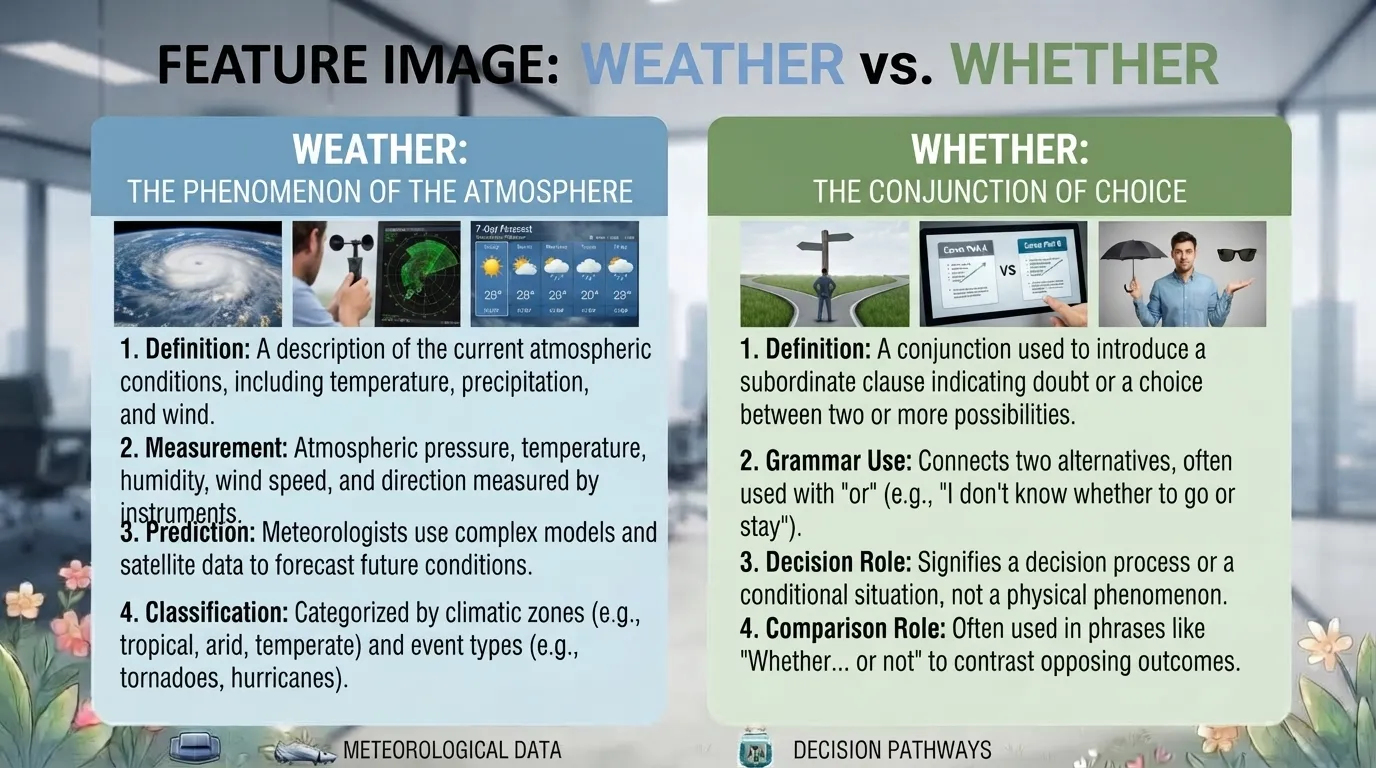
“Whether” is a word for choices. “Weather” is a word for rain, sun, and wind.
Anna sat down to write a text to her friend. She typed, “I don’t know weather I should bring an umbrella.” Her friend wrote back, “Ha! Depends on the weather, not the whether!” Anna laughed, but she still felt puzzled. Which one did she need?
This mix-up trips up many writers. “Whether” asks about a choice between two or more things. “Weather” talks about the sky and the climate: rain, sun, wind, or snow. The two words sound almost the same when spoken out loud. That is why so many people search for whether or weather help online.
People want to stop guessing. They want one clear rule they can trust every time they write. This guide gives you that rule, plus real examples, so you never confuse whether or weather again.
Pronunciation
- Whether
- US: WEH-ther
- UK: WEH-thuh
- Weather
- US: WEH-ther
- UK: WEH-thuh
- Read More About https://orlymean.com/in-vs-into/
Difference Between Whether and Weather
1. Meaning
“Whether” points to a choice. “Weather” points to the sky and climate.
- “I don’t know whether to go.”
- “The weather is sunny today.”
2. Part of Speech
“Whether” is a conjunction. It joins ideas. “Weather” is a noun. It names a thing.
- “Whether we win or lose, we tried hard.”
- “The weather turned cold.”
3. Used With Choices
“Whether” often pairs with “or.” “Weather” does not need “or” to make sense.
- “Whether it rains or shines, we will go.”
- “The weather looks bad.”
4. Used With Verbs
“Whether” often comes before “to” plus a verb. “Weather” often comes after words like “the” or “bad.”
- “She asked whether to call him.”
- “Bad weather delayed the flight.”
5. Spelling Clue
“Whether” has the letter “h” right after “w,” and it holds the small word “wh,” like “which” and “when.” “Weather” holds the small word “ear,” since it deals with what you sense outside.
- “Whether” rhymes with “feather” in sound, but not spelling.
- “Weather” has “ea” like “hear” and “wear.”
6. Sentence Position
“Whether” often starts a clause in the middle of a sentence. “Weather” often stands as the subject or object.
- “I wonder whether he called.”
- “The weather affected our trip.”
7. Formal Use
“Whether” shows up in formal writing about options and decisions. “Weather” shows up in forecasts, news, and daily chat.
- “The board will decide whether to approve the plan.”
- “Check the weather before you leave.”
8. Question Form
“Whether” can replace “if” in indirect questions. “Weather” cannot replace “if.”
- “He asked whether she was ready.” (same as “if she was ready”)
- “He asked about the weather.” (no swap with “if”)
9. Can Stand Alone
“Weather” can be a full subject on its own. “Whether” almost always needs the rest of the sentence to make sense.
- “Weather changes fast in the mountains.”
- “Whether” alone means nothing without more words.
10. Common Pairing Words
“Whether” pairs with “or not.” “Weather” pairs with words like “forecast,” “report,” or “conditions.”
- “I will go whether or not it rains.”
- “The weather report says snow tonight.”
Nature and Behaviour of Whether and Weather
Whether behaves like a small connector. It links two sides of a choice or a doubt. It never changes shape. It has no plural form and no verb form. It just joins thoughts together in a clean, quiet way.
Weather behaves like a changing force. It shifts by the hour, by the season, and by the place. It can be mild or wild. It shows up in forecasts, small talk, and even in emotional speech, like “stormy weather” for hard times.
Why People Get Confused About Whether and Weather
Both words sound almost the same when spoken. In fast speech, the small “h” sound blurs, and both come out close to “weh-ther.” Since English spelling does not always match sound, writers often pick the wrong one by ear.
Autocorrect tools do not always catch this error, since both are real words. Spellcheck stays quiet. This makes the mistake slip through even in emails and posts that got a quick review.
Comparison Table
| Point | Whether | Weather | Same or Different? |
| Word type | Conjunction | Noun | Different |
| Meaning | A choice or doubt | Rain, sun, wind, climate | Different |
| Sound | weh-ther | weh-ther | Same |
| Common partner word | “or,” “or not” | “forecast,” “report” | Different |
| Can start a clause | Yes | Rarely | Different |
| Can be a subject | No | Yes | Different |
| Used in formal writing | Yes | Yes | Same |
| Used in daily chat | Yes | Yes | Same |
The Origin of Whether or Weather
“Whether” comes from Old English “hwæther.” This old word meant “which of two.” It has stayed close to that meaning for over a thousand years. It once matched with “either,” since both begin with a choice between two paths.
“Weather” comes from Old English “weder.” This word always meant the state of the air and sky. It links back to old Germanic roots shared with the Dutch word “weer” and the German word “Wetter.” Both old words point to the same idea: what the sky brings each day.
The two words never shared a root. They just grew to sound alike over time as English pronunciation shifted.
British vs American English
Spelling stays the same for both words in US and UK English. No swap happens here.
- US: “Whether it rains or not, the game goes on.”
- UK: “Whether it rains or not, the match goes on.”
- US: “Check the weather before the trip.”
- UK: “Check the weather before the trip.”
The only shift is small: some British speakers say “WEH-thuh” with a softer “r” sound, while American speakers say “WEH-ther” with a stronger “r” sound. Meaning and spelling stay fixed across both.
Which One Should You Use?
- US: Use “whether” for choices and doubts. Use “weather” for the sky and climate. Spelling rules match UK English exactly.
- UK: Same rule applies. No spelling change between the two regions.
- Global: Learners can use one simple check. If the sentence is about rain, sun, or wind, use “weather.” If it is about a choice, use “whether.”
Common Mistakes
- ❌ “I don’t know weather to go.” → ✅ “I don’t know whether to go.”
- ❌ “The whether is nice today.” → ✅ “The weather is nice today.”
- ❌ “She asked weather he was coming.” → ✅ “She asked whether he was coming.”
- ❌ “Bad whether delayed the flight.” → ✅ “Bad weather delayed the flight.”
- ❌ “Whether or not depends on him.” (missing full context) → ✅ “Whether or not he comes, we will start on time.”
Everyday Usage Examples
Email: “Please let us know whether you can attend the meeting on Friday.”
Social media: “This weather is perfect for a walk in the park! ☀️”
News: “Forecasters say the weather will turn cold by the weekend.”
Formal writing: “The committee must decide whether the proposal meets the required standards.”
Usage Trends
Both words stay common in daily English across the world. “Weather” spikes in searches during storms, heat waves, or big weather events. People check forecasts on their phones many times a day.
“Whether” stays steady, since people use it in writing, work emails, and school essays. It does not spike with events, but grammar guides and spelling checkers keep search interest steady for this word all year.
Metaphors and Similes
Metaphors
- “She is under the weather.” It means she feels sick.
- “He weathered the storm.” It means he got through a hard time.
Similes
- “The mood in the room changed like the weather, fast and without warning.”
- “His mind flipped whether to stay or go, like a coin tossed in the air.”
Connotative Meaning
Weather
- Neutral: “The weather is mild today.”
- Positive: “We had beautiful weather on our trip.”
- Negative: “The bad weather ruined our picnic.”
Whether
- Stays mostly neutral in tone, since it is a grammar tool, not an emotional word.
- “Whether you agree or not, the plan moves forward.” (can carry a firm, slightly tense feeling)
Idioms and Proverbs
- Under the weather: feeling sick. “I stayed home because I felt under the weather.”
- Weather the storm: get through a hard time. “The small shop weathered the storm of the tough year.”
- Come rain or shine: no matter the weather or situation. “We will meet, come rain or shine.”
- Whether or not: used to show something happens either way. “Whether or not you join us, we start at noon.”
Literature and Movies
Literature
- Wuthering Heights, a classic novel by Emily Brontë, published in 1847, uses wild weather and moors as a mood-setting force throughout the story.
- The Weather in the Streets, a novel by Rosamond Lehmann, published in 1936, uses weather in its title as a mood for a story of love and loss.
Movies
- The Perfect Storm (2000), a US film, centers on a deadly weather event at sea.
- Weathering with You (2019), a Japanese animated film, tells a story built around a girl who can control the weather.
Why This Difference Matters
For learners: These two words often appear on spelling tests and grammar quizzes. Getting them right shows a strong grasp of English basics. It helps writing look clean and correct in school, work, and daily life.
For society: Clear communication avoids confusion. A weather report needs the right word to keep people safe and informed. A form or contract that uses “whether” correctly avoids legal mix-ups in written choices and conditions.
Usefulness in Daily Life
- Write clear emails without spelling slips.
- Check forecasts and talk about the sky with the right word.
- Ask clear questions about choices and decisions.
- Sound polished in school essays and job applications.
- Avoid awkward mix-ups in texts and social posts.
Situational Preference
Use “weather” when you talk about rain, heat, snow, wind, or forecasts. It fits daily chat, travel plans, and news reports. Use “whether” when you talk about choices, doubts, or two possible paths. It fits emails, essays, and formal decisions. If your sentence could swap in “if,” pick “whether.” If your sentence could swap in “climate” or “forecast,” pick “weather.” This simple test works in almost every case, in both casual and formal writing.
Possible Short Questions
Q1: What is the easiest way to remember whether vs weather?
Think of “weather” and “wear,” since weather affects what you wear outside. Think of “whether” and “which,” since both deal with choices.
Q2: Can “whether” ever describe the sky?
No. “Whether” never relates to rain, sun, or climate. That job belongs only to “weather.”
Q3: Is “whether” the same as “if”?
Often yes, in indirect questions. “I don’t know whether he called” means the same as “I don’t know if he called.”
Q4: Why does spellcheck miss this error?
Both “whether” and “weather” are real, correctly spelled words. Spellcheck only flags misspelled words, not wrong word choices.
Q5: Does “whether or not” need both words together?
Not always. “Whether he comes or not” and “whether he comes” can both work, though adding “or not” adds emphasis.
Q6: Do British and American English spell these words differently?
No. Both words keep the same spelling in US and UK English. Only pronunciation shifts slightly.
Q7: Which word fits a job application form that asks about availability?
Use “whether.” For example: “Please state whether you can start immediately.”
Conclusion
So, whether or weather? The choice is simple once you know the rule. “Whether” points to a choice between two or more paths. “Weather” points to rain, sun, wind, and the state of the sky. They sound close, but they serve very different jobs in a sentence.Remember the small tricks from this guide. Swap in “if” to test for “whether.” Swap in “forecast” or “climate” to test for “weather.” These checks work fast, even under pressure, like when you write a quick text or email.Getting this right makes your writing clean and clear. It helps you sound confident in school, at work, and in daily chats. Small words like these carry real weight in how people read your message.Next time you feel unsure, pause and ask yourself: is this about a choice, or about the sky? That one question will guide you to the right word, every single time.

I’m Ghafoor Khan, a content writer and blogger at Orly. I write simple, engaging articles on English grammar, word meanings, synonyms, antonyms, and vocabulary to help readers improve their English skills.








1 thought on “Whether or Weather: The Simple Trick to Never Mix Them Up Again”