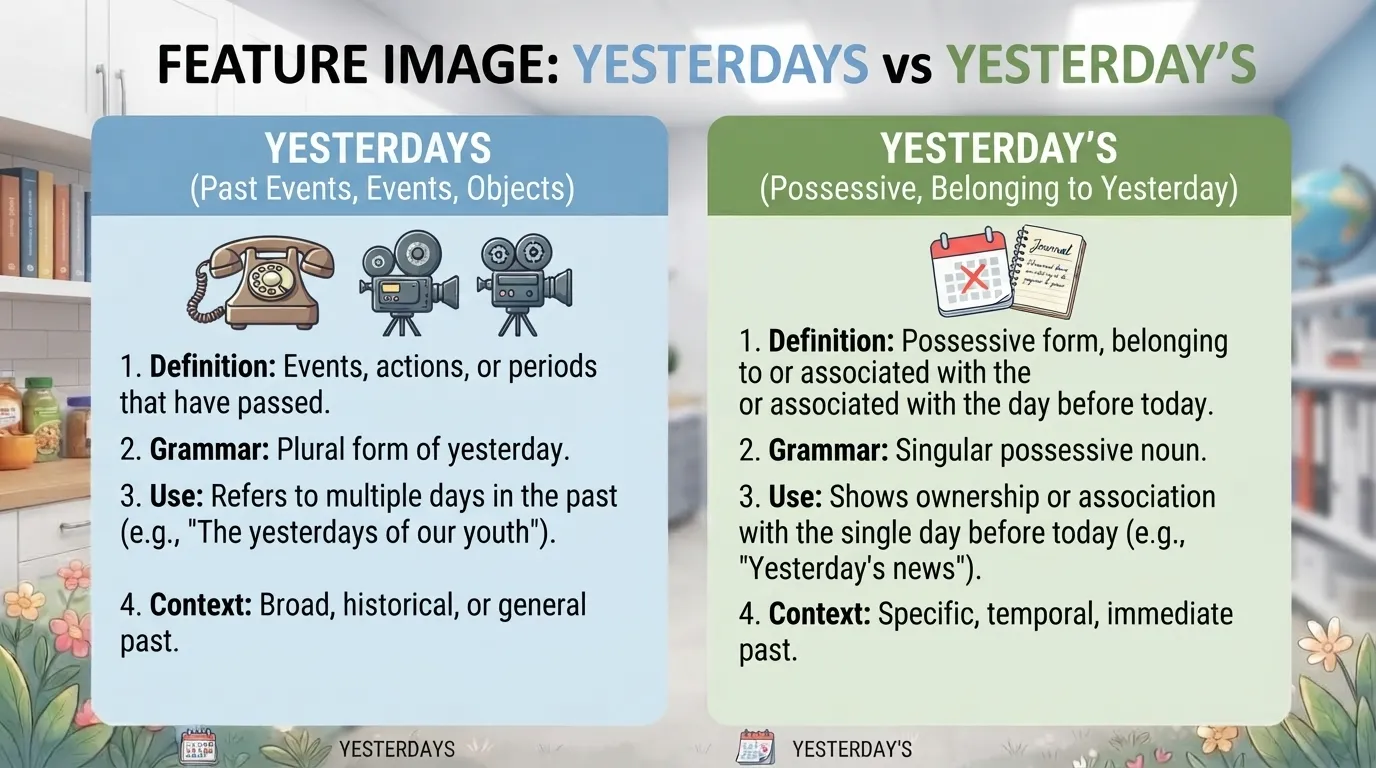
“Yesterday’s” shows ownership. “Yesterdays” is a rare plural form, with no apostrophe.
Picture Mia typing a work email. She writes, “Please review yesterdays report.” She pauses. Something feels off. Should there be an apostrophe? She isn’t alone. This tiny mark trips up even careful writers.
“Yesterday’s” uses an apostrophe to show that something belongs to yesterday, like “yesterday’s weather” or “yesterday’s mistake.” “Yesterdays,” with no apostrophe, is the plural form of the noun “yesterday.” It’s rare, but it shows up in poems, songs, and deep reflections on time, like “all our yesterdays.”
People search “yesterdays vs yesterday’s” because this small apostrophe changes the whole meaning of a sentence. Without it, a reader may pause, just like Mia did. Getting yesterday’s right in writing shows care and builds trust with your reader.
Pronunciation
Yesterdays
- US: “YES-ter-days”
- UK: “YES-tuh-days”
Yesterday’s
- US: “YES-ter-days” (same sound as above, spoken the same way)
- UK: “YES-tuh-days” (same sound as above)
- Read More About https://orlymean.com/vaporizer-vs-humidifier/
Difference Between Yesterdays and Yesterday’s
1. “Yesterday’s” shows ownership. “Yesterdays” does not.
- “Yesterday’s game was close.” (the game of yesterday)
- “Those old yesterdays feel far away now.” (plural noun, no ownership)
2. “Yesterday’s” is common in daily writing. “Yesterdays” is rare.
- “Yesterday’s news is old news.” (very common)
- “He longed for his yesterdays.” (rare, poetic use)
3. “Yesterday’s” pairs with a noun right after it.
- “Yesterday’s meeting ran long.”
- “Yesterday’s rain left puddles everywhere.”
4. “Yesterdays” can stand alone as a plural noun.
- “Our yesterdays shaped who we are today.”
- “She missed her simple yesterdays.”
5. “Yesterday’s” always needs an apostrophe before the “s.”
- Correct: “yesterday’s lunch”
- Wrong: “yesterdays lunch”
6. “Yesterdays” never uses an apostrophe.
- Correct: “many yesterdays”
- Wrong: “many yesterday’s”
7. “Yesterday’s” often appears in news and daily talk.
- “Yesterday’s storm knocked out power.”
- “Yesterday’s stock prices dropped.”
8. “Yesterdays” often appears in songs, poems, or deep thoughts.
- “I think about my yesterdays.”
- “Those yesterdays are gone forever.”
9. “Yesterday’s” acts like a describing word before a noun.
- “Yesterday’s outfit still smells like rain.”
- “Yesterday’s headline shocked everyone.”
10. “Yesterdays” acts like a normal plural noun, similar to “days” or “memories.”
- “The old man’s yesterdays filled his stories.”
- “Her yesterdays were full of adventure.”
Nature and Behaviour of Yesterdays and Yesterday’s
Yesterday’s behaves like a possessive word. It always points to something that belongs to, or came from, the day before today. It almost always sits right in front of a noun, like “yesterday’s lunch” or “yesterday’s plans.”
Yesterdays behaves like a plain plural noun. It stands for many past days, often used in a big, thoughtful, or emotional way. It rarely shows up in daily talk, but it feels natural in songs, poems, or deep memories.
Why People Get Confused About Yesterdays and Yesterday’s
Both words sound exactly the same when spoken out loud. Since English speakers hear them the same way, many forget the apostrophe rule when writing. This mix-up is common with other time words too, like “today’s” versus a made-up plural like “todays.”
Comparison Table
| Feature | Yesterdays | Yesterday’s |
| Apostrophe | No | Yes |
| Meaning | Plural noun (many past days) | Possessive (belonging to yesterday) |
| Common use | Rare, poetic | Very common, everyday |
| Followed by a noun | Not required | Usually yes |
| Similarity | Both relate to the past | Both relate to the past |
The Origin of Yesterday
The word “yesterday” comes from Old English “geostran dæg,” meaning “yesterday day.” Over time, English speakers shortened this phrase into one simple word. Adding “‘s” for ownership follows a normal rule in English, used to show that something belongs to a time, place, or person, like “today’s news” or “the cat’s toy.”
The plural form “yesterdays” grew from treating “yesterday” like a countable noun, much like turning “day” into “days.” Writers and poets picked up this plural form to talk about many past days at once, often in a reflective or emotional way.
British vs American English
There is no spelling difference for yesterdays or yesterday’s between US and UK English. Both follow the same apostrophe rules.
- US: “Yesterday’s meeting was long.”
- UK: “Yesterday’s meeting was long.”
Both regions also treat “yesterdays” as a rare, mostly literary plural form, used the same way in both places.
Which One Should You Use?
- US: Use “yesterday’s” for everyday writing, like emails, news, and reports. Save “yesterdays” for creative or reflective writing.
- UK: Same rule applies. British writers also lean on “yesterday’s” for daily use.
- Global: Stick with “yesterday’s” almost all the time. Only reach for “yesterdays” in poems, lyrics, or deep personal writing.
Common Mistakes
- Wrong: “Please send me yesterdays report.” Correct: “Please send me yesterday’s report.”
- Wrong: “I miss my yesterday’s.” Correct: “I miss my yesterdays.”
- Wrong: “Yesterdays weather was terrible.” Correct: “Yesterday’s weather was terrible.”
Everyday Usage Examples
Email: “Can you resend yesterday’s invoice? I can’t find it in my inbox.”
Social Media: “Missing my carefree yesterdays. Life felt so much simpler back then.”
News: “Yesterday’s storm caused flooding across the city.”
Formal Writing: “The board reviewed yesterday’s financial report during the meeting.”
Usage Trends
“Yesterday’s” stays common in news, business writing, and daily talk, since people often refer to recent events. “Yesterdays” appears far less often, mostly in songs, poems, or nostalgic writing about the past.
Metaphors and Similes
- “Her yesterdays felt like old photographs, faded but still dear.” This metaphor compares memories to fading pictures.
- “He carried his yesterdays like a heavy backpack.” This simile shows how memories can feel like a weight.
Connotative Meaning
Yesterday’s
- Neutral: “Yesterday’s mail is on the table.”
- Positive: “Yesterday’s win boosted the whole team’s spirit.”
- Negative: “Yesterday’s mistake still bothers him.”
Yesterdays
- Neutral: “Our yesterdays are part of who we are.”
- Positive: “She smiled thinking about happy yesterdays.”
- Negative: “He couldn’t escape his painful yesterdays.”
Idioms and Proverbs
- “Yesterday’s news” — meaning something no longer matters or feels important.
- “That scandal is yesterday’s news now.”
While “yesterdays” doesn’t appear in common idioms, it shows up in reflective phrases like “all our yesterdays,” a famous line from Shakespeare’s Macbeth, used to speak about the fleeting nature of time.
Literature and Movies
Literature: William Shakespeare used the phrase “all our yesterdays” in his tragedy Macbeth, written around 1606. The line reflects on how quickly time passes and how the past fades behind us.
Movies: Yesterday (2019), a film from the United Kingdom, tells a story built around memory, music, and how the past shapes the present, playing on the emotional weight tied to the word “yesterday.”
Why This Difference Matters
For learners, knowing the apostrophe rule builds clear, correct writing habits. For everyday readers, a missing apostrophe can cause a small pause or confusion, even if the meaning still comes through. Getting this right helps writing feel polished and professional, especially in work emails, news, and formal documents.
Usefulness in Daily Life
- Helps you write clear work emails and reports.
- Helps you avoid small grammar mistakes that stand out.
- Helps you use rare, poetic words like “yesterdays” the right way in creative writing.
- Helps you sound more polished in everyday communication.
Situational Preference
Use “yesterday’s” almost every time you write about something from the day before, like a meeting, a report, or the weather. Save “yesterdays” for creative writing, song lyrics, or deep, reflective thoughts about the past. In business and daily communication, “yesterday’s” will almost always be the correct and expected choice, while “yesterdays” fits best in personal, artistic, or emotional writing.
Possible Short Question
Q1: Is “yesterdays” ever correct without an apostrophe? Yes, when it means many past days as a plural noun, like “those old yesterdays.”
Q2: Do I always need an apostrophe with “yesterday’s”? Yes, whenever you show that something belongs to or comes from yesterday.
Q3: Which one should I use in a work email? Almost always use “yesterday’s,” since it points to something specific from the day before.
Q4: Can “yesterdays” be used in formal writing? It’s rare in formal writing, since it leans more poetic and reflective in tone.
Q5: Why do people mix up yesterdays and yesterday’s? Both words sound the same out loud, so the apostrophe rule often gets forgotten in writing.
Q6: Is there a similar rule for “today’s” and “todays”? Yes. “Today’s” shows ownership, while “todays” would be an unusual, rarely used plural form.
Q7: What is the safest choice if I’m unsure? Use “yesterday’s” with an apostrophe, since it fits almost every everyday sentence.
Conclusion
Yesterdays and yesterday’s may sound the same, but they serve very different jobs in writing. “Yesterday’s” shows ownership, pointing to something tied to the day before, like yesterday’s weather or yesterday’s mistake. “Yesterdays,” without an apostrophe, works as a rare plural noun, often used in poems, songs, or deep thoughts about time gone by.Knowing this small difference helps your writing feel clear and correct. It helps you avoid a common apostrophe mistake that many writers make without noticing. It also helps you use “yesterdays” the right way when you want your writing to feel more emotional or reflective.Next time you write about the day before, pause for a second. Ask yourself: does this word show ownership, or does it mean many past days? That simple question will guide you to the right choice, every single time you write yesterdays or yesterday’s.

I’m Ghafoor Khan, a content writer and blogger at Orly. I write simple, engaging articles on English grammar, word meanings, synonyms, antonyms, and vocabulary to help readers improve their English skills.





1 thought on “Yesterdays vs Yesterday’s: The Apostrophe Rule”