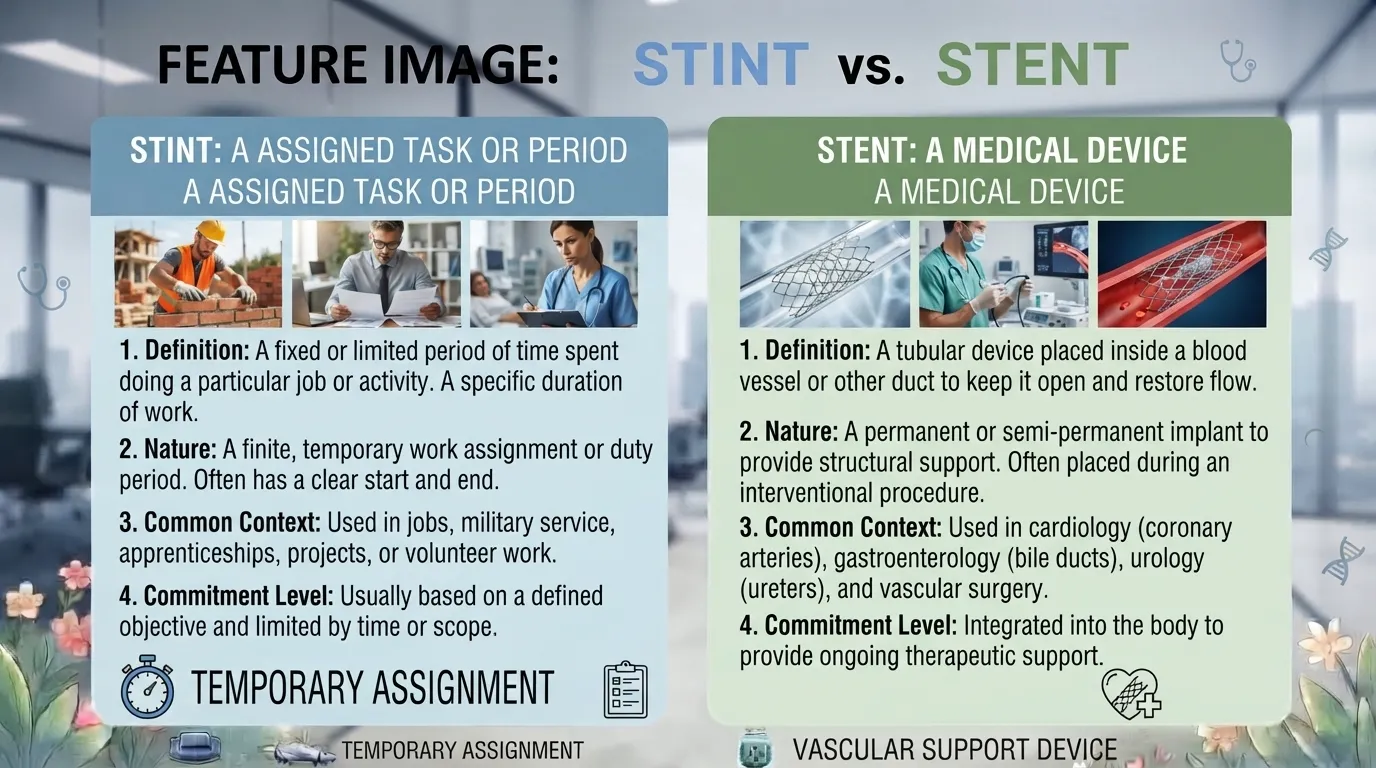
A “stint” is a period of time doing something. A “stent” is a small medical tube.
Picture Dana typing a message to her friend. She writes, “I did a stent at the hospital last year.” Her friend looks confused. Did Dana mean she worked there for a while, or did she have a medical device placed in her body? One small letter changed the whole meaning of her sentence.
“Stint” and “stent” sound almost the same, but they mean completely different things. A stint is a short period of time spent doing a job or task, like “a two-year stint in the army.” A stent is a small tube doctors use to hold open a blood vessel or another part of the body. Mixing up stint and stent can lead to some very strange, confusing sentences.
People search “stint vs stent” because these two words look and sound so close. This small mix-up trips up writers, speakers, and even careful readers, especially in emails, news, and everyday chat.
Pronunciation
Stint
- US: “stint” (rhymes with “mint”)
- UK: “stint” (same sound)
Stent
- US: “stent” (rhymes with “sent”)
- UK: “stent” (same sound)
- Read More About https://orlymean.com/yesterdays-vs-yesterdays/
Difference Between Stint and Stent
1. “Stint” means a period of time doing something. “Stent” means a medical device.
- “She had a two-year stint as a teacher.”
- “The doctor placed a stent in his artery.”
2. “Stint” is often used with jobs, roles, or activities.
- “He had a short stint as team captain.”
- “She spent a summer stint volunteering abroad.”
3. “Stent” is only used in medical contexts.
- “The stent helped keep his artery open.”
- “A stent can also be placed in other body passages.”
4. “Stint” can also mean to limit or hold something back, as a verb.
- “He didn’t stint on the details in his report.”
- “She never stints when it comes to helping friends.”
5. “Stent” is always a noun, never a verb.
- Correct: “He needed a stent.”
- Incorrect: “He stented the report.” (not a real usage)
6. “Stint” fits casual, everyday topics like work and hobbies.
- “I had a brief stint as a barista in college.”
- “His stint on the debate team taught him a lot.”
7. “Stent” fits serious, technical health topics.
- “The surgery included placing a small stent.”
- “Stents are common in heart procedures.”
8. “Stint” often describes a short, temporary experience.
- “It was just a short stint, not a full-time job.”
- “Her stint abroad lasted only three months.”
9. “Stent” often describes something left in place for support.
- “The stent stayed in place to keep the vessel open.”
- “Some stents are temporary, while others stay long term.”
10. The two words are unrelated in origin and meaning, despite sounding alike.
- “Stint” traces back to Old English roots about limits.
- “Stent” comes from a person’s name in medical history.
Nature and Behaviour of Stint and Stent
Stint behaves like a time-based word. It almost always describes a short period spent doing a job, task, or activity. It can also work as a verb, meaning to hold back or limit something.
Stent behaves like a fixed medical term. It only refers to a small tube or device used in the body, most often to keep a blood vessel or passage open. It never changes meaning based on context.
Why People Get Confused About Stint and Stent
Both words share almost the same sound and a similar short shape. Since English has many similar-looking word pairs, readers and writers sometimes swap the two without noticing, especially in fast typing or quick speech.
Comparison Table
| Feature | Stint | Stent |
| Meaning | A period of time doing something | A small medical tube |
| Word type | Noun or verb | Noun only |
| Common field | Jobs, hobbies, daily life | Medicine and health |
| Can mean “to limit” | Yes | No |
| Similarity | Both sound alike and are short words | Both sound alike and are short words |
The Origin of Stent
The word “stent” comes from Charles Thomas Stent, a British dentist from the 1800s. He created a special material used to hold shapes in place during dental work. Over time, doctors adapted this idea for use inside blood vessels, and the word “stent” grew into the medical term used today.
The word “stint” comes from Old English, tied to a word meaning to shorten or limit something. Over centuries, its meaning shifted to describe a set, often short, period of time spent doing a task or job.
British vs American English
There is no spelling difference for stint or stent between US and UK English. Both regions use the exact same spelling and meaning for each word.
- US: “He had a short stint at the company.”
- UK: “He had a short stint at the company.”
Since “stent” traces back to a British dentist’s name, both American and British medical fields use the term the same way today.
Which One Should You Use?
- US: Use “stint” for jobs, roles, or time spent doing something. Use “stent” only for medical topics.
- UK: Same rule applies, since both words carry identical meanings in British English.
- Global: Always match the word to the topic. Use “stint” for time-based tasks. Use “stent” strictly for medical devices.
Common Mistakes
- Wrong: “He did a stent in the army.” Correct: “He did a stint in the army.”
- Wrong: “The doctor placed a stint in his artery.” Correct: “The doctor placed a stent in his artery.”
- Wrong: “She never stents on the details.” Correct: “She never stints on the details.”
Everyday Usage Examples
Email: “I completed a short stint at our London office last year.”
Social Media: “My uncle just got a stent placed after his checkup. Sending good thoughts his way!”
News: “The senator served a brief stint on the committee before stepping down.”
Formal Writing: “The patient’s recovery improved after the stent successfully restored proper blood flow.”
Usage Trends
“Stint” stays common in daily writing, especially around jobs, careers, and personal stories. “Stent” stays common in health articles, medical news, and doctor-patient conversations. Both words remain steady in use, each staying firmly within its own topic area.
Metaphors and Similes
- “His career felt like a long series of short stints, each one teaching him something new.” This metaphor compares career changes to short chapters in a book.
- “The medicine acted like a stent, holding the plan together when it almost fell apart.” This simile borrows the supportive idea behind a stent for a non-medical situation.
Connotative Meaning
Stint
- Neutral: “She had a stint at a local bakery.”
- Positive: “His stint abroad broadened his view of the world.”
- Negative: “It was a rough stint, full of long hours and little pay.”
Stent
- Neutral: “The stent is a common part of heart procedures.”
- Positive: “The stent helped him feel much healthier and stronger.”
- Negative: “He worried about needing another stent down the road.”
Idioms and Proverbs
There are no traditional idioms built around “stint” or “stent,” since both are fairly narrow, specific words. However, the phrase “without stint,” an older expression meaning without limit, still appears in some formal or literary writing.
- “She gave without stint, helping anyone who asked.”
Literature and Movies
Literature: Older English texts and formal writing sometimes use “without stint” to describe generous, unlimited giving, a phrase found in classic essays and older literary works from the 19th and early 20th centuries.
Movies: Neither “stint” nor “stent” plays a central role in famous films, since both are everyday or technical words rather than dramatic story elements. However, medical dramas often reference stents when portraying heart surgery or emergency room scenes.
Why This Difference Matters
For learners, knowing the difference between stint and stent prevents strange, confusing sentences. For patients and caregivers, using the correct medical term matters even more, since mixing up “stint” and “stent” in a health conversation could cause real confusion during an already stressful time.
Usefulness in Daily Life
- Helps job seekers describe their work history clearly.
- Helps patients and families discuss medical procedures accurately.
- Helps writers avoid an easy, embarrassing typo.
- Helps readers understand health news and personal stories correctly.
Situational Preference
Use “stint” whenever you talk about a period of time spent on a job, hobby, or role, like a summer stint at a camp or a short stint on a sports team. Use “stent” only when talking about the small medical device placed in the body to support blood flow or another passage. These two words never overlap in meaning, so picking the right one simply depends on whether you’re describing time spent doing something or a piece of medical equipment.
Possible Short Questions
Q1: Is “stint” the same as “stent”? No. A stint is a period of time doing something. A stent is a small medical tube.
Q2: Can “stint” be used as a verb? Yes. It can mean to limit or hold back, as in “she didn’t stint on effort.”
Q3: Can “stent” be used as a verb? No. “Stent” is only used as a noun, referring to the medical device itself.
Q4: Where does the word “stent” come from? It comes from Charles Thomas Stent, a British dentist whose material inspired the medical term.
Q5: Why do people mix up stint and stent? The two words sound very similar and share a short, simple shape, making them easy to swap by mistake.
Q6: Is “stint” only used for jobs? No. It can describe any short period spent on an activity, not just paid work.
Q7: Is “stent” used outside of medicine? No. Stent is a strictly medical term, always tied to health and body procedures.
Conclusion
Stint and stent may sound almost the same, but they belong to completely different worlds. A stint describes a short period of time spent doing a job, hobby, or task. A stent describes a small medical tube used to support blood flow in the body. Confusing the two can lead to strange, unclear sentences, especially in emails, health conversations, or everyday chat.Learning this simple difference helps you write and speak with more confidence. It helps you describe your work history correctly. It also helps you talk about health topics with accuracy and care, especially during important medical conversations.Next time you type one of these words, pause for a second. Ask yourself: am I talking about time, or about a medical device? That quick question will guide you to the right word, every single time you choose between stint and stent.

I’m Ghafoor Khan, a content writer and blogger at Orly. I write simple, engaging articles on English grammar, word meanings, synonyms, antonyms, and vocabulary to help readers improve their English skills.










1 thought on “Stint vs Stent: Meaning, Differences, and Examples”