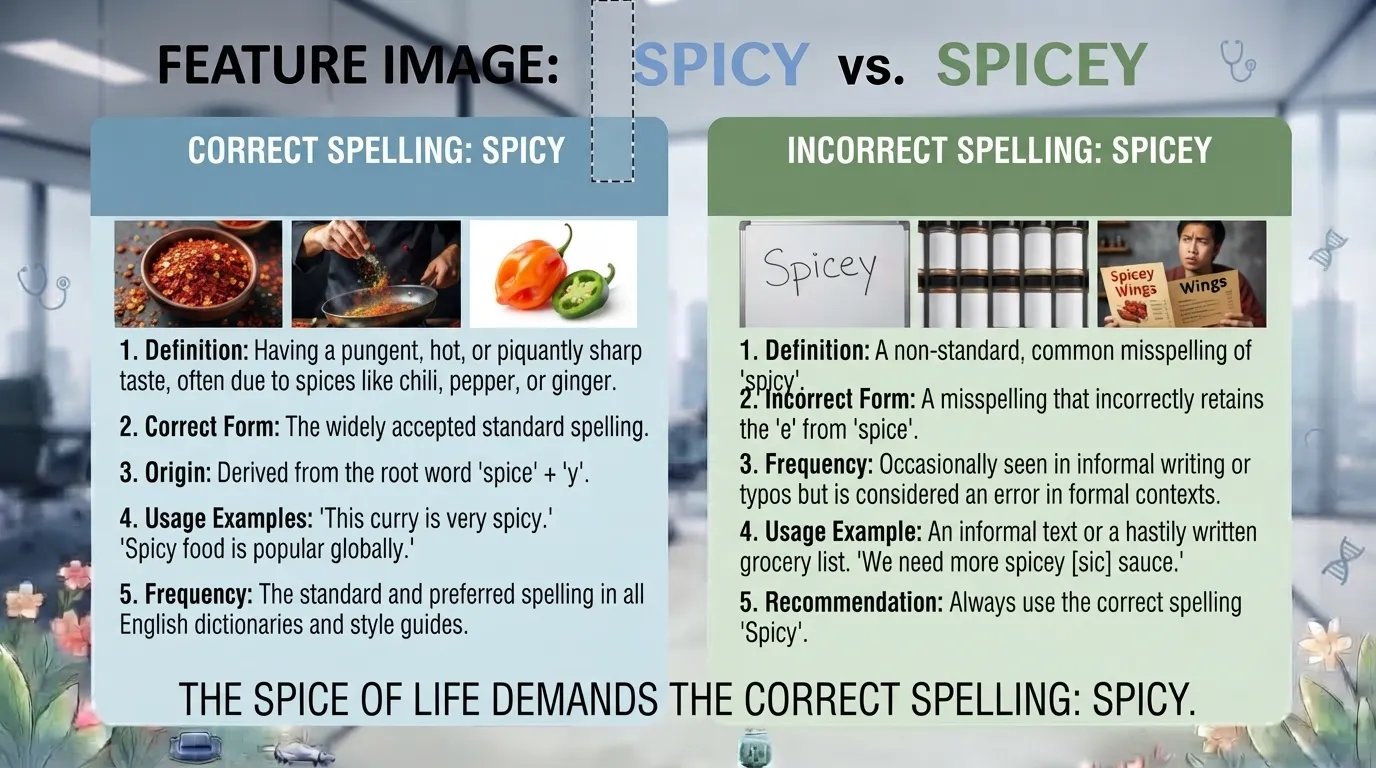
“Spicy” is the correct spelling. “Spicey” is a common misspelling.
Picture this. Ben writes a review for his favorite taco shop. He types, “This salsa is so spicey!” His friend replies, “You mean spicy!” Ben feels confused. Both words look right to him. This happens to many people every day.
This is the classic spicy vs spicey mix-up. “Spicy” means food with a hot, strong taste, like chili or pepper. It is the correct and standard spelling in English. “Spicey” is not a real word in standard dictionaries. It is simply a spelling mistake that many people make by accident.
People search for “spicy or spicey” because both spellings look normal at first glance. The extra “e” feels natural to add, since many English words follow that pattern. But this small change creates real confusion in menus, reviews, and social media posts.
Learning the correct spelling of spicy helps you write with more confidence, whether you’re leaving a review or writing a recipe.
Pronunciation
- Spicy
- US English: SPY-see
- UK English: SPY-see
- Spicey
- US English: SPY-see (same sound, wrong spelling)
- UK English: SPY-see (same sound, wrong spelling)
- Read Moreb About https://orlymean.com/in-vs-into/
Difference Between Spicy and Spicey
1. Correctness
“Spicy” is the correct spelling. “Spicey” is not found in standard dictionaries. Example 1: The soup was very spicy. Example 2: “Spicey” often shows up as a typo in fast texting.
2. Dictionary status
“Spicy” appears in every major dictionary. “Spicey” does not appear as a standard entry. Example 1: Merriam-Webster lists “spicy” as the correct word. Example 2: You will not find “spicey” listed as correct.
3. Spelling rule
English often drops the final “e” before adding “-y.” “Spicey” breaks this common rule. Example 1: “Spice” + “y” becomes “spicy,” not “spicey.” Example 2: Compare with “juice” + “y,” which becomes “juicy,” not “juicey.”
4. Common cause of error
People add an extra “e” out of habit from other words. This creates the “spicey” mistake. Example 1: Words like “homey” may cause writers to guess wrong. Example 2: Autocorrect sometimes fails to catch the error.
5. Use in writing
“Spicy” is safe to use in all writing. “Spicey” should be avoided in formal or careful writing. Example 1: A cookbook will always print “spicy” recipes. Example 2: A menu should never print “spicey” dishes.
6. Search behavior
Many people type “spicey” into search bars by mistake. Search engines still show “spicy” results. Example 1: Typing “spicey wings” still brings up “spicy wings” results. Example 2: Google often auto-corrects the search term for users.
7. Brand names
Some brands use “spicey” on purpose as a stylized name. This does not make it standard English. Example 1: A snack brand might name a product “Spicey Bites” for style. Example 2: This is a brand choice, not a grammar rule.
8. Formal vs casual use
“Spicy” fits both formal and casual writing. “Spicey” only appears in casual, informal typing. Example 1: A news article always uses “spicy.” Example 2: A quick text message might carry the “spicey” typo.
9. Grammar checkers
Most grammar tools flag “spicey” as incorrect. Few tools accept it as valid. Example 1: Word processors often underline “spicey” in red. Example 2: “Spicy” never gets flagged as wrong.
10. Global acceptance
“Spicy” is accepted worldwide in English. “Spicey” is not accepted as standard in any English-speaking country. Example 1: UK, US, and Australian dictionaries all list “spicy.” Example 2: No major English dictionary lists “spicey” as correct.
Nature and Behaviour of Spicy and Spicey
Spicy behaves like a normal, well-formed English adjective. It follows the standard rule of dropping the final “e” before adding “-y.” It works in recipes, reviews, and daily talk.
Spicey behaves like an accidental variant. It shows up mostly in fast typing, texts, and casual posts. It does not follow the standard spelling rule, and most style guides reject it.
Why People Get Confused About Spicy and Spicey
People get confused because many English words end in “-ey,” like “homey” or “matey.” This makes “spicey” feel like a normal spelling choice. But “spicy” follows a different, more common pattern, where the final “e” in “spice” drops before adding “-y.”
Comparison Table
| Feature | Spicy | Spicey |
| Correct spelling | Yes | No |
| Dictionary listed | Yes | No |
| Sound | SPY-see | SPY-see |
| Follows spelling rule | Yes | No |
| Similarity | Same sound | Same sound |
| Similarity | Both describe hot, strong flavor | Both describe hot, strong flavor |
| Use | Standard writing | Informal typo |
The Origin of Spicy
“Spicy” comes from the word “spice,” which traces back to the Old French word “espice” and the Latin word “species.” Over time, English speakers added the “-y” suffix to describe food with a strong, hot taste. The final “e” in “spice” dropped, following a common English spelling pattern.
British vs American English
Both UK and US English use the same correct spelling for this word. There is no regional difference here.
- US English uses “spicy” as the correct spelling.
- UK English also uses “spicy” as the correct spelling.
- Neither region accepts “spicey” as standard.
- Example: A US recipe blog and a UK recipe blog will both print “spicy,” not “spicey.”
Which One Should You Use?
- US writers: Always use “spicy.” No regional exception applies.
- UK writers: Always use “spicy” as well. The spelling stays fixed across both regions.
- Global writers: Stick with “spicy” everywhere. It is the only accepted form in standard English.
Common Mistakes
- Mistake: “This curry is so spicey.” Fix: “This curry is so spicy.”
- Mistake: “I love spicey food.” Fix: “I love spicy food.”
- Mistake: Trusting autocorrect to always catch the error.
- Mistake: Assuming brand names reflect correct grammar.
Everyday Usage Examples
- Social media: “This ramen is way too spicy for me!”
- News headline: “Local Restaurant Wins Award for Spicy Wings.”
- Email to a friend: “Let’s try that new spicy noodle place this weekend.”
- Formal writing: “The report highlights a rise in demand for spicy snack foods.”
Usage Trends
“Spicy” stays common in food blogs, restaurant menus, and cooking shows worldwide. “Spicey” still appears often in casual texts and social media, mostly by mistake. Search data shows many users type “spicey” but still expect “spicy” results.
Metaphors and Similes
- “Her personality is as spicy as hot sauce.”
- “The debate turned spicy once politics came up.”
- “He added a spicy twist to the old recipe.”
- “Their rivalry was spicy, like two chefs competing for the same prize.”
Connotative Meaning
- Positive: “Spicy” can suggest exciting, bold, or full of flavor.
- Negative: “Spicy” can also suggest something too intense or hard to handle.
- Neutral: In recipes, “spicy” simply describes heat level, without added feeling.
Idioms and Proverbs
- “Add some spice to your life” means to make things more exciting.
- “Too hot to handle” fits food or situations that feel spicy and intense.
- “Spice things up” means to bring energy into something dull.
Literature and Movies
- Many cookbooks explore spicy world cuisines, especially in the food writing genre popular since the 1990s.
- Chef (2014) is an American film that features spicy, flavorful street food throughout the story.
- Food blogs and travel books often use “spicy” to describe dishes from India, Mexico, and Thailand.
Why This Difference Matters
Using the wrong spelling can make writing look careless, especially on menus, blogs, or professional content. Since “spicey” is not standard English, using it in formal writing can confuse readers or hurt credibility. Learning the correct spelling helps writers, students, and food bloggers sound polished and clear.
Usefulness in Daily Life
This knowledge helps when writing restaurant reviews, recipes, food blogs, and even casual texts about dinner plans. It keeps your writing looking clean and professional, especially in public posts.
Situational Preference
Always use “spicy” in any type of writing, whether formal or casual. There is no situation where “spicey” is the correct or preferred choice. If you are texting quickly and type “spicey” by mistake, it is a simple typo, not a real spelling option. Whether you write a cookbook, a tweet, or a business report, “spicy” is always the right word to use.
Possible Shorts Questions
1. Is “spicey” ever correct? No, “spicey” is not listed as correct in standard English dictionaries.
2. Why do so many people write “spicey”? It happens because other English words end in “-ey,” which makes the mistake feel natural.
3. Do UK and US English differ on this word? No, both regions use “spicy” as the only correct spelling.
4. Can “spicey” be used as a brand name? Yes, brands can choose stylized spellings, but this does not make it correct grammar.
5. Does spell-check always catch “spicey”? Most modern spell-checkers do catch it, but not all tools flag it every time.
6. What is the easiest way to remember the correct spelling? Remember that “spice” drops its final “e” before adding “-y,” just like “juice” becomes “juicy.”
7. Is “spicy” only used for food? No, it can also describe exciting situations, bold personalities, or intense debates.
Conclusion
The spicy vs spicey confusion is a simple but common spelling mistake. “Spicy” is the correct, dictionary-approved word used to describe hot, strong flavors and even bold, exciting situations. “Spicey” is not a standard word, even though it sounds exactly the same when spoken.Once you learn this simple rule, the mistake becomes easy to avoid. Remember that “spice” drops its final “e” before adding “-y,” just like many other English words follow this same pattern. Whether you are writing a recipe, a review, or a quick text, always choose “spicy.” With a little practice, you will never second-guess this spelling again.

I’m Ghafoor Khan, a content writer and blogger at Orly. I write simple, engaging articles on English grammar, word meanings, synonyms, antonyms, and vocabulary to help readers improve their English skills.








1 thought on “Spicy or Spicey: Which Spelling Is Actually Correct?”